The fuel shock that defense analysts warned about for months is now hitting consumers directly, and the airline industry is the canary.
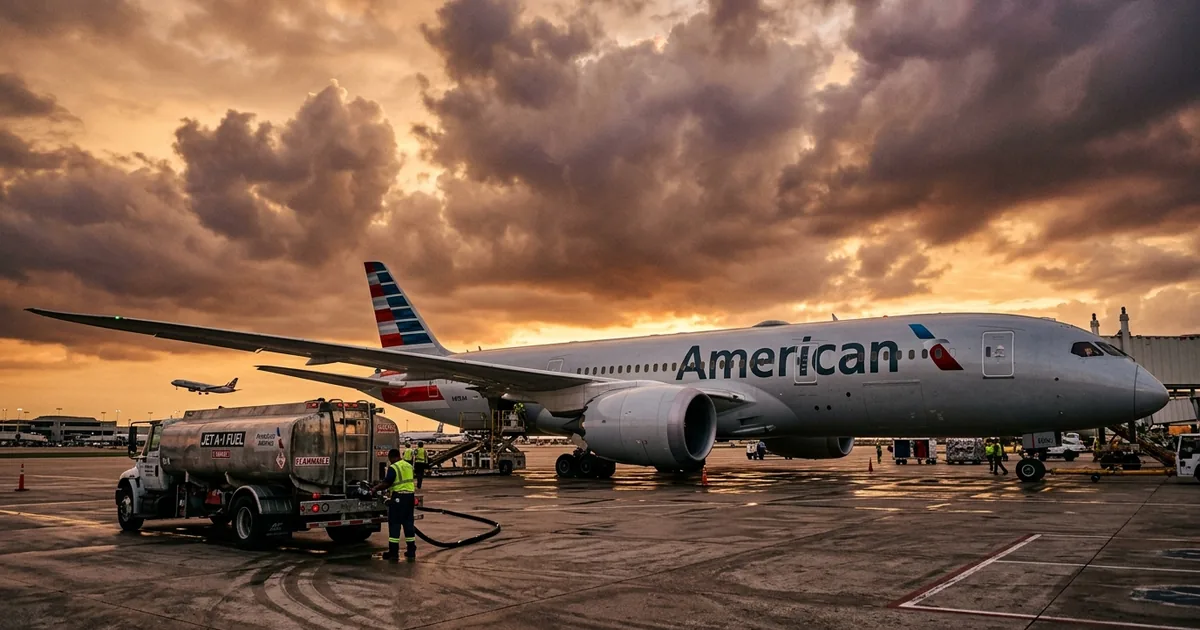
American Airlines confirmed this week that it will temporarily suspend six domestic routes in August and September as jet fuel prices, driven by the ongoing Iran war and Strait of Hormuz disruptions, continue to squeeze airline economics. The cuts target lower-demand routes out of LAX and other hubs where the revenue per available seat mile no longer covers the fuel bill, according to FTN News reporting on the suspensions.
The Fuel Math Has Changed
Jet fuel typically accounts for 25% to 30% of an airline’s operating costs. Since the Iran conflict escalated on February 28, jet fuel prices have roughly doubled, and WTI crude recently climbed above $95 per barrel with ongoing uncertainty around the Strait of Hormuz, through which roughly 20% of the world’s oil supply transits.
The math is straightforward: when fuel costs double, routes that were marginally profitable become money losers. Airlines have three levers: raise fares, reduce capacity, or absorb the loss. American is pulling the second lever on its thinnest routes, and it is not alone.
CBS News reported that airlines across the industry are cutting routes in response to the fuel spike. Air Canada suspended multiple routes between Toronto and New York. Delta has thinned schedules on off-peak days. Most carriers are choosing “schedule thinning,” reducing frequencies on existing routes rather than eliminating destinations entirely, to preserve market presence while cutting fuel burn.
The Consumer Impact Is Real
For travelers, the squeeze is arriving just as summer demand peaks. Fares are rising as capacity contracts, creating a double hit: fewer seats available and higher prices for the ones that remain. Airlines that had been adding routes aggressively during the post-pandemic travel boom are now pulling back on marginal markets.
The route suspensions also expose a geographic pattern. Smaller markets and secondary city pairs are the first to lose service, because those routes have the lowest load factors and the thinnest margins. That concentrates air service further into hub cities, making it harder and more expensive for travelers in mid-size markets to fly.
The Geopolitical Premium Is Not Going Away
The deeper issue for the industry is that the fuel shock has no clear end date. The Strait of Hormuz remains a flashpoint. JPMorgan analysts recently noted that the Strait could reopen as soon as this month as oil inventory depletion pressures U.S. officials to seek a resolution, but that timeline is speculative. The diplomatic situation remains fluid, and any escalation would send crude, and jet fuel, higher still.
Oil prices are forecast to surge 24% in 2026 to their highest level since Russia’s invasion of Ukraine in 2022, according to World Bank projections. For airlines, that means the route rationalization underway right now is not a temporary blip. It is the industry repricing itself for a sustained period of elevated energy costs.
What Wall Street Is Watching
Airline stocks have underperformed the broader market this year, and the route cuts will not help near-term sentiment. But there is a contrarian case: carriers that cut unprofitable routes early preserve cash flow and come out the other side leaner. American Airlines in particular has been aggressive about cost management, including its recent deal to equip 500 planes with SpaceX Starlink in-flight Wi-Fi, a move aimed at improving the premium product that generates the highest yields per seat.
The airline industry has always been a pass-through for geopolitical risk, and right now, the pass-through is wide open. Fuel prices are set by forces beyond any carrier’s control. What airlines can control is how quickly they adapt their networks to the new reality.
The Broader Energy Overhang
Beyond airlines, the commodity price spike has implications across the economy. Gold climbed back above $4,500 per ounce this week, and WTI crude’s push above $95 is pressuring everything from shipping costs to manufacturing input prices. The energy overhang from the Iran conflict is filtering into consumer prices, corporate margins, and central bank calculations about whether and when to cut rates.
For business travelers, corporate travel managers, and the airline industry itself, the message is the same: plan for expensive fuel through at least the end of 2026, and expect more route adjustments as carriers recalibrate to a world where the geopolitical risk premium is priced into every barrel.
The airline industry has survived fuel shocks before, from the 2008 oil spike to the pandemic grounding. But this one is different because it arrives alongside record travel demand, meaning the pricing power that airlines gained from full planes is being offset by the cost of filling those planes with $95-per-barrel fuel. The carriers that manage this tension best will come out stronger. The ones that do not will be the next Spirit Airlines cautionary tale.