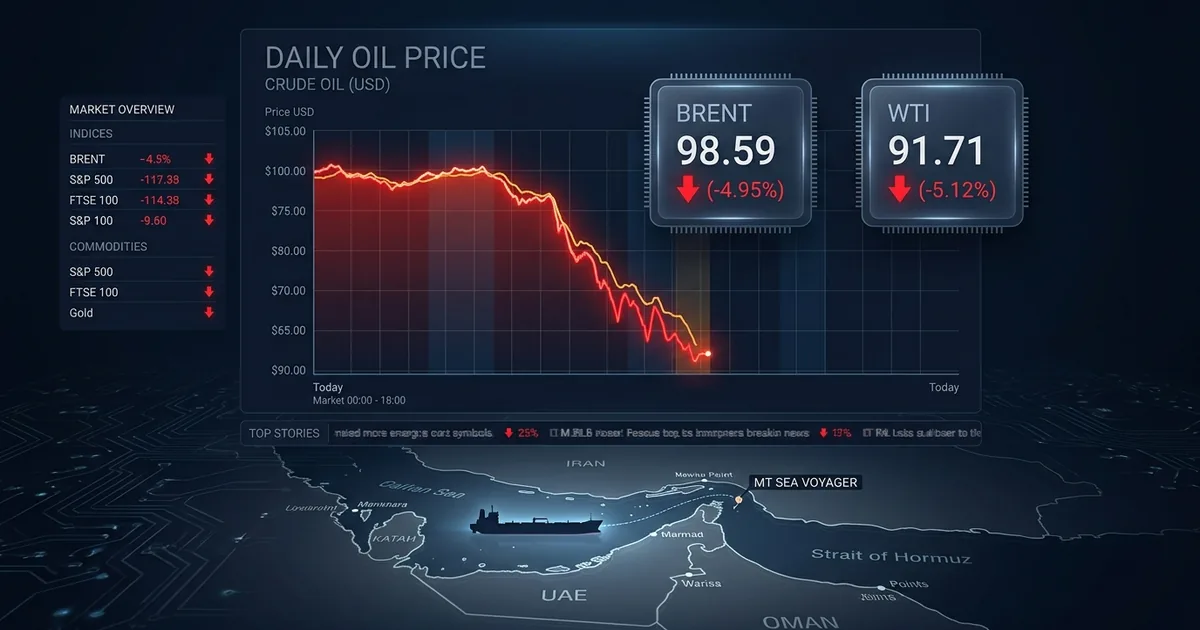
Crude oil fell about 5% on Sunday, the kind of one-day move that resets an entire quarter of inflation math, after President Donald Trump posted that an agreement to end the US-Iran war and reopen the Strait of Hormuz is “largely negotiated, subject to finalization.” The market did not wait for the fine print. Brent crude settled near $98.59 and West Texas Intermediate dropped roughly 4.89% to about $91.71, one of the sharpest single-session declines since the war began, as traders started pricing out the geopolitical premium that has warped everything from pump prices to the Federal Reserve’s next decision.
This is the trade that energy desks and rates desks have waited eighteen months to make. The open question is whether Trump just handed it to them or set them up for a fake-out.
The Post That Moved the Tape
The framing did the work. Trump told negotiators “not to rush,” added that “time is on our side,” and said talks were “proceeding in an orderly and constructive manner,” with a deal to be announced “shortly,” according to NPR’s account of the president’s weekend remarks. CNBC reported Sunday that crude slid as much as 5% on the comments, the clearest sign yet that the market reads a settlement as close.
Tehran is not playing along with the victory lap. Iran’s Fars news agency called the reopening claim “incomplete and inconsistent with reality” and insisted the strait remains under Iranian management, a reminder that the single most important number in this story, the reopening date, does not exist yet. The mine-clearing and the reopening sit inside a proposed 60-day ceasefire, and the US naval blockade stays in place until an agreement is actually signed. The tape moved on the prospect, not the fact.
What 14 Million Barrels Coming Back Means
The supply at stake is enormous, which is why a single post can move Brent five points. The International Energy Agency’s May report put more than 14 million barrels per day of production shut in, with cumulative Middle East supply losses since the conflict began topping a billion barrels. Before the war, roughly 14.7 million barrels of crude and another 4.8 million barrels of refined products moved through Hormuz every day, close to a fifth of the world’s oil.
Put that supply back on the water and the math that has driven 2026 inflation runs in reverse. That is the bet the market made on Sunday. It is also the bet that unwinds violently if Tehran’s denial turns out to be the real signal and Trump is front-running a deal that is not done.
The Inflation Math Just Flipped
Energy has been the load-bearing wall under this year’s inflation problem. April CPI came in at 3.8% year over year, a three-year high, with the oil shock doing most of the damage. A sustained move back toward $90 Brent pulls headline inflation down quickly, and the timing could hardly be sharper, with the Personal Consumption Expenditures index, the Fed’s preferred gauge, due Thursday.
Wall Street’s economists see the relief but are not uniform on it. Neil Dutta of Renaissance Macro framed cheaper crude as “much better for inflation than it will be for growth, though it will be good for both.” Fed Governor Christopher Waller has been more guarded, warning that the run of price shocks “may lead to a more lasting increase in inflation” even as the headline number cools. That split is not academic. It is the same argument now playing out at the top of the central bank.
Warsh Finally Gets His Cover
No one has more riding on Hormuz than the new Fed chair. Kevin Warsh was sworn in this month after a 54-45 Senate vote and took the chair on May 15, and he has openly echoed the view that the war’s price surge is temporary and will fade once the fighting stops. That stance left him exposed, because cutting rates into 3.8% inflation is close to indefensible unless the energy spike reverses. A reopened strait is the cover he has been waiting for.
Just thirteen days ago, the same ceasefire looked like it was on life support, with oil pinned near $107 and the strait still choked off. The speed of the round trip, from a collapsing truce to a “largely negotiated” deal in under two weeks, is itself the risk. Markets that reprice this fast can reprice back just as fast.
The Trade From Here
Watch four things this week. Whether Iran’s public denial hardens or softens. Whether the blockade actually lifts, which is the only proof that counts. Thursday’s PCE print, which will either confirm the cooling or complicate it. And whether Warsh signals that a reopened Hormuz changes the rate path at the next meeting.
The war premium is bleeding out of crude in real time, and with it the cleanest excuse for the Fed to stay frozen. If the strait truly reopens, the rate-hike trade that defined the first half of 2026 reverses, and the names that suffered most under $100 oil become the ones that lead. If Tehran is telling the truth, Sunday’s crash will read as the trap. Either way, the most important price in the global economy just moved five percent on a single sentence, and everyone from the gas pump to the Eccles Building is now trading the finalization.