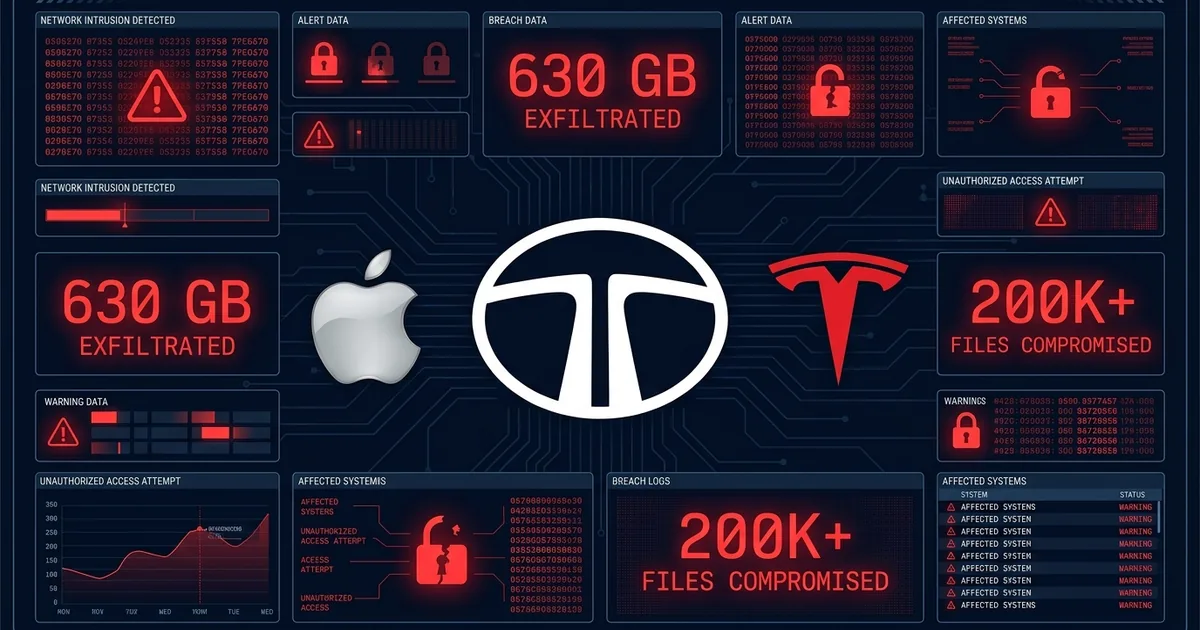
Ransomware group World Leaks has published more than 200,000 files stolen from Tata Electronics, one of Apple’s most critical manufacturing partners in India, dumping 630 gigabytes of data that includes iPhone circuit board inspection standards, Tesla part schematics, and full passport scans onto the dark web. Tata confirmed the “cybersecurity incident” on June 23, eleven days after the stolen files first surfaced online.
What Leaked and Why It Matters
The scope of this breach is staggering. Among the published files: Apple trade secrets covering quality inspection standards for iPhone circuit boards manufactured at Tata’s Hosur plant in Tamil Nadu, Tesla documents including Model Y chargeport controller schematics and Model 3 “Project Highland” files explicitly marked “TRADE SECRET,” and personal data ranging from employee passport scans to internal communications.
World Leaks, a ransomware operation that has been gaining notoriety in the cybercriminal underground, posted the data on June 12. Tata Electronics acknowledged the breach publicly only after CNBC and other outlets reported on the leaked files. The company confirmed it received a ransom demand but has not disclosed whether any payment was made.
Apple is actively investigating the breach, according to Reuters. Tata insists its manufacturing operations remain unaffected, though that claim deserves serious scrutiny when the exposed data includes production-line quality control documents.
The Supply Chain Security Problem Nobody Wants to Talk About
Here is the uncomfortable truth: two of the world’s most valuable companies trusted their most sensitive manufacturing data to a tier-1 supplier that apparently could not keep it safe. Apple’s market capitalization hovers around $4 trillion. Tesla sits north of $1.2 trillion. Both companies have invested billions in supply chain diversification away from China, and India, specifically Tata, was supposed to be the answer.
Tata Electronics operates the Hosur facility where iPhones are assembled for both the Indian domestic market and global export. The plant has been central to Apple’s “Make in India” strategy, a geopolitical hedge against Chinese manufacturing concentration that CEO Tim Cook has championed publicly. Tesla’s relationship with Tata, while less publicized, clearly runs deep enough that confidential vehicle engineering documents ended up in the same compromised systems.
The breach raises a question that every Fortune 500 CISO should be losing sleep over: if Tata Electronics, a subsidiary of one of India’s largest and most sophisticated conglomerates, cannot protect trade secrets from a ransomware gang, who can?
The India Manufacturing Bet Gets Riskier
India’s pitch to global manufacturers has always been straightforward: cheaper labor, friendly government policy, and distance from geopolitical flashpoints in the Taiwan Strait. What this breach exposes is that the cybersecurity infrastructure underpinning that pitch may not be ready for the responsibility.
GBHackers reported that the leaked dataset contains not just product engineering data but also operational intelligence that competitors could exploit. Factory workflow documents, supplier relationships, quality benchmarks: this is the kind of information that gives a manufacturing operation its competitive edge.
For Apple, the exposure of iPhone circuit board inspection standards is particularly damaging. Those documents represent years of precision engineering and quality control methodology. Any competitor with access to them gains a shortcut that Apple spent billions developing.
For Tesla, the Model Y chargeport controller schematics and Project Highland documents are even more sensitive. Vehicle engineering specifications in the wrong hands create not just competitive risk but potential safety implications if counterfeit parts are manufactured to spec.
What Comes Next
Tata Electronics will almost certainly face regulatory scrutiny in both India and the markets where its clients operate. The European Union’s NIS2 directive and India’s own evolving data protection framework both impose obligations on organizations that handle sensitive manufacturing data.
Apple and Tesla will need to audit every system that Tata Electronics had access to, a process that could take months and cost tens of millions of dollars. The more pressing question is whether either company will accelerate diversification of its Indian manufacturing base beyond a single partner.
The broader lesson is one the tech industry keeps learning the hard way: your cybersecurity posture is only as strong as your weakest supplier. In the race to build alternative manufacturing capacity outside China, the industry may have moved faster than the security infrastructure could follow. World Leaks just proved it.