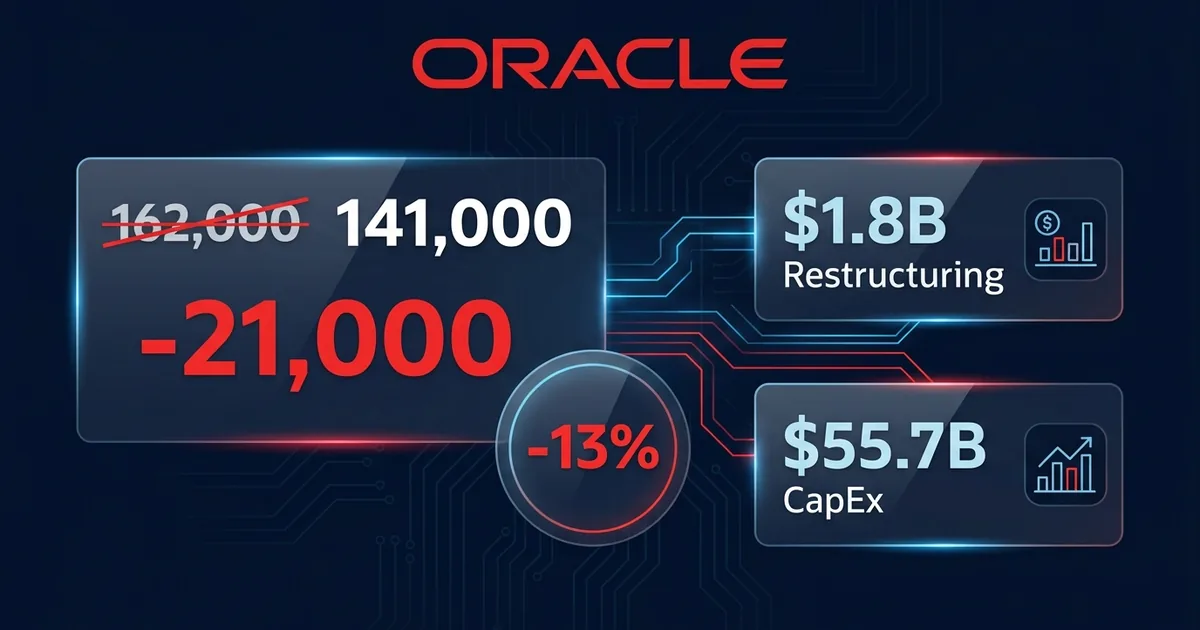
Oracle just did something no major tech company has been willing to do: it put the quiet part in an SEC filing. Over fiscal year 2026, the company shed 21,000 employees, dropping from 162,000 to roughly 141,000 workers as of May 31. The restructuring bill came to $1.8 billion, nearly five times the $374 million Oracle spent on similar measures the year prior.
And in the filing itself, Oracle stated plainly that “the adoption and deployment of AI technologies across our operations has resulted, and may continue to result, in reductions to our workforce.” That is not a leaked internal memo. That is a publicly traded company telling the SEC, its shareholders, and every current employee that AI is directly responsible for eliminating jobs, and that more cuts are coming.
The Numbers Tell a Story the Industry Has Been Avoiding
The 13% headcount reduction is staggering on its own. But the financial architecture around it makes the picture sharper. Oracle’s capital expenditure hit $55.7 billion in fiscal 2026, up 162% from $21.2 billion the previous year. The company is not pulling back. It is reallocating, pouring tens of billions into AI data center infrastructure while simultaneously reducing the human workforce that used to operate a more traditional enterprise software business.
Under what Oracle has designated the 2026 Restructuring Plan, the company expects total charges of up to $2.1 billion. That plan is explicitly framed around “sharpening operational efficiency through AI integration,” according to CNBC’s reporting on the filing. This is not a one-time correction. It is a permanent rebalancing of how Oracle thinks about labor versus compute.
For context, Oracle’s cloud infrastructure revenue has been growing at a 50%+ clip, fueled by massive AI training and inference contracts. The company’s recent Q4 earnings beat and $40 billion capital raise confirmed the strategic bet: Oracle is becoming an AI infrastructure company first, and an employer of human workers second.
Why This Filing Matters More Than the Layoffs Themselves
Tech companies have been cutting headcount for two years now. Meta, Google, Amazon, Microsoft, Salesforce, and dozens of smaller firms have all announced significant reductions since 2024. But the language has always been carefully hedged. “Efficiency improvements.” “Organizational restructuring.” “Aligning resources with strategic priorities.” Everyone in the industry understood that AI was driving a significant portion of these cuts, but no executive team wanted to say it directly in a legal document.
Oracle just broke that wall. By naming AI adoption explicitly in its SEC filing, the company created a precedent that regulators, labor economists, and other public companies will have to reckon with. SEC filings are not press releases. They carry legal weight. When Oracle tells the Securities and Exchange Commission that AI deployment “has resulted, and may continue to result, in reductions to our workforce,” that is a risk disclosure with teeth.
Tom’s Hardware noted that Oracle’s language suggests the company views ongoing workforce reduction as a natural consequence of AI deployment, not an anomaly to be corrected. The filing’s forward-looking statements make clear that Oracle expects the pattern to continue.
The Capex-to-Headcount Ratio Is the New Metric
Here is the number that should keep every enterprise workforce planner awake: Oracle spent $55.7 billion in capital expenditure while cutting 21,000 jobs. That works out to roughly $2.65 million in new infrastructure investment for every position eliminated. The company is not just replacing people with software. It is building an entirely different kind of business that requires fewer humans and more GPUs.
This ratio will become a benchmark. When Alphabet, Microsoft, and Amazon report their own capital spending alongside headcount figures over the next two quarters, analysts will use Oracle’s explicit disclosure as a measuring stick. The question shifts from “are you using AI to replace workers?” to “how much are you spending per eliminated position, and what is the return on that investment?”
What Comes Next for the Workforce
Oracle’s 2026 Restructuring Plan anticipates up to $2.1 billion in total charges, meaning the company has roughly $300 million in additional restructuring costs still ahead. The forward-looking language in the SEC filing makes clear that these are not the last cuts. As AI systems become more capable and Oracle’s infrastructure buildout matures, the economic logic of replacing human labor with compute only accelerates.
The broader implications extend well beyond Oracle’s Redwood City campus. If a company with 162,000 employees can eliminate 13% of its workforce in a single fiscal year and attribute it directly to AI, then every enterprise technology company with similar operational profiles is running the same calculus. The difference is that Oracle put it in writing first.
For workers in enterprise tech, the signal is unmistakable. The companies building AI infrastructure are simultaneously the companies most aggressively reducing their need for human employees. That is not a contradiction. It is the business model.