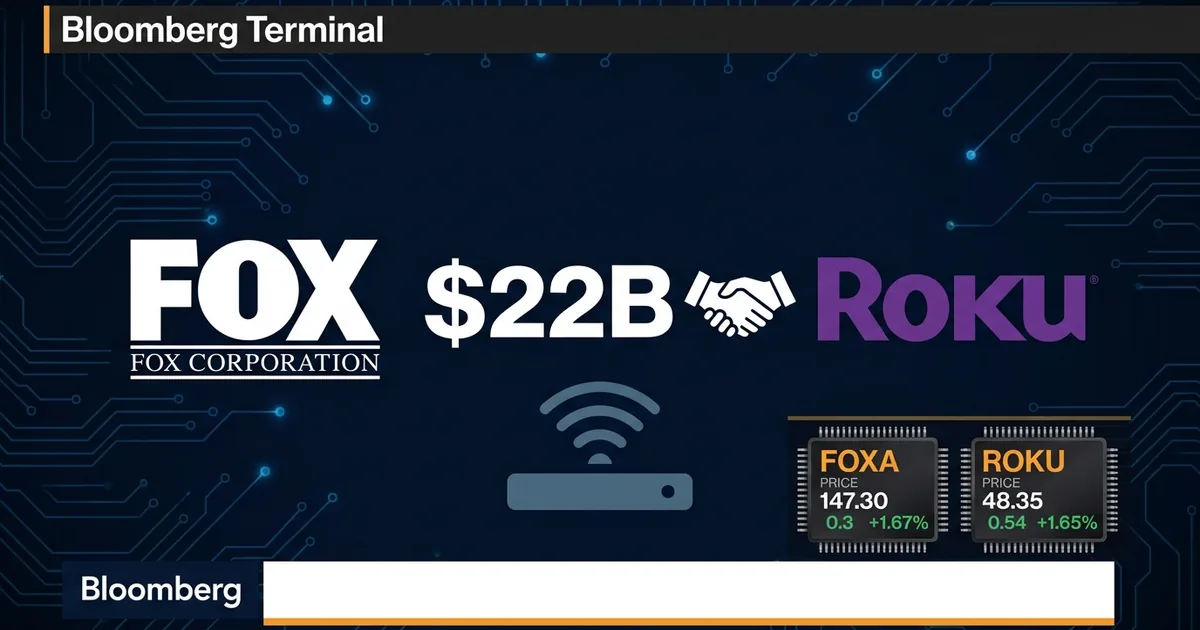
Fox Corporation is not content with being a cable news and sports powerhouse anymore. The company announced a $22 billion deal to acquire Roku, the connected TV platform that reaches more than 100 million streaming households worldwide, in a move that transforms Lachlan Murdoch’s company from a content licensor into a full-stack streaming operator.
Inside the Deal
The transaction, announced on Sunday, values Roku at $160 per share in a mix of cash and Fox Class A common stock. Roku shareholders receive $96 in cash and 0.9693 Fox shares per Roku share, giving them roughly 27% ownership of the combined entity. Fox secured a $12 billion loan to fund the cash portion, with the balance coming from cash on hand.
The deal sent Roku shares to their highest level in four years, though the stock dipped nearly 2% in the session following the announcement as investors digested the modest premium over Roku’s recent trading range. Fox stock fell further, a typical acquirer reaction when the market questions whether the buyer is overpaying.
Why Fox Needs Roku’s Pipes
The strategic logic centers on a problem every legacy media company faces: owning content without owning the distribution layer means renting access to your own audience. Fox already operates Tubi, the free ad-supported streaming service it acquired in 2020 for $440 million. But Tubi lives on someone else’s platform. Every time a viewer opens Tubi through a Roku device, Amazon Fire Stick, or Apple TV, Fox gives up first-party data, ad targeting precision, and the ability to control the user experience.
Roku changes that equation entirely. The company’s operating system powers roughly 40% of connected TVs sold in North America. Its advertising platform, built on first-party viewer data from those 100 million households, generated $3.1 billion in platform revenue in 2025. Fox is not just buying a hardware brand; it is buying the living room’s default interface.
The Hollywood Reporter noted that the combination gives Fox something no other traditional media company currently has: a vertically integrated path from content production through ad sales to the screen itself.
The Competitive Calculus
The deal arrives at a moment when the streaming landscape is consolidating faster than anyone predicted. The Paramount-Warner Bros. Discovery merger cleared its DOJ hurdle just days earlier. Disney has been expanding its streaming bundle strategy. Netflix continues to dominate subscriber counts. The window for mid-sized media companies to assemble competitive scale is closing.
Fox’s approach differs from its peers in one critical respect: instead of merging with another content library, it bought the distribution layer. That bet reflects a growing conviction in media boardrooms that the value in streaming is migrating away from content catalogs and toward the platforms that aggregate, recommend, and monetize them. Content is expensive and depreciating. The operating system that sits between the content and the viewer is a toll road.
The Risks Are Real
Twenty-two billion dollars is a staggering price for a company that has never posted consistent profitability. Roku’s hardware margins are razor-thin by design: the company sells devices at or below cost to grow its installed base, then monetizes through platform ads and revenue shares. That model works when user growth is accelerating. It gets harder to justify when the connected TV market approaches saturation in the U.S.
There is also the competitive threat from the tech giants. Amazon, Google, and Apple all operate rival connected TV platforms with deeper pockets and broader ecosystems. If those companies decide to compete more aggressively on price or features, Fox-Roku’s market share advantage could erode faster than the deal’s financial models assume.
Fox expects the transaction to close in the first half of 2027, pending regulatory and shareholder approvals. ABC News reported that existing Fox shareholders would own roughly 73% of the combined company after closing.
What the Deal Signals
Fox buying Roku is not just a media deal. It is a bet that the next phase of the streaming wars will be won not by whoever has the biggest content library, but by whoever controls the screen the viewer sees first. Lachlan Murdoch is spending $22 billion on that thesis. The rest of Hollywood is about to find out whether he is right.