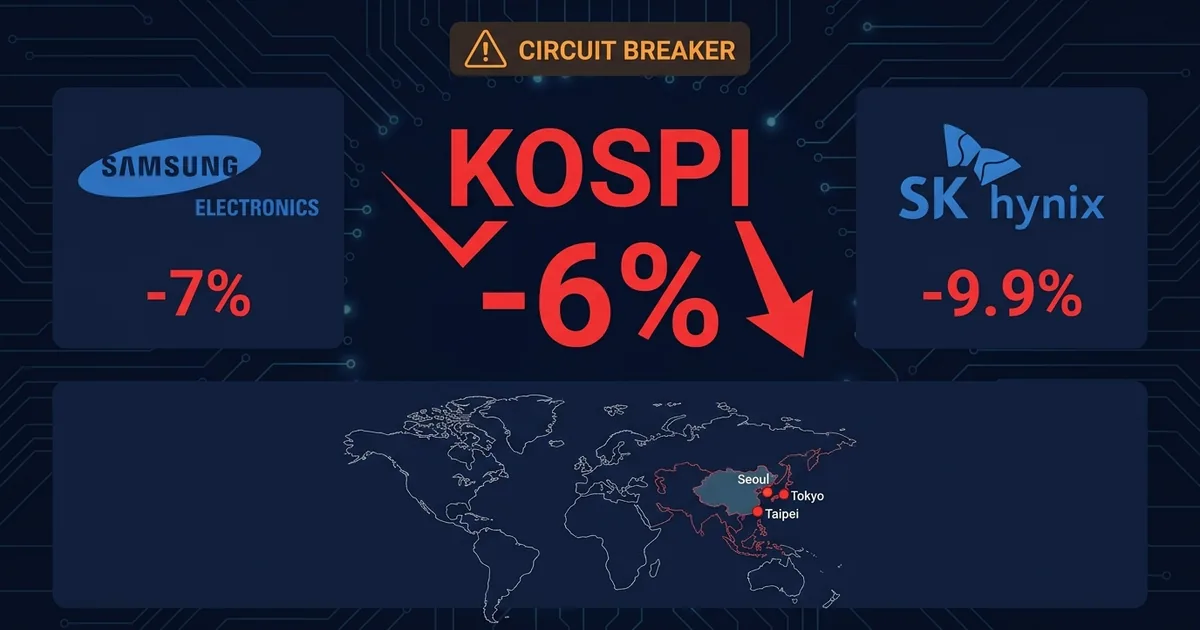
Wall Street’s semiconductor selloff did not stay in Wall Street. South Korea’s KOSPI index plunged over 6% on Friday, triggering a circuit breaker that suspended program trading for five minutes as the global AI chip trade unwound at speed. Samsung Electronics fell more than 7%, SK Hynix cratered 9.9%, and 2x semiconductor ETFs lost roughly 20% in a single session. The carnage confirmed what U.S. investors hoped to avoid: the Broadcom-triggered repricing is not a domestic event.
The Asian Session
The KOSPI’s losses widened rapidly after the open, with the benchmark briefly down as much as 7.2% before the Korea Exchange activated the circuit breaker mechanism on KOSPI 200 futures, which had fallen 5%. Samsung Electronics, the index’s largest component, closed down 6.4%, while SK Hynix dropped 9.92%, as reported by Seoul Economic Daily.
The 2x products amplified the pain. The TIGER SK Hynix Single Stock 2x ETF fell 20.11%, and the KODEX SK Hynix Single Stock 2x ETF fell 20.29%. Samsung-linked amplified products recorded similar double-digit declines. Korean retail investors, who have been heavy buyers of these products throughout the AI boom, absorbed most of the losses.
The $22 Billion Foreign Outflow
The selling was not purely domestic. Since May, foreign investors have net sold approximately $22 billion in South Korean stocks, with SK Hynix alone accounting for roughly $12 billion of that outflow. The concentrated liquidation suggests that the positions being unwound were crowded: when everyone owns the same trade, the exit gets narrow fast.
TradingKey noted that the KOSPI, heavily weighted in semiconductors, is “unwinding its significant year-to-date gains amid a broader AI narrative softening.” The index had been one of 2026’s best-performing major markets, up over 20% through May, driven almost entirely by the memory chip and AI hardware trade. Friday’s session erased approximately a third of those gains.
Why Korea Matters for the Global AI Trade
South Korea is the world’s largest producer of memory chips. Samsung and SK Hynix together control over 70% of the global DRAM market and a similar share of high-bandwidth memory, the component that makes AI accelerators work. When Broadcom’s guidance miss raised questions about the pace of AI infrastructure spending, it hit Korean chipmakers harder than their American counterparts because memory pricing is more sensitive to volume expectations.
The connection to the Broadcom guidance miss that BTN covered earlier this week is direct: Broadcom’s six core custom chip customers include Google, Meta, OpenAI, and Anthropic. If those companies are spending less aggressively on custom silicon, the memory that goes alongside it faces the same deceleration. SK Hynix, which has been shipping HBM4e samples and banking on explosive demand growth, is the most exposed name in the chain.
What the Circuit Breaker Signals
Circuit breakers are rare events. The last time the KOSPI triggered one during regular trading was during the pandemic crash in March 2020. The mechanism exists to prevent cascade selling, and on Friday it did its job: the index stabilized somewhat after the suspension and closed well off its intraday lows. But the fact that it was triggered at all tells institutional investors that the AI chip unwind has moved from an orderly sector rotation to a forced-selling event, at least in the most concentrated pockets of the trade.
Japan’s Nikkei fell 1.8% in sympathy, and Taiwan’s TAIEX declined 2.3%, with TSMC dipping on concerns about downstream demand. The regional contagion was broad but not as severe as Korea’s, reflecting the KOSPI’s unusually heavy weighting toward memory semiconductors.
The Bigger Picture
Friday’s Asian session completed a three-day sequence that reshaped the near-term outlook for the AI hardware trade. Broadcom’s guidance miss on Tuesday evening sparked the initial selloff. The hot U.S. jobs report on Friday morning added rate pressure. And the Korean circuit breaker turned a sector rotation into a global event. The AI infrastructure boom is not over, but the market is telling you that the linear extrapolation phase is. What comes next will be choppier, more selective, and less forgiving of premium valuations that assume every quarter gets better than the last.