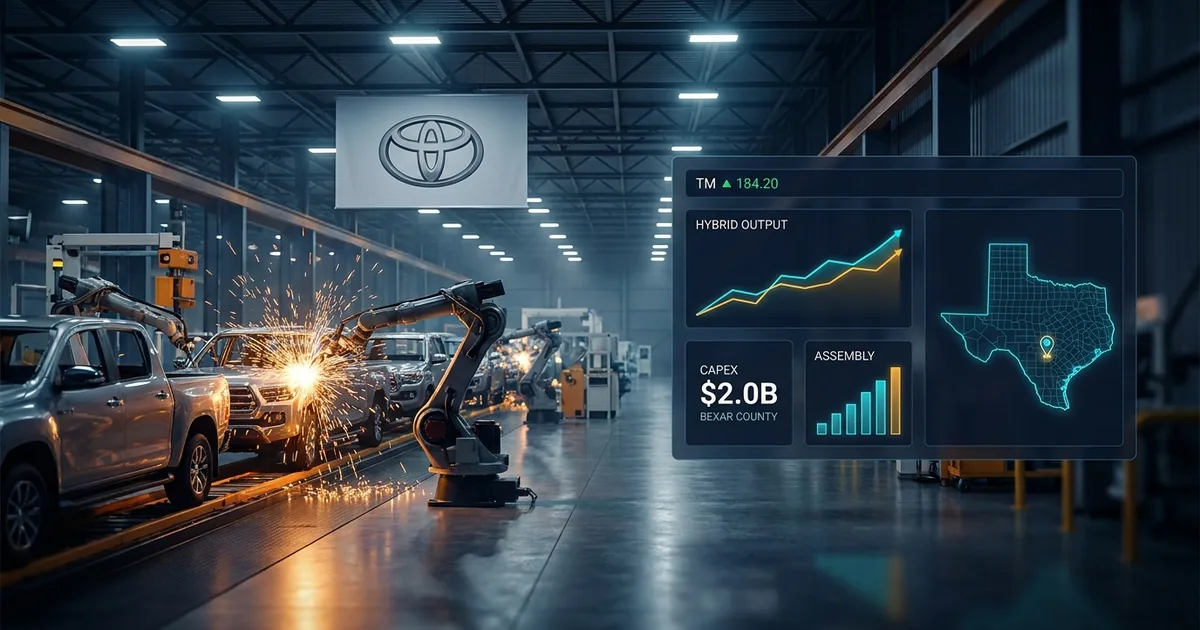
Toyota just put $2 billion on the table for a hybrid bet that quietly says more about the auto industry than any EV announcement of the past six months. According to filings made public Friday in Bexar County, Toyota Motor wants to build a new vehicle assembly line adjacent to its existing San Antonio truck plant, codenamed “Project Orca,” with construction set to begin by year-end and production targeted for 2030.
The investment splits cleanly: $1.05 billion in buildings and property improvements, $950 million in machinery and equipment. Toyota expects the project to create 2,000 new jobs in Bexar County, on top of the 3,200 already employed at the Tundra and Sequoia plant down the road. The company has not formally disclosed which models will roll off the line, but industry analysts expect the focus to be hybrid trucks and SUVs, in keeping with Toyota’s strategic plan to push hybrid output to roughly 6.7 million units by 2028.
This is not a Tesla story. It is something more interesting.
Why Now, Why Texas, Why Hybrid
Strip away the corporate theater and the timing is the story. Toyota is filing for a $2 billion US assembly plant during a US-China trade summit, in a tariff-era policy environment, in a state with no income tax, in a county with significant existing Toyota infrastructure, and aimed at a vehicle category (hybrids) that the rest of the industry has been telling investors for three years was already obsolete.
The reshoring math is now actively favorable. Trump’s tariff schedule on imported vehicles, currently sitting at a 15% baseline for most non-North American producers, makes domestic assembly the economically rational choice for Japan-based OEMs that want to keep US market share. Toyota already builds the Camry in Kentucky, the RAV4 in Canada and Japan, and now wants more nameplates stamped USA. According to Bloomberg’s review of the filing, Project Orca will operate as an extension of the existing Toyota Texas footprint rather than a greenfield site, which trims the regulatory and permitting timeline materially.
The hybrid focus is the bigger tell. EV demand growth in the US has slowed to a crawl. Pure-battery electric vehicles still hover around 8% of new car sales, and the federal tax credit pullback under the current administration has compressed margins for EV-only OEMs. Hybrids, meanwhile, have been the quietest winner in the industry. Toyota sold roughly 1.4 million hybrids in the US last year, the Prius is back in cultural conversation, and the RAV4 hybrid is selling out at most dealerships within a week of arriving on the lot.
Toyota’s strategic call has been the same for a decade. Don’t bet the farm on any single powertrain. Build hybrids that consumers actually want, plug-in hybrids for the regulatory boxes, hydrogen for the prestige projects (see: the $10 billion Woven City experiment we covered earlier this month), and battery electric only when the unit economics start working. Project Orca is the Texas-shaped expression of that thesis.
What 2,000 Jobs Look Like In 2026
The Bexar County numbers matter politically, even if 2,000 direct jobs is a small slice of the US auto workforce. The state of Texas has been aggressively recruiting auto manufacturing, with Tesla’s Gigafactory Austin and now Toyota’s Project Orca anchoring opposite ends of the powertrain spectrum. Governor Greg Abbott will milk the announcement for everything it’s worth, and Toyota knows exactly how that plays in Washington when the next round of trade negotiations comes around.
Local tax incentives are still being negotiated. The Bexar County Commissioners Court filings suggest Toyota is seeking property tax abatements through Texas’s HB 5 economic development program (the successor to the old Chapter 313 framework). The full incentive package will likely come in north of $200 million in tax breaks over the project life, par for the course in Texas auto deals.
The Reshoring Wave Is Becoming A Trend, Not A Press Release
Read this announcement against the rest of the week and the picture clarifies. Stellantis announced Friday it will build Jeeps in China through a joint venture with Dongfeng. Hyundai’s $7.6 billion Georgia plant is fully operational. Honda is expanding its Ohio EV cluster. The pattern is consistent: Asian OEMs are localizing North American production faster than at any point since the original Toyota Kentucky decision in 1986.
The strategic logic is simple. The dollar is strong, the tariff regime is sticky, US labor is more productive than the Japanese auto industry assumes, and the Inflation Reduction Act manufacturing credits (the parts of it that survived 2025) are still meaningful for capital projects breaking ground in 2026. If you are Toyota, the path of least resistance is to build it where you sell it.
According to Automotive News reporting, the Project Orca filing represents the largest single-site Toyota US capital commitment in over five years. That sentence matters because it tells you Toyota’s product roadmap is not contemplating a pure EV pivot. It is contemplating a hybrid-led decade with EVs as a slower-moving option, executed from Texas.
What To Watch From Here
Three things will determine whether Project Orca becomes a flagship or a footnote.
First, the model selection. If Toyota anchors the line with the next-generation hybrid Tacoma, that is a high-volume, high-margin, high-cultural-moment product. If it gets a niche SUV variant, the headline shrinks.
Second, the timeline. Construction by year-end and production by 2030 is aggressive but not impossible. Auto plants routinely slip by 18 months. Watch for the first equipment installation milestone in mid-2027.
Third, the tariff environment. If the Trump administration’s auto tariff schedule loosens after the Beijing summit (it didn’t this week, but the door isn’t closed), the underlying economics of Project Orca change. Toyota is building this plant assuming current tariff conditions hold for the rest of the decade. That bet may or may not age well.
For now, the read is straightforward. Toyota saw the tariff math, the hybrid demand curve, and the Texas labor pool, and decided to put $2 billion to work. The auto industry’s quiet reshoring story just got its loudest data point of the year.