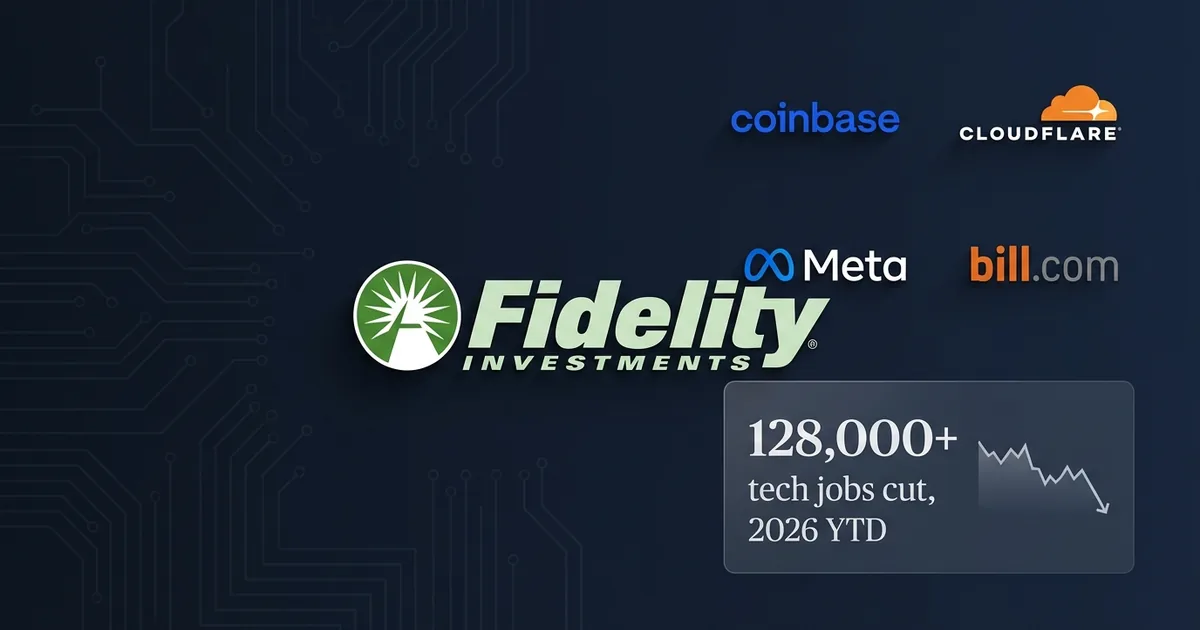
Fidelity Investments told 800 employees this week that their roles are being eliminated as the Boston-based asset manager rebuilds its technology and product-delivery teams, even as the company says it will hire 3,300 new staffers in 2026. The cut, about 1% of Fidelity’s global workforce, lands in a week that produced layoff announcements at Coinbase, Cloudflare, BILL, and Upwork on top of Meta’s 8,000-job May reduction, pushing the running 2026 tech-sector layoff total above 128,000 jobs. This is not a recession story. It is a wage-bill restructuring story, and the bill is being paid, in real time, by the labor side of the AI capex trade.
What Fidelity Actually Did
The Boston Globe reported that Fidelity is concentrating the cuts in technology and product-delivery teams, transitioning the firm away from an “agile” squad-based operating model toward larger, more centralized teams. A company spokesperson framed the move as getting “the right combination of skills in place for where Fidelity is headed.” Translated for the deal room, that means trimming senior tech headcount and replacing the comp envelope with a mix of junior, early-career, and AI-augmented roles.
The hiring side of the announcement does the work the press release wants. Fidelity says it plans roughly 3,300 new hires in 2026, with about 1,650 of those positions in technology and product, and close to 2,000 in early-career staffers across the firm. On paper, headcount expands. On the wage bill, it almost certainly contracts. Senior tech roles do not get replaced one-for-one with junior tech roles at Fidelity scale; they get replaced with two or three juniors at a fraction of the comp.
The other piece of context is the return-to-office mandate. Days before the layoffs, Fidelity directed roughly 25,000 employees in Boston and several other locations to resume five-day in-office work starting September 2026, ending the hybrid arrangement that had been in place since the pandemic. That sequence matters. RTO mandates produce voluntary attrition. Voluntary attrition reduces severance and bad-press exposure on the next round of cuts. The company that gets to chose between paying out severance and watching unhappy senior staff self-select to the door tends to choose the second.
The Broader Pattern Across May 2026
Fidelity is not the only restructuring this week. Coinbase announced it would cut about 14% of staff, roughly 700 employees, with CEO Brian Armstrong framing the decision as a structural shift toward smaller, AI-augmented teams. Cloudflare said it would cut more than 1,100 jobs globally, about 20% of its 5,156-person workforce. Payments firm BILL announced a headcount reduction of up to 30%. Upwork CEO Hayden Brown told employees the company would cut roughly a quarter of its workforce. Meta, as CNN reported, is in the middle of a planned 8,000-employee reduction in May tied directly to its AI capex ramp.
The running 2026 tally is already above 128,000 jobs, and we are in early May. For comparison, the earlier BTN coverage of Q1 2026 tech layoffs put the Q1 figure near 80,000, with nearly half blamed on AI restructuring. The May acceleration tells you the curve is not flattening.
The story does not stop at headcount. Same week as these announcements, the AI capex line is moving in the opposite direction. Meta lifted 2026 capex guidance to $125 to $145 billion. CNBC reported that Anthropic struck a deal to take all of the compute capacity at SpaceX’s 300-megawatt Colossus 1 data center in Memphis, with talks underway on multiple gigawatts of orbital compute. AMD CEO Lisa Su told CNBC the company doubled its long-term server CPU forecast to more than $120 billion by 2030 on the back of agentic AI demand. The capital is flowing at unprecedented scale into infrastructure. The labor flows in the opposite direction.
The Cost Arbitrage Underneath
Walk the math. A senior software engineer at a Boston asset manager runs roughly $250,000 to $400,000 fully loaded. Replace that role with two early-career engineers at $130,000 each plus a Copilot-or-Claude-Code seat at a few hundred dollars a month, and the wage line drops by 30 to 50 percent for a productivity outcome the CFO can credibly defend in front of the board. Multiply by 800 cuts. The annualized labor savings on the Fidelity reorg sit in the low hundreds of millions, before you even count the offshore arbitrage that the “centralized teams” framing usually implies.
For an active asset manager facing structural fee pressure from Vanguard and BlackRock on the index side, that math is not optional. It is the only path to defending operating margins as fee compression continues. The “transformation” frame in the press release is the cover story. The story underneath is wage-bill optimization in a low-margin business under structural threat.
This is not unique to Fidelity. The same logic is running every tech-adjacent corporate finance department in May 2026. The press release uses the words “right-sizing,” “skills mix,” “future of work,” and “AI-native organization.” The income statement uses the words “compensation expense, down year-over-year.” Both can be true. Investors notice the second one.
What to Watch Going Into Monday
The first read is sympathy moves on Monday’s open across adjacent names. T. Rowe Price, Charles Schwab, and BlackRock all face the same fee-compression pressure as Fidelity, and all three trade as a margin-expansion thesis whenever a peer announces a wage-bill cut framed as “transformation.” Watch whether the analyst notes that hit between now and the open frame the Fidelity cut as a margin print or as an execution risk; the former is a buy, the latter is a hold.
The second read is the broader labor-market signal. The April US jobs report came in at 115,000 net adds against a 60,000 estimate, with strength concentrated in healthcare and transportation, not tech. That divergence is the macro signature of an AI capex cycle that is hiring infrastructure capacity, not knowledge workers. If the May report comes in similar, the layoff cascade will not be a sentiment story; it will be a structural story the Fed has to think about as it considers the late-2026 rate path.
The third read is the political one. Mass tech layoffs at the same time AI capex is at record highs is a narrative ready-made for regulatory pressure on labor displacement. That pressure will arrive in the next quarter or the one after. Companies that have moved early on the wage-bill restructuring will be in a defensible position; companies that move late will eat the political and regulatory cost on top of a higher initial labor base. The math says move now. The week’s announcements say the corporate finance departments did the math.