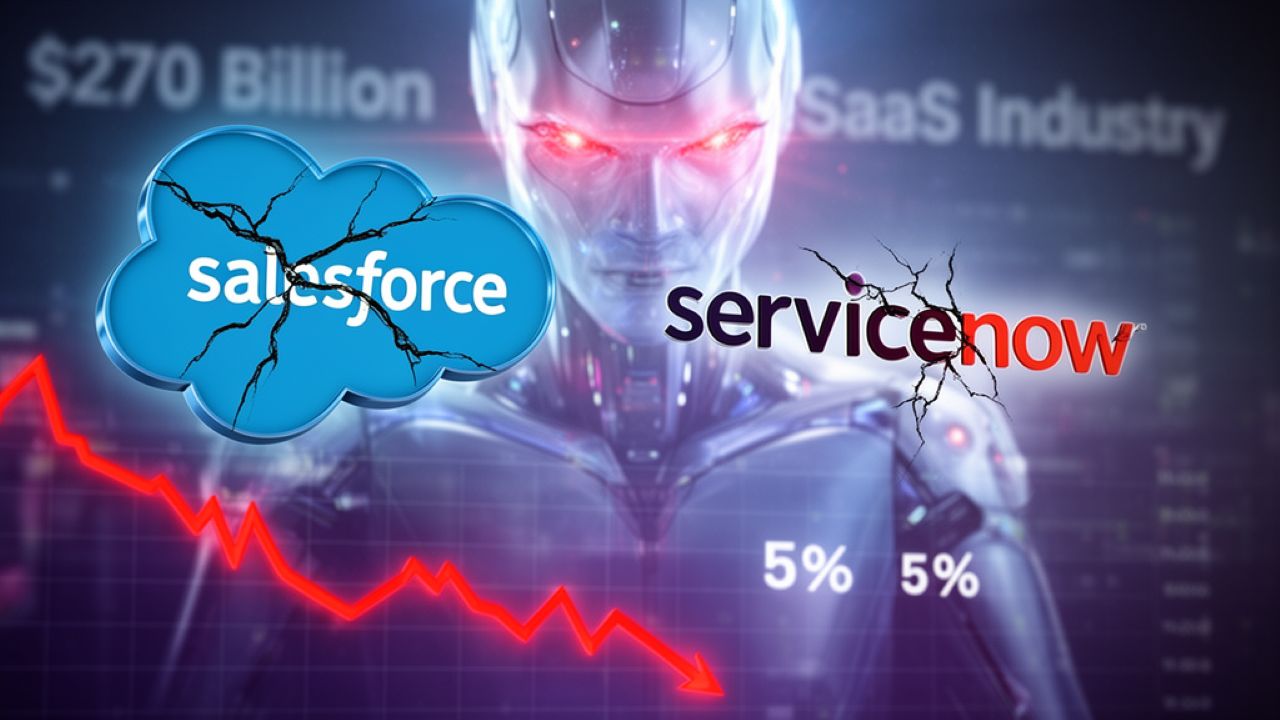
It’s not often you see an entire industry category get repriced in real time, but that’s precisely what happened on Tuesday, March 24, 2026, when the enterprise software sector melted down with the kind of ferocity usually reserved for earnings misses and executive scandals. Salesforce and ServiceNow, two of the industry’s supposed fortresses, both tanked around 5%, dragging down the entire ecosystem as investors finally woke up to a terrifying reality: the software licensing model that has been printing money for thirty years might be obsolete.
This isn’t some theoretical doomsday scenario anymore. It’s happening now, and it’s happening fast. Enterprise software stocks have hemorrhaged nearly 30% in the past three months. HubSpot is down 39% year-to-date. Figma, the once-invincible design darling, cratered 40%. Salesforce itself is off 25% from recent highs. Microsoft dropped 2.12%, IBM fell 3.37%. The carnage is real, the panic is real, and the culprit isn’t hard to identify: Anthropic’s new Claude Cowork platform and its suite of enterprise AI agent plugins are doing what every investor feared AI would eventually do, replacing entire categories of expensive software.
The Irony That Broke The Market
Here’s where it gets delicious. ServiceNow, which fell roughly 5% on the news, didn’t just lose ground to Anthropic. ServiceNow partnered with Anthropic. The company recently integrated Claude into its ServiceNow Build Agent, essentially inviting the wolf into the henhouse and hoping nobody would notice. Turns out, everybody noticed. The market’s message was brutally clear: your partnership with Anthropic is your death warrant, not your salvation.
This is the kind of strategic irony that makes you want to laugh if you weren’t too busy crying for the portfolio managers holding billions in SaaS exposure. ServiceNow thought it could co-opt AI agents by partnering with the company best positioned to make their entire product line redundant. Instead, the partnership announcement simply accelerated investors’ realization that the business model itself is under siege. Why pay for ServiceNow’s workflows when an AI agent powered by Claude can handle them for a fraction of the cost?
Anthropic’s Market Capture And The Death Of Software Licensing
The numbers tell a story that should make every SaaS CEO lose sleep. Anthropic now captures 73% of first-time enterprise AI spending, up from just 50% six months ago. That’s not just market share. That’s dominance. That’s the kind of concentration you see right before an entire category gets disrupted. One Anthropic executive recently went on record predicting that AI agents will replace most traditional software products entirely by the end of 2026. That’s not hyperbole. That’s potentially the most accurate description of what’s about to happen to this industry.
Claude Cowork’s enterprise AI agent plugins for finance, engineering, and design workflows aren’t just competing with Salesforce, HubSpot, and Figma anymore. They’re rendering them optional. An enterprise can now pay per interaction with an AI agent or commit to six-figure annual contracts for software that does roughly the same thing. You don’t need to be an MBA to figure out which option wins.
The timing is particularly brutal because this disruption is happening before most SaaS companies have figured out how to monetize AI themselves. Salesforce has been frantically bolting AI features onto Einstein. ServiceNow has integrated Claude. Microsoft and Salesforce have both announced partnerships with OpenAI. But here’s the problem: when you announce that you’re incorporating someone else’s AI agent into your product, you’re essentially admitting that your core product isn’t defensible anymore. You’re conceding that the real value has shifted away from your software and toward the underlying AI model.
When Even Your Partners Become Your Executioners
OpenAI CEO Sam Altman felt the pressure months ago. In December 2025, he issued an internal “code red” about the competitive threat from other AI companies. But here’s the thing about “code red” memos: they usually come too late. By the time you’re declaring a crisis, the crisis has already started pricing itself into the market. Anthropic has been operating with surgical precision, positioning Claude not as a feature to be bolted onto existing software but as a replacement for entire categories of software. The distinction matters enormously.
Salesforce, for all its scale and market position, is now competing against a company that doesn’t have a sales organization, doesn’t have support costs on the same scale, and doesn’t need to maintain decades of technical debt. Anthropic can iterate faster, move faster, and price lower. In a head-to-head competition, Salesforce is fighting with one hand tied behind its back. It’s weighted down by its own success, its own customer base, and its own business model.
The $270 Billion Question: Is This Rational Or Panic?
The obvious question is whether this sell-off represents a rational repricing of the SaaS sector or blind panic in the face of genuine disruption. The answer is probably: both. The disruption threat is real. AI agents will eventually replace significant portions of the software licensing market. That’s not speculation. That’s math. When you can pay per interaction instead of per seat, the entire unit economics of the SaaS industry inverts.
But the panic element is also evident in the magnitude of the moves. A 5% single-day drop in a mega-cap like Salesforce isn’t a pricing correction. It’s a stampede. It’s capital running for the exits because if the SaaS licensing model is actually breaking, every company in that category becomes significantly less valuable overnight. Not gradually less valuable. Overnight. That’s what Tuesday’s action was really pricing in.
The enterprise software sector will probably survive, but it will look dramatically different. Companies like Salesforce will either transition to agent-first business models or get eaten by companies that do. The $270 billion question facing investors now is whether any of the current market leaders have the organizational flexibility to make that transition before the disruption completes. Based on Tuesday’s trading, the market is betting the answer is no.
We’ve seen this movie before. IBM thought mainframes were forever. Kodak invented digital photography and couldn’t switch. Blockbuster had market dominance that looked unassailable until it didn’t. The SaaS industry is no different. When the underlying technology fundamentals shift this dramatically, legacy business models don’t just decline. They collapse. And if Anthropic’s executives are right about the timeline, we’re not looking at a gradual transition. We’re looking at the early stages of a complete industry remake.