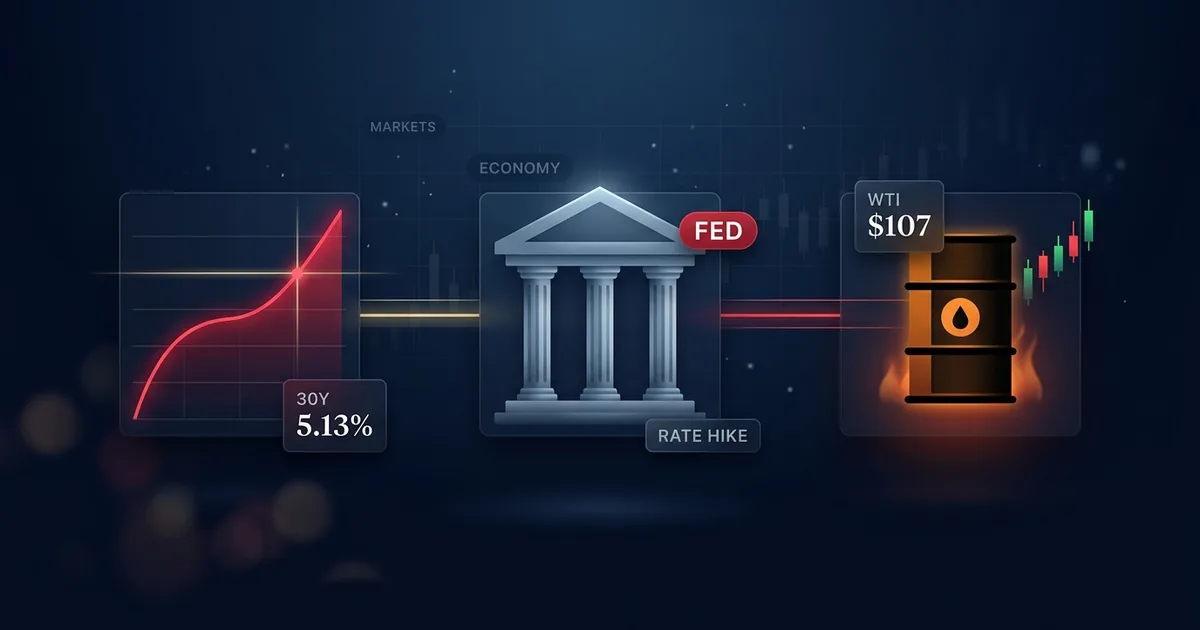
The bond market has stopped pretending. On Friday the 30-year US Treasury yield punched through 5.127 percent, the highest level since 2007, and the selloff carried into Monday’s open in Asia and Europe before US futures gave back another half percent. Stocks fell, oil climbed back to $107.65 a barrel, and traders pulled forward the next Fed move from a cut to a hike. The pivot is brutal, and it is happening in real time.
Three months ago the consensus on Wall Street was two quarter-point cuts in 2026 under whoever ended up running the Fed. As of Monday morning, CME fed funds futures put the next move as a hike by March 2027. That is the most aggressive front-end repricing the curve has seen since the 2022 inflation shock, and it is being driven by a combination the Fed cannot fix with words: a war in the Middle East that will not end, an oil supply story with no obvious off ramp, and a US wholesale inflation print that came in at 1.4 percent month over month for April.
Why The Long End Is Breaking
The clean read on a 30-year above 5.1 percent is that the world’s biggest bond market is telling the new Fed chair, Kevin Warsh, that it does not believe him. Warsh inherits the chair from Jerome Powell with the long end already pricing in a higher path for fed funds, a steeper term premium, and a credibility tax on any near-term cut. The April PPI shock baked in the rate-hike narrative, and the renewed oil spike since the May 12 Hormuz exchange has kept the curve from sticking a bottom.
Krishna Guha at Evercore ISI put it bluntly to clients over the weekend, as cited in Bloomberg’s Monday markets wrap: “The combination of a renewed gradual march higher in oil prices on stalled US-Iran negotiations and strong US investment data is putting upward pressure on bond yields, in the US and globally, creating a new headwind for equities.”
Translation: the bond move is not a fluke, and it is squeezing every asset that priced AI growth at 2025 discount rates.
The Equity Math No Longer Works
That math is now showing up in the tape. S&P futures sat 0.35 percent lower into the New York open. Dow futures were off 0.67 percent. The Nasdaq held up better at minus 0.16 percent, but that is more about flight to megacap balance sheets than any real conviction in the AI trade. The Philadelphia semiconductor index closed Friday at a fresh record, then opened Monday in the red. The VIX nudged up to 18.95.
Outside the US, the picture is uglier. Asian shares fell 1.4 percent overnight. South Korea’s KOSPI, the best-performing benchmark in the world year to date, slid toward correction. Japan’s 10-year yield jumped nine basis points to 2.79 percent, a level that finally has Japanese institutional capital looking at home instead of buying Treasuries. Australia’s 10-year added six basis points to 5.13 percent.
The dollar is doing what the dollar does in a Middle East shock. It rose for a sixth straight day, with the DXY pulling further away from where most macro shops modeled it for May. Gold and silver, normally the haven story when yields move, actually fell, because the dollar bid is dominant and silver had its own technical unwind, losing 7 percent on Friday after a long retail rally.
The Iran War As An Oil Curve, Not A Headline
The market has stopped treating Iran as a headline and started pricing it as a curve. West Texas Intermediate touched $107.65 a barrel on Monday, with Brent at $107.46. The May 6 framework that briefly cooled tensions cracked when Iranian missiles hit two US destroyers and the US returned fire near Hormuz. Since then, the energy desks have assumed roughly 70 basis points of headline CPI sit on top of the official April print, and that is before the gasoline complex resets at the pump.
Fortune reported over the weekend that crude inventories at Cushing are flashing the kind of warning levels that historically precede non-linear price moves. The phrase the analysts are using is “panic buying,” which is the kind of thing oil traders only say when they think the buyer base has not actually positioned for $120 yet.
Goldman, Morgan Stanley, and JPMorgan all reissued their commodities frameworks last week. The thumbnail version: every $10 sustained on crude is roughly 30 basis points of headline CPI and a quarter point of erosion on real consumer spending. The Iran war is doing in six weeks what tariff policy has not been able to do in a year.
What Bessent And Warsh Cannot Outrun
Inside the building, the political math is grim. President Trump returned from Beijing on Thursday with a 200-jet Boeing order, a soybean pledge, and no chip deal. He returned to a bond market that is functionally pricing his Fed pick to either tighten policy or watch the long end keep ripping. Treasury Secretary Scott Bessent has spent the past two weeks reassuring foreign creditors that the US is committed to fiscal discipline. The auction calendar this week, with the 20-year reopening Wednesday and the 10-year TIPS Thursday, will tell him whether the audience believes him.
Warsh’s first FOMC under his own gavel is June 16 and 17. The dot plot that comes out of that meeting is now arguably the single most important Fed communication of the cycle. If Warsh tries to validate the cuts that markets priced in February, the 30-year goes to 5.5 percent. If he validates the hike that markets are now pricing for March, he hands the equity market its first true monetary headwind of the AI era.
The Trade
This is not a buy-the-dip tape until either oil rolls over or the Treasury market reprices to a less hostile curve. The single highest-conviction call coming off the desks on Sunday night was duration short, dollar long, oil long, and selective megacap balance-sheet quality on equities. Watch Walmart’s print on Thursday for the consumer read. Watch Nvidia on Wednesday for the AI capex backstop. Watch the front end of the curve every morning at 8:30 a.m. for the new Fed reaction function.
The bond market is the story. Everything else is a function of it.