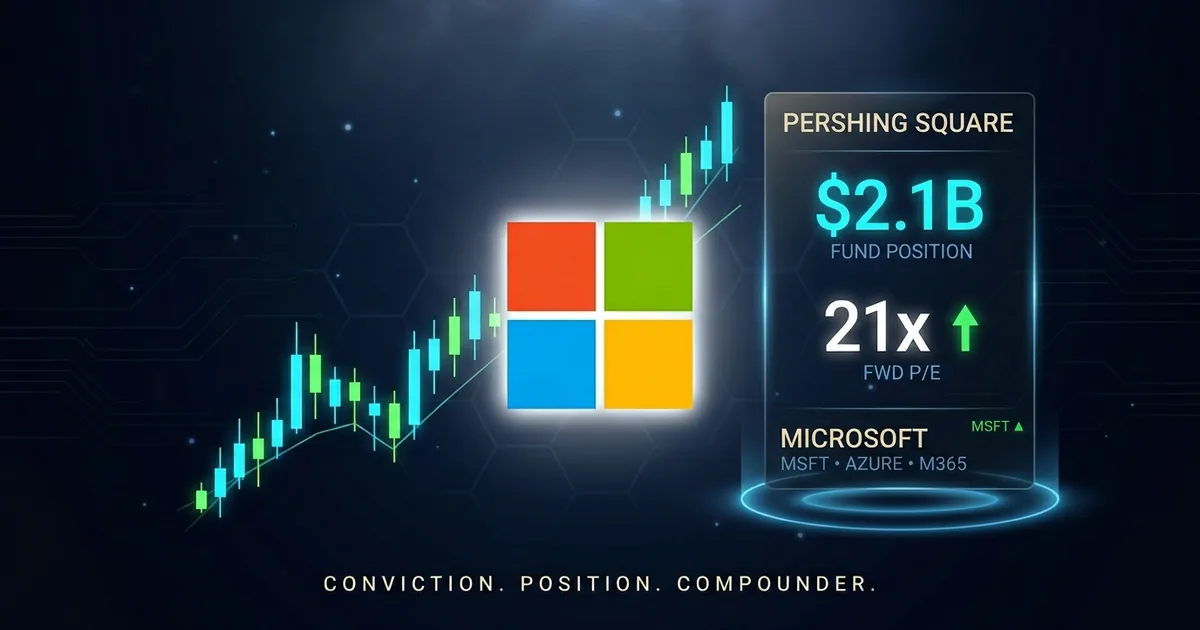
Bill Ackman quietly built a $2.1 billion Microsoft position since February and waited until Friday morning to tell anyone. The disclosure landed on X like it was a note about lunch, but the math behind it is the most consequential big-fund position taken on a Magnificent Seven name in 2026. Pershing Square now owns roughly 5.65 million Microsoft shares, and Ackman told his followers the entry price represents “21 times forward earnings, broadly in line with the market multiple and well below Microsoft’s trading average over the last few years.” Translation: the rest of you are mispricing the franchise.
That is a fighting line coming from a fund manager who built his reputation on contrarian conviction trades. Microsoft is not Valeant. It is not a Herbalife short. It is the second most valuable company on the planet and the most reliable AI capex story in tech. For Ackman to plant a flag here, on this multiple, in this tape, tells you what he actually thinks the next twelve months look like.
Why The Stock Fell In The First Place
The setup matters. Microsoft cratered after its fiscal Q2 print in late January when management refused to back off its capex guidance and analysts started doing arithmetic on AI return-on-investment. Azure growth, while still strong, started to look priced-in. The OpenAI relationship, once a moat, started to look like a liability as Anthropic’s enterprise share kept climbing. Add in the broader rotation out of AI hyperscalers in February and you get the entry point Ackman caught.
He started buying in early February. He kept buying through the spring. By the time he announced the position Friday, Pershing Square had built one of its largest single-stock concentrations in years. Both the main hedge fund and Ackman’s newly launched closed-end vehicle Pershing Square USA, ticker PSUS, hold the position. Bloomberg’s coverage of the disclosure framed it as the most aggressive single-name conviction trade Ackman has made since his Chipotle bet.
The Thesis: Two Franchises, One Discount
Ackman’s framing is worth quoting directly because he chose it carefully. He called Microsoft 365 and Azure “two of the most valuable franchises in enterprise technology.” That is not a pitch about AI. That is a pitch about installed base. Microsoft 365 is the operating system for white-collar work. Azure is the cloud infrastructure layer underneath. The AI revenue, which crossed an annual run rate of $37 billion last quarter at 123% year-over-year growth, is gravy on top of a business that already collects rent from roughly every Fortune 500 desktop on Earth.
The 21x forward multiple is the number to focus on. Microsoft has traded between 28x and 35x for most of the AI bull run. Even at 21x, it commands a premium to the S&P 500’s roughly 19x forward multiple, but it sits well below where the market has historically priced the franchise. Ackman is essentially betting Microsoft has been mispriced as an AI capex story when it should be priced as a high-quality compounder that happens to have AI optionality. That is a different stock entirely.
The Real Risk Is Not What You Think
The bear case on Microsoft has not been about the moat. It has been about the spend. Microsoft will pour between $80 billion and $90 billion into AI infrastructure this fiscal year. If that spend does not generate clearly above-cost-of-capital returns inside 24 months, the multiple compresses regardless of how strong the underlying franchises look. Ackman is implicitly betting that capex hits the right hurdle rate.
He is also betting that the Anthropic threat to OpenAI does not bleed Microsoft. Ramp’s AI Index this week confirmed Anthropic has now passed OpenAI in business adoption, sitting at 34.4% of businesses versus OpenAI’s 32.3%. Microsoft owns roughly 49% of OpenAI’s commercial entity, but the company has been steadily diversifying its AI partnerships. The recent reporting that Microsoft would lean on Elon Musk’s Colossus supercomputer to run Anthropic inference at a $4 billion scale tells you Microsoft is not putting all its inference chips in one basket.
The Treasury Yield Problem
There is a macro asterisk on the trade. Friday, the same day Ackman disclosed the Microsoft position, the 10-year Treasury yield closed at 4.59% and the 30-year topped 5.1%. Higher yields are the enemy of long-duration tech multiples. Microsoft at 21x forward earnings is not the obvious bargain when the risk-free rate is rising and Kevin Warsh just took over a Fed that will not telegraph cuts the way Powell did.
Ackman would tell you the franchise is durable enough to absorb a higher discount rate. The bond market would tell you to check back in September.
The Alphabet Cut Tells You More
The same 13F that revealed the Microsoft stake also showed Ackman trimming his Alphabet position. That is the more interesting trade. Pershing Square sold down Alphabet ahead of Google I/O on Tuesday, which the company is positioning as a justification for its $190 billion 2026 AI capex envelope. Ackman is essentially saying he likes the cloud business attached to the desktop monopoly more than the cloud business attached to the search monopoly. That is a sharper view than the headline suggests.
The 13F reads less like a portfolio update and more like a verdict on which Big Tech AI distribution model survives. Ackman picked the one with the legacy lock on the corporate desktop. CNBC pulled out the part of Ackman’s note that called the Azure-365 combination “deeply embedded” inside enterprise IT, which is the polite way of saying customers cannot leave even if they want to.
The Verdict, For Now
If Microsoft delivers a clean fiscal Q4 print in late July, Azure growth holds north of 35%, and the AI run rate keeps expanding, Ackman looks early instead of wrong, and the Pershing Square trade ages into one of his best in a decade. If capex returns disappoint, or if the Anthropic enterprise wave keeps eroding the OpenAI premium, the 21x forward multiple turns out to be the new ceiling, not the old floor.
The bet is concentrated, public, and unhedged. Ackman has been right enough times that the market will pay attention. The market will also be watching every single capex earnings call from here to year-end with a sharper pencil.
That is the Ackman trade in one line: Microsoft is a quality compounder mispriced as an AI capex story. Buy the franchise, ignore the noise, wait twelve months.