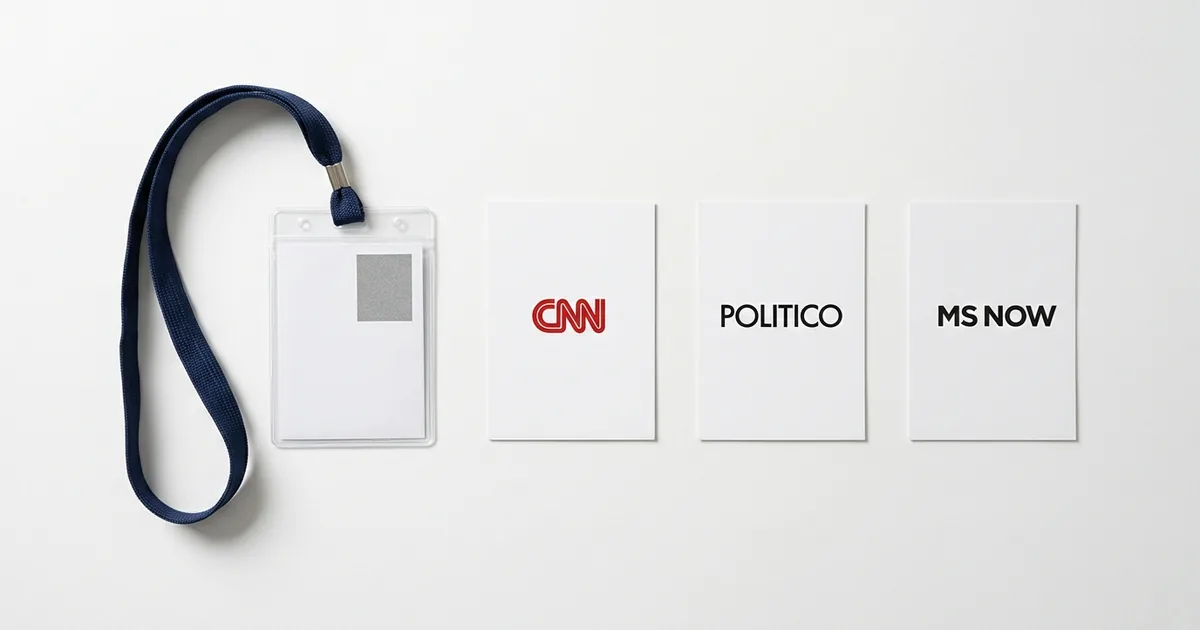
The outlets did not win a right to be there. They won a right to be told why they were being thrown out.
A federal judge ordered the White House on Wednesday to restore the press credentials of reporters from CNN, MS NOW and Politico, and by that evening journalists from all three were back inside the complex. Read the order rather than the coverage, though, and the win is narrower than it looks.
Here is the sequence, because the timeline matters:
- Trump announced on Truth Social that he was banning the three outlets, citing what he called their constant reporting of fake news.
- Their reporters were turned away from the White House grounds the following day.
- The outlets sued. Rival networks, including ones not covered by the ban, jointly suspended video coverage of the president.
- Judge Timothy J. Kelly of the US District Court for the District of Columbia, a Trump appointee, granted a 14-day temporary restraining order.
- Hard passes were reactivated and reporters re-entered the building.
Why the Ruling Is Narrower Than the Headlines
Almost every account of this has framed it as a First Amendment victory. It was not, and the distinction is the whole story.
Kelly ruled on due process, not on speech. He found the outlets likely to succeed in showing their hard passes were revoked without constitutionally adequate process, noting the government did not dispute that the outlets received no notice and no opportunity to be heard beforehand. He was applying Sherrill v. Knight, a 1977 D.C. Circuit decision that binds him.
Now look at what Sherrill actually requires. It entitles a journalist denied a pass to three things:
- notice of the reason,
- a meaningful opportunity to rebut it,
- and a written decision from the government.
That is a procedure. It is not a guarantee of access. As legal scholars noted this week, there is no Supreme Court precedent establishing a constitutional right of access to the White House at all. So the ruling the three outlets just won is, read plainly, a set of instructions. Give notice. Hold a hearing. Write it down. Do those things and the same revocation may well survive.
The one genuinely damaging finding for the administration is not procedural. Kelly rejected the national security justification outright, writing that nothing in the record predating the lawsuit suggested the revocations were motivated by security concerns, and pointing instead at the president’s own announcement, which focused on the outlets’ truthfulness and negativity. A stated viewpoint rationale is far harder to launder through a hearing than a procedural defect is to fix.
The Part That Is Actually a Business Story
Three corporate owners are exposed here, and they are all mid-transition.
- CNN sits inside Warner Bros. Discovery, which is splitting itself in two and has spent the year insisting CNN is not for sale while fielding interest anyway.
- MS NOW belongs to Versant, the company spun out of Comcast’s NBCUniversal, still establishing itself as a standalone public entity.
- Politico is owned by Axel Springer, a German group that has bet heavily on US political coverage.
For all three, a White House hard pass is not a prestige item. It is a production input. Washington bureaus are expensive, and their output is priced on proximity. An administration that can switch that input off for a fortnight at a time, lawfully, with notice, has acquired something close to a lever over the cost base of every news organisation that covers it.
Notice also what the industry did in response, because it was unusually coordinated: networks halted video coverage of the president even though most of them had not been banned. That is a cartel-like response from competitors, and it happened because everyone understood the precedent applied to them next. Meanwhile the White House has been building its own YouTube distribution, which changes the calculation: an administration that can reach an audience directly has less to lose from a pool boycott than one that cannot.
What Happens in Two Weeks
The order expires after 14 days. Kelly set a schedule for both sides to brief and submit evidence while he weighs longer-lasting relief, and reporters are inside in the meantime. The administration did not immediately appeal.
BTN’s view: treat this as a stay of execution, not a settlement. The outlets won on the weakest available ground, which is also the easiest ground for the government to cure, and the coverage celebrating a constitutional victory has largely skipped that. The finding worth watching is not the due process one. It is Kelly’s refusal to accept the national security story, because that is the finding that says the stated reason was the real one.
If the passes come back out in two weeks with a notice letter and a hearing attached, nobody should be surprised. The roadmap was in the ruling.