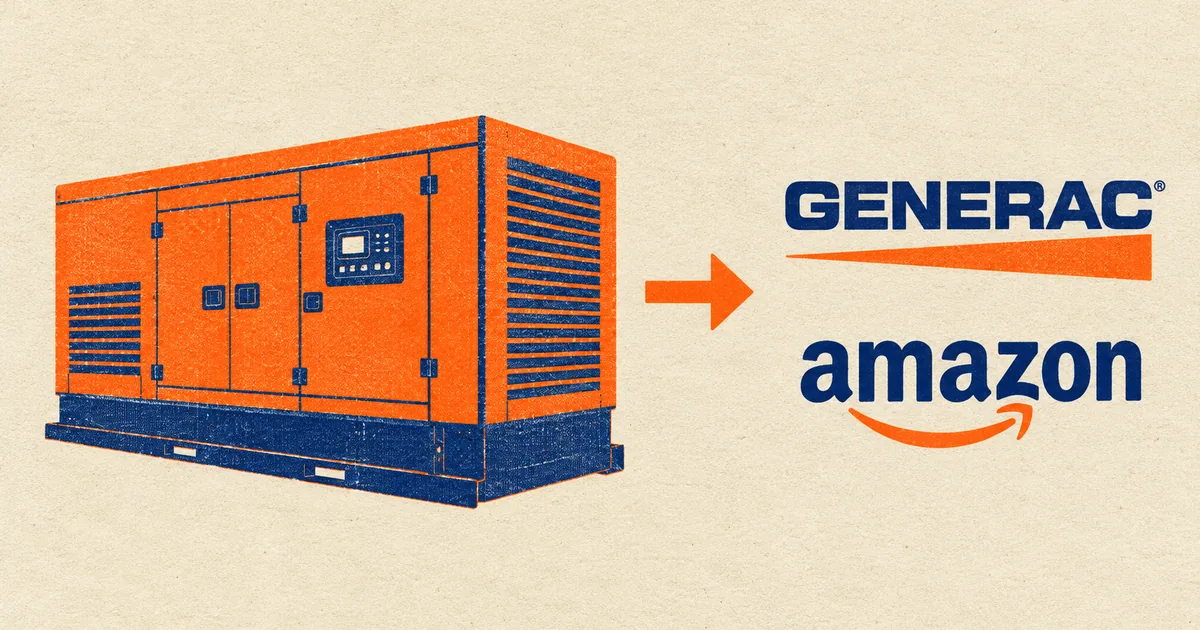
Generac Holdings closed at $175.11 on Wednesday, disclosed a long-term agreement to supply backup generators to Amazon’s data centers after the bell, and spent Thursday somewhere between 19% and 28% higher, touching $208.48 by late morning after an opening spike that briefly set up the best session in the company’s history. Every headline carried the same figure: an $8 billion deal. That figure is in the filing. It is not the size of the order.
Read the 8-K itself and $8 billion appears in one place, as the ceiling on a formula that governs when Amazon’s warrants vest. The only number describing goods anyone has agreed to buy is $2.4 billion, spread across 2027 and 2028. Generac added close to $2 billion of market value in a single session, against roughly 59 million shares outstanding, on a contracted order worth $2.4 billion over two years. Wall Street capitalized about a year of the deal in a day, and it did so using a number whose job in the document is to measure Amazon’s compensation rather than Generac’s revenue.
What the Filing Commits To, and What It Does Not
The warrant terms are precise in a way the coverage was not. Generac issued Amazon.com NV Investment Holdings LLC a warrant over 1,693,745 shares at $200.9266 each, exercisable through September 16, 2033. Of those, 307,954 vested immediately on signing. The rest vest against “aggregate gross payments, net of certain offsets” that Generac and its affiliates receive from Amazon for backup power generators, up to a total of $8 billion.
So the $8 billion is a vesting schedule. It describes how much Amazon would have to spend for the last tranche of its own warrant to become exercisable, which tells you what Amazon might do, not what it has promised to do. The contracted piece, the initial deliveries of $2.4 billion in 2027 and 2028, is the real order. It is a genuinely large one: Generac’s trailing twelve-month revenue was $4.44 billion as of June 30, so roughly $1.2 billion a year of incremental hyperscaler demand is worth something like a quarter of the current top line, arriving in a segment with better growth optics than selling home standby units into storm season.
None of that required a 19% repricing on day one. The move implies the market marked a meaningful share of the optional $5.6 billion as though it were booked.
Amazon Has Run This Play Before
The structure is not novel, which is part of why it should have been read more carefully. Amazon has taken warrant positions in suppliers repeatedly, including:
- Astera Labs, in AI connectivity silicon
- Air Transport Services Group, in air cargo
- Plug Power, in green hydrogen
- SpartanNash, in grocery distribution
The pattern is consistent. Amazon commits to a commercial relationship, takes equity upside in the supplier that the relationship itself creates, and pays for that upside with order flow rather than cash. We covered the same architecture in August when Google took a $12.2 billion warrant position in Marvell, and the reflex there was identical: the headline number was the ceiling, and the market treated it as the order.
The Warrant Is Actually Better Than “Amazon Takes a Stake” Suggests
Here the coverage erred in the opposite direction, and it is worth saying so plainly because it cuts against the skeptical read.
The strike price of $200.9266 sits about 15% above Wednesday’s undisturbed close of $175.11. Amazon did not receive a discounted stake. It received an out-of-the-money option that only pays if the shares rise, and beyond the 307,954 shares that vested at signing, it has to buy roughly $8 billion of generators to unlock the rest. If Amazon exercised the entire warrant it would pay Generac about $340 million for the privilege. Several outlets described the warrant as being “worth as much as $340 million,” which is the wrong direction: $340 million is the cash Amazon would hand over, not the windfall it would collect.
Measured against Thursday’s price, the whole warrant is in the money by something on the order of $13 million. That is a rounding error next to $8 billion of purchases. As dilution goes, 1.7 million shares against 59 million outstanding is under 3%, most of it contingent on Amazon writing very large checks. Generac’s board negotiated this well.
Our Read: The Structure Is Sound, the Price Is Not
The deal is good for Generac. The valuation attached to it on Thursday is a different question, and the answer is that investors bought the ceiling.
Cantor Fitzgerald reiterated an Overweight rating with a $333 target and Wells Fargo an Overweight at $280, and CNBC catalogued the wave of upgrades that followed. Those targets are not absurd on a company with a credible hyperscaler channel. They are being justified, in public, with a number that Amazon has the option to never spend. When an analyst writes $8 billion into a model without noting that $5.6 billion of it is an option held by the counterparty, that is not aggressive forecasting, it is a category error.
This is the AI-power trade compressed into a single session. Demand for data-center electricity is real, and the suppliers riding it are posting order growth that justifies rerating. What keeps happening on top of that genuine story is a discipline failure: a contracted figure gets published alongside a much larger ceiling, and within hours the ceiling is the one in every headline. Amazon’s multibillion-dollar fiber agreement with Corning in June ran the same way.
Generac has to deliver $2.4 billion of industrial generators in 2027 and 2028 before any of the optional tranche is even a live question. That is the number to hold the company to at the next four earnings calls. Amazon, meanwhile, has already banked the part of this deal that required nothing: 307,954 shares, vested on signature, struck below where the stock now trades because its own order moved the price.