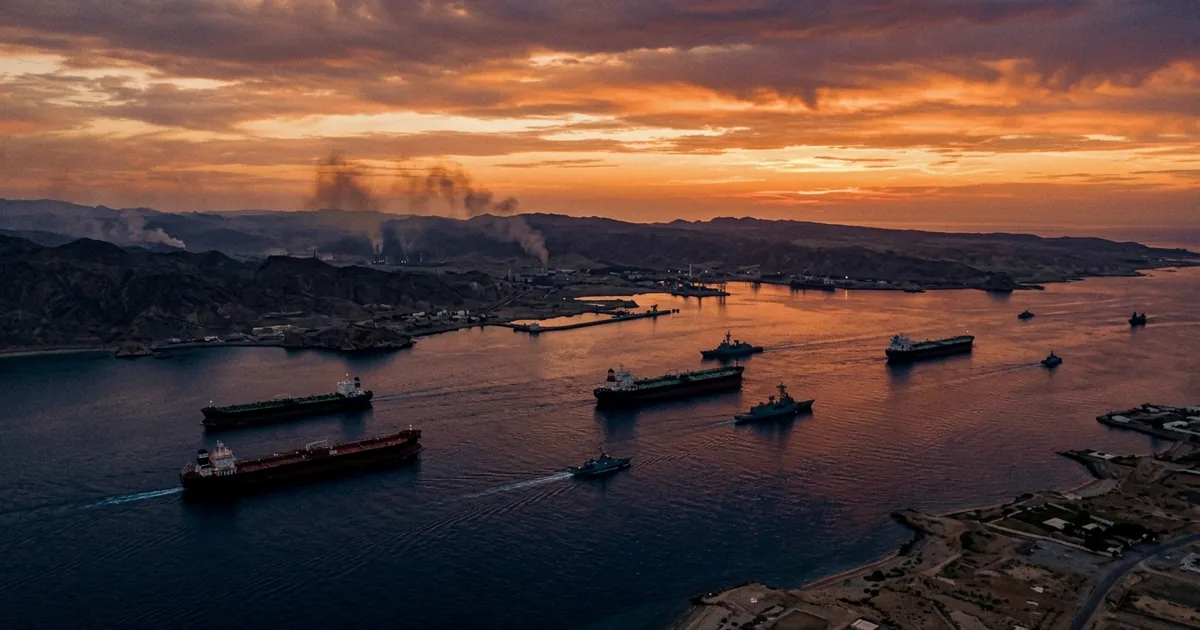
The United States completed a fresh round of military strikes against Iranian targets near the Strait of Hormuz on Tuesday, one day after Iran shot down an American Army Apache helicopter in the contested waterway. Wall Street responded with a broad selloff that dragged all three major indexes lower, while oil prices swung wildly before settling in a nervous holding pattern around $88 a barrel.
The Strike, the Chokepoint, and the Market Math
The Pentagon confirmed it struck Iranian military positions along the strait’s northern coastline, the latest salvo in a conflict that has already shut down an estimated 11.8 million barrels per day of production across six Gulf producers. Rystad Energy has called this the most severe oil supply disruption in modern history, with cumulative production losses approaching one billion barrels.
The numbers tell the story plainly. US crude oil futures for July delivery settled at $88.03 per barrel after initially jumping more than 1%, while Brent crude slipped to $91.27. The choppy action reflects a market caught between two fears: an outright closure of the strait (roughly one-fifth of global seaborne oil transits the chokepoint) and the growing realization that the conflict’s economic damage has already been priced into supply expectations.
Wall Street Takes the Hit
The S&P 500 dropped about 1.06%, losing 78 points to close near 7,308. The Nasdaq Composite fell 1.6%, shedding 475 points, while the Dow gave up 486 points for a 0.95% decline. The selling was broad, with energy the lone sector showing any green, and even that faded into the close.
This is the second significant geopolitics-driven selloff in under a week, following Friday’s semiconductor rout that wiped $1.4 trillion from chip stocks. Traders are running a dual-threat calculus now: AI valuation stretch on one side, real-world conflict risk on the other. Neither headline is going away, and the combination is compressing risk appetite fast.
The damage extends beyond equities. Bitcoin slipped below $61,500, down more than 2% on the session, as risk assets broadly retreated. The crypto market is particularly fragile ahead of the May CPI report released today, which showed headline inflation at 4.2% year-over-year, still more than double the Fed’s 2% target.
Why the Strait Still Controls Everything
The Strait of Hormuz is a 21-mile-wide bottleneck between Oman and Iran, and it remains the single most consequential piece of geography in global energy markets. Before the current conflict, roughly 17 to 18 million barrels per day transited the strait. That flow has been dramatically curtailed since hostilities escalated in late 2025, and every new strike raises the probability of a full closure scenario that energy analysts have warned could push crude above $150.
The BTN editorial team has tracked this pressure point closely; the ceasefire collapse in early May marked the turning point that sent crude from the low $100s to the current range. Tuesday’s Apache shootdown and retaliatory strikes suggest the conflict is intensifying, not stabilizing.
Follow the Money: Who Wins, Who Loses
Defense contractors are the obvious beneficiaries, and shares of Lockheed Martin, Raytheon parent RTX, and Northrop Grumman all outperformed the broader market on Tuesday. Energy majors like ExxonMobil and Chevron held relatively steady, though their gains were modest given the headline risk, a sign that elevated oil prices are already baked into their valuations.
The losers are airlines, shipping companies, and any business exposed to energy input costs. American Airlines, which BTN reported last week suspended several routes citing jet fuel prices, fell another 3.2% on the session. Consumer discretionary names took collateral damage as investors recalculated inflation expectations.
For the Federal Reserve, the timing is brutal. The May CPI print landed at 4.2% headline and 2.9% core. The core number offers a sliver of hope, but oil-driven headline inflation keeps the Fed boxed in. Rate cuts are off the table as long as energy prices stay elevated, and any further escalation in the strait could push inflation back toward 5%.
What Happens Next
The market is pricing in continued volatility, not resolution. CBOE Volatility Index readings have crept higher over the past week, and options activity suggests traders are hedging for a 5% to 10% drawdown scenario if the strait situation deteriorates further.
The critical variable is not the military strikes themselves but whether Iran retaliates by targeting commercial shipping or oil infrastructure directly. So far, both sides have kept the conflict focused on military assets. The moment a tanker or a refinery becomes a target, the calculus changes entirely, and the market knows it.
Investors should watch two things this week: any diplomatic signals from Oman (the traditional back channel) and Friday’s SpaceX IPO debut, which will test whether risk appetite can coexist with geopolitical fear. For now, the smart money is staying cautious, and the strait is still calling the shots.