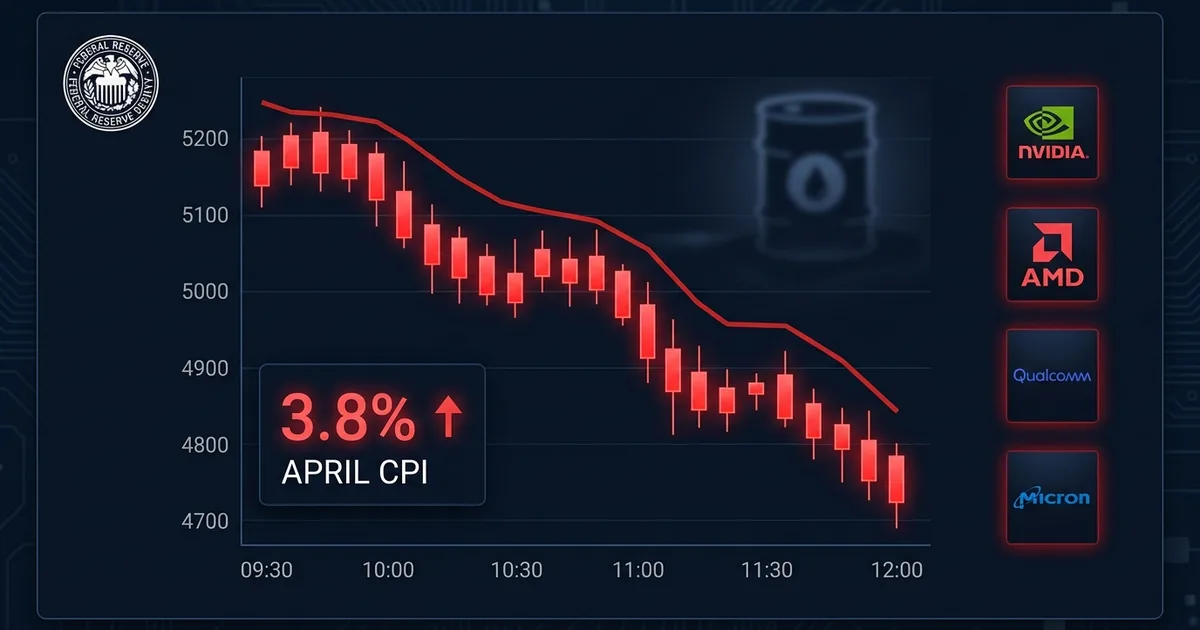
The inflation story Wall Street had spent three months trying to ignore landed Tuesday morning, and it was uglier than the bulls were positioned for. The Bureau of Labor Statistics reported that headline consumer prices rose 0.6% in April and 3.8% year over year, the hottest annual print since May 2023, with energy delivering more than 40% of the monthly gain. By the time the closing bell rang, the Nasdaq had given up 1.9%, the Russell 2000 was off 2.3%, and the PHLX Semiconductor Index posted its worst single session in roughly seven months. The Fed will not be cutting rates in June, and the only people who still thought it might were forced into the trade everyone else placed weeks ago.
The Print Was Bad Top To Bottom, Not Just Energy
The headline number is what runs in the wire stories, but the composition is what the FOMC actually reads. Core CPI, the measure that strips out food and energy and is the closest thing the Fed has to a true signal, came in at 0.4% month over month and 2.8% annually, the highest monthly core read since January 2025. That matters because the bull case for a cut in June rested on a story where energy was the one-time shock and the underlying disinflation trend stayed intact. Tuesday’s report ended that story.
Food added 0.5% on the month and 3.2% over the year. Gasoline jumped 5.4% in April and is now up 28.4% from a year ago, a number that translates into a roughly 10-cent-a-week climb at the pump for the average American household. CNBC’s breakdown of the report shows the energy index as a whole gained 3.8% for the month and 17.9% on the year, easily the biggest single contributor to the headline jump. Shelter, the lagging indicator that has been the FOMC’s favorite reason to keep waiting, is still elevated and still not falling fast enough to offset what is happening at the pump and on grocery shelves.
The April number is also half a percentage point higher than the March print of 3.3%, which we covered in our March CPI breakdown tying the inflation lift to the Iran war energy shock. The trajectory is not flattening, it is steepening, and every month of energy-driven prints is a month where shelter and services get less benefit of the doubt.
Brent At $107 Is The Macro Story Right Now
This was supposed to be a year where energy was the disinflationary tailwind. Instead, Brent crude pushed past $107 a barrel intraday Tuesday and WTI cleared $101, with the Strait of Hormuz remaining effectively closed to commercial traffic for the third consecutive week. Roughly 20% of the world’s seaborne oil moves through that chokepoint in a normal week. Almost none of it is moving now. Brent briefly touched $118 in April before easing, and the EIA’s own short-term outlook now models a second-quarter peak above $115.
The inflation read is the price the American consumer is paying for the Hormuz blockade in real time. Strip out the energy and food channels and you can argue core is sticky but contained. You cannot strip them out at the gas station. The Atlanta Fed’s nowcast has already shifted, and the Cleveland Fed’s inflation tracker is now signaling May could come in hotter still if Brent doesn’t ease.
The Chip Trade Got Repriced In A Single Session
Semiconductors were the cleanest place to express the “rate cuts coming, AI capex permanent” view that had been working for most of 2026. On Tuesday it stopped working. The PHLX Semiconductor Index fell roughly 5%, its worst session in seven months. Qualcomm dropped 12%, its worst day since 2020. Micron fell more than 10% after surging 37% the prior week and roughly 53% over the prior month. Advanced Micro Devices was off 6%. Nvidia, too big to fall as hard but too important to escape the macro, slid with the group.
The mechanics are not complicated. Chip stocks are long-duration cash flows priced off long-duration rates. When the market reprices Fed cuts further out, the discount rate on those cash flows rises, and the multiples compress fastest where they had stretched the most. Layer in the China export overhang and the Hormuz energy shock, and the entire AI-capex thesis runs into three independent headwinds at once. The chip sell-off is not a bet that AI is over. It is a bet that the cheap-money premium baked into the trade was excessive.
The Russell 2000 selling tells the same story from the other end. Small caps had ripped more than 10% in April on the assumption that cuts were close and a softer dollar was coming. Tuesday’s 2.3% drop is the same trade run in reverse: rates higher for longer, financing costs sticky, and refinance walls still in the way.
Fed June Hold Is Now A Lock
CME FedWatch is pricing roughly a 98% probability the FOMC holds at the June 16-17 meeting, Yahoo Finance reported in its live coverage of the print. As of Tuesday afternoon, futures were also pricing effectively zero rate cuts for the balance of 2026, a sharp reversal from the two-cut consensus that prevailed in March. The April dot plot already showed dissent from regional presidents who wanted to keep the option to hike open if energy shock fed through to wages. Tuesday’s print gave that camp the data they needed.
Chair Powell’s challenge is the one every central banker dreads. The supply-side shock from Iran is not something the federal funds rate can fix, but the wage-price feedback the shock can produce is exactly what monetary policy is designed to contain. The Fed will sit on its hands in June, restate the data-dependent line, and watch shelter and services. If those don’t roll over by July, the conversation in Washington starts shifting from “when do they cut” to “do they have to hike.”
What To Watch Next
The next CPI release on June 11 will land five days before the FOMC decision, a calendar that gives the Fed exactly the cover it wants. If May comes in hotter, the press conference becomes a hawk’s pulpit. If May moderates, Powell can talk about transitory energy effects and leave the September meeting live. Either way, the chip trade has to find a new story, and the broader market has to internalize a Fed that is not coming to the rescue.
The through-line from war risk to grocery aisle is now explicit in the data, and the equity market spent Tuesday acknowledging what the oil tape has been saying for two months. The bulls who got long semis on the rate-cut thesis are the ones holding the bag this week. Watch Brent. Everything else follows.