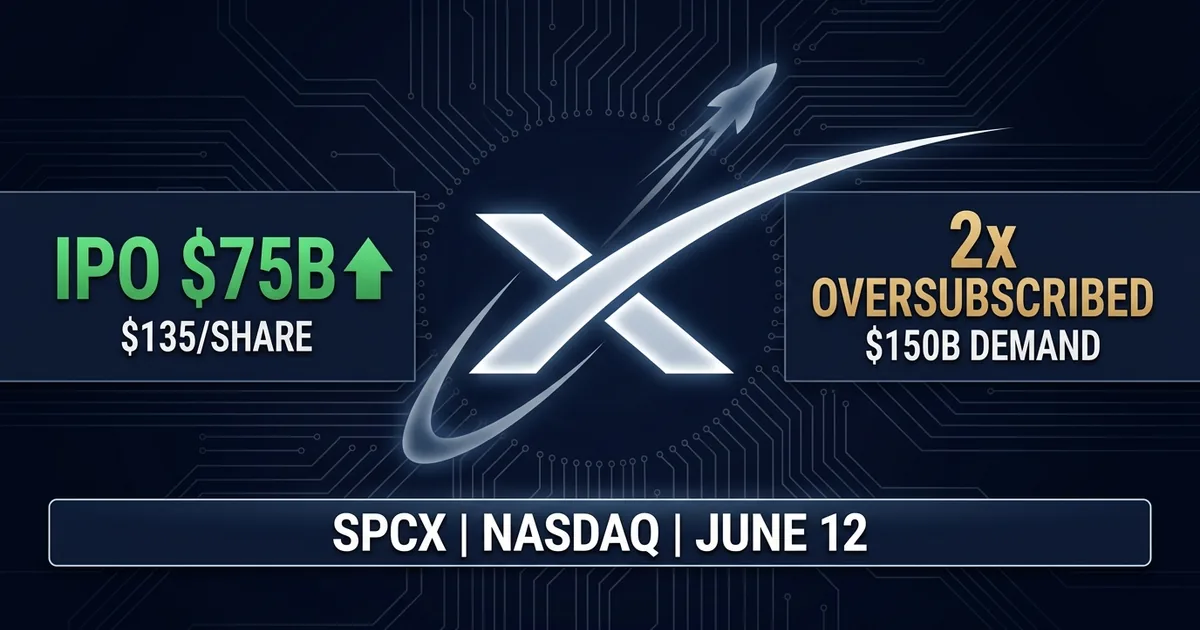
SpaceX’s roadshow launched on June 4, two days ahead of its originally reported timeline, and the demand numbers are already unprecedented. The $75 billion offering is roughly 2x oversubscribed, with approximately $150 billion in indicated interest from institutional investors before the first formal pricing meeting. That makes the SpaceX IPO not just the largest in history by offering size, but potentially the most oversubscribed mega-cap listing ever.
The Numbers
SpaceX is targeting a fixed price of $135 per share across 556.6 million shares, which would value the company at approximately $1.75 trillion at listing. Goldman Sachs is leading the syndicate, followed by Morgan Stanley, Bank of America, Citigroup, and JPMorgan Chase. CNBC reported that around 125 analysts from 21 participating banks are expected to meet SpaceX management during the roadshow, with pricing set for after market close on June 11 and the first trading day targeted for June 12 on Nasdaq under the ticker SPCX.
Elon Musk will retain over 82% voting control after the offering, a dual-class structure that gives him effective veto power over any shareholder resolution. That governance arrangement would typically suppress institutional demand. The fact that the offering is 2x oversubscribed anyway tells you everything about how the market views the underlying business.
The Retail Play
The most unusual feature of this IPO is the retail allocation. SpaceX allocated 25% to 30% of shares to individual investors, shattering convention for a mega-cap listing where institutional investors typically receive 90% or more. Fidelity dropped its access threshold to just $2,000 in a retail brokerage account, down from the $500,000 that traditionally gatekept IPO allocations. A dedicated investor event for approximately 1,500 retail participants is planned for June 11.
This is strategic, not philanthropic. SpaceX wants a broad retail shareholder base because retail investors tend to hold longer than institutional ones. They are also less likely to short the stock or demand governance changes. For a company controlled by a single individual who has historically clashed with public-market investors, that is a useful buffer.
Why the Market Cannot Get Enough
Three revenue streams justify the valuation. The launch business, anchored by Falcon 9 and the still-grounded Starship, generates recurring revenue from commercial satellite deployments, NASA contracts, and the Department of Defense. Starlink, the satellite internet constellation, has grown into a multi-billion-dollar recurring revenue business with expanding coverage and falling unit economics. And the AI angle, which SpaceX has been pitching more aggressively in recent months, positions the satellite network as critical infrastructure for edge computing and global connectivity.
The timing also matters. SpaceX is coming to market during a week when semiconductor stocks are selling off and Treasury yields are surging. In that environment, a hardware infrastructure company with government contracts, recurring subscription revenue, and no direct exposure to AI chip pricing cycles offers a kind of diversification that growth-stock investors are suddenly craving.
Risks the Prospectus Cannot Hide
The Starship program remains grounded after its last test flight, and the vehicle is central to SpaceX’s long-term Mars ambitions and its next-generation Starlink deployment plans. Regulatory uncertainty around launch licensing, orbital debris, and spectrum allocation adds complexity. And Musk’s 82% voting control means minority shareholders have no practical ability to influence corporate strategy, executive compensation, or capital allocation.
The original BTN coverage of SpaceX’s IPO filing noted that the $1.75 trillion valuation prices in substantial future growth. With the roadshow now running and demand at double the offering, the market is telling SpaceX that the future growth is underpriced. Whether that confidence survives the first earnings report as a public company is a different question entirely.
What Happens Next
Pricing on June 11. First trade on June 12. With $150 billion chasing $75 billion in shares, the allocation process will be the real story. How much retail actually gets filled, whether institutions get scaled back, and what the opening-day pop looks like will set the tone not just for SpaceX but for the broader IPO market in the second half of 2026. Anthropic’s S-1 is sitting at the SEC. Stripe’s potential listing is back in play. If SpaceX prices well and trades up, the window is wide open.