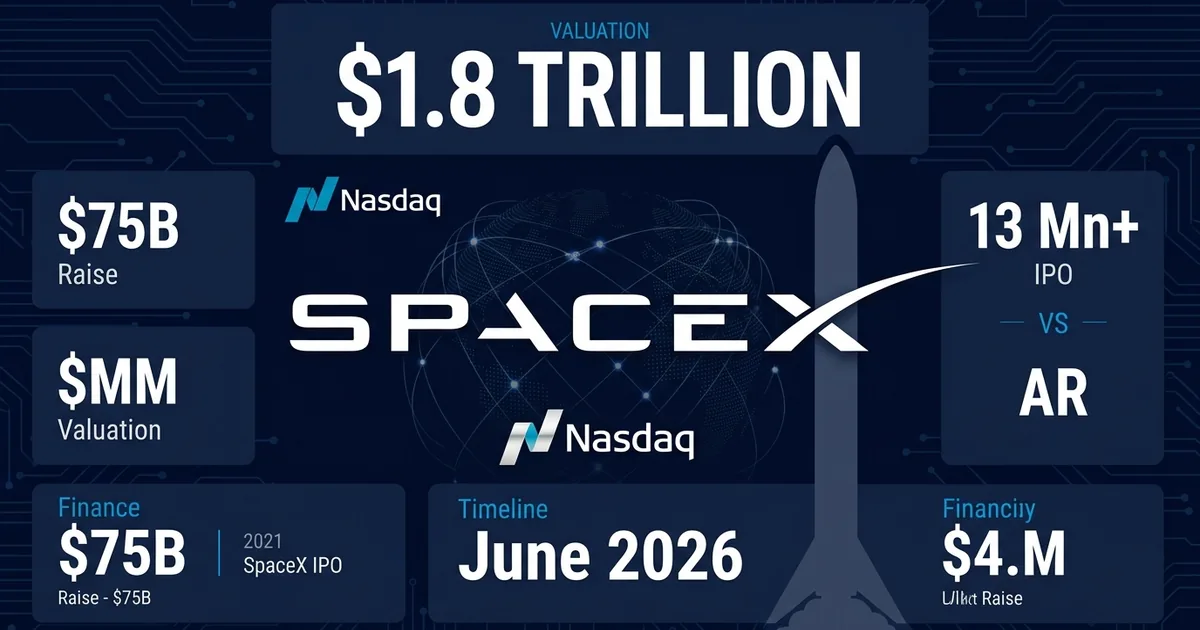
SpaceX has quietly cut its IPO valuation target to at least $1.8 trillion, down from an earlier goal north of $2 trillion, as the company and its advisers recalibrate expectations ahead of what could be the largest public offering in history. The Nasdaq listing is targeted for as early as June 12, and the company is looking to raise up to $75 billion in the process.
The Valuation Adjustment
Bloomberg reported on May 29 that SpaceX lowered its IPO valuation target after consultations with advisers and investors indicated that the $2 trillion-plus figure was too aggressive for the current market environment. The revised floor of $1.8 trillion still represents an extraordinary premium for a company with projected 2025 revenues of $18.7 billion, implying a price-to-sales multiple of roughly 96x at the low end.
For context, BTN covered the initial $1.75 trillion valuation target and the xAI cash burn concerns in late May. The upward revision to $2 trillion and subsequent pullback to $1.8 trillion suggest SpaceX tested investor appetite and found the ceiling.
The adjustment is pragmatic, not panicked. Al Jazeera reported that the valuation could still be revised upward during the roadshow phase depending on institutional demand signals. SpaceX CEO Elon Musk and the company’s bankers are leaving room to price into strength rather than risk a first-day flop at a higher target.
Why This IPO Is Unprecedented
At $1.8 trillion, SpaceX would debut as one of the ten most valuable companies in the world, surpassing the market capitalizations of Berkshire Hathaway and Eli Lilly at their current levels. The $75 billion raise would dwarf the previous record for a traditional IPO, Saudi Aramco’s $29.4 billion offering in 2019.
The business itself spans three distinct revenue engines. Starlink, the satellite internet division, now serves more than 4 million subscribers across 100 countries and generates the majority of SpaceX’s revenue. The launch services division remains the world’s most active orbital launch provider. And the Starship program, while still in development, represents the long-term bet on interplanetary infrastructure and heavy-lift commercial payloads.
The Starlink Moat
Starlink is the revenue story that makes the valuation conversation possible. The satellite internet business has achieved profitability ahead of internal projections, and the addressable market continues to expand. American Airlines announced on May 26 that it would install Starlink on more than 500 aircraft, joining United Airlines and Southwest in what has become a rapid sweep of the commercial aviation market, as The Motley Fool detailed.
The aviation contracts are strategically important beyond their direct revenue contribution. They lock in long-term recurring revenue at scale, demonstrate enterprise-grade reliability, and create switching costs that strengthen the competitive position against Amazon’s Project Kuiper and other emerging satellite internet providers.
What the Roadshow Needs to Answer
The valuation adjustment signals that SpaceX’s advisers are taking the roadshow seriously. Institutional investors will want clarity on several open questions: how the company plans to manage the capital allocation tension between Starlink’s cash generation and Starship’s cash consumption, whether Musk’s involvement with xAI and Tesla creates governance risk, and what the path looks like for Starlink to sustain growth as the easy-to-reach markets saturate.
The $1.8 trillion floor also needs to be defended against the broader market backdrop. The Nasdaq has posted nine consecutive weeks of gains, and a June 12 debut would land in the middle of what has been one of the strongest IPO windows since 2021. If the market holds, SpaceX could price into momentum. If it does not, even $1.8 trillion might prove ambitious.
The Musk Factor
No SpaceX IPO discussion is complete without addressing the governance question. Musk’s simultaneous roles as CEO of SpaceX, CEO of Tesla, owner of X, and chairman of xAI create a concentration of responsibilities that institutional investors will scrutinize. The xAI relationship is particularly sensitive: SpaceX has provided infrastructure and resources to xAI, and the boundaries between the two companies have drawn regulatory attention.
Musk’s political profile adds another layer of complexity. His role as a government adviser and his public positioning on policy issues create headline risk that could affect SpaceX’s stock price independently of its operational performance. Public company shareholders tend to be less tolerant of CEO controversy than private investors, and the governance structure SpaceX adopts for its public listing will signal how seriously the company takes that concern.
The stakes are straightforward. SpaceX is about to test whether the public markets can absorb the largest IPO in history at a valuation that prices in a future most of its competitors have not yet built. The $1.8 trillion floor says the company is confident. The adjustment from $2 trillion says it is also realistic.