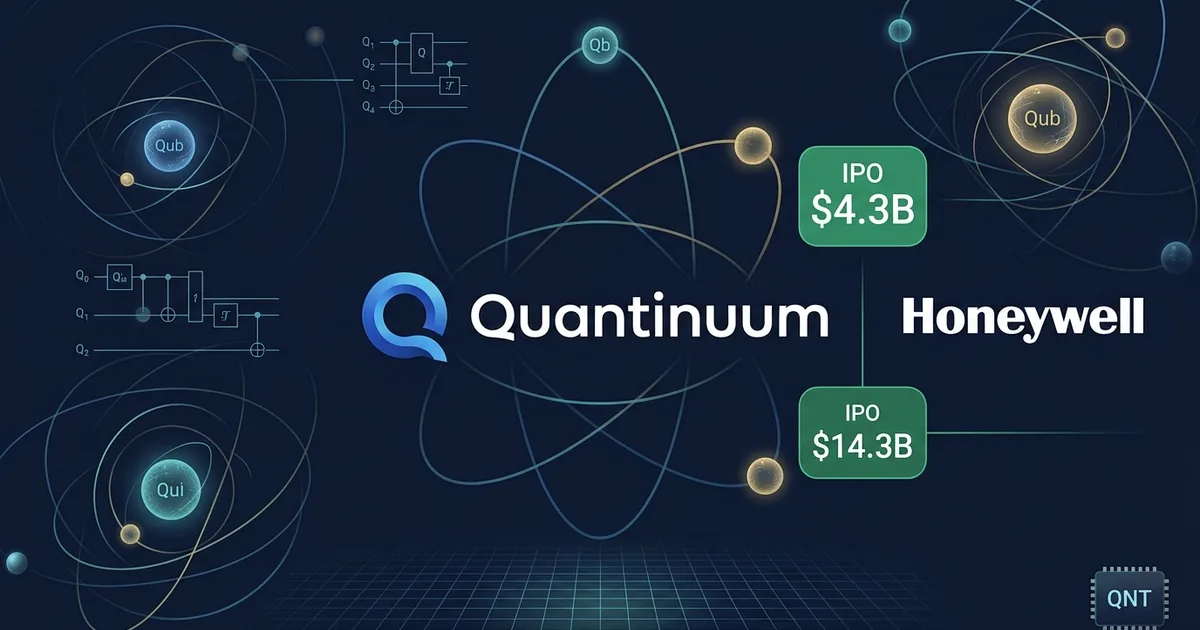
Quantinuum, Honeywell’s quantum computing spinoff, raised both its share count and its price range after massive oversubscription, targeting a $14.3 billion valuation and a $1.46 billion raise ahead of its expected Nasdaq debut under the ticker QNT. It is the biggest pure-play quantum computing IPO ever attempted, and the valuation implies the market is willing to pay 462 times last year’s revenue for a bet on a technology that still has more promise than production workloads.
The Numbers Behind the Upsized Offering
Quantinuum plans to offer 26.5 million shares at $53 to $55 each, up from an earlier range that would have raised roughly $1 billion. The upsizing reflects demand that far exceeded initial expectations, with institutional investors competing for allocation in what has become the hottest quantum computing deal in the sector’s short public-market history.
At the top of the range, Quantinuum would carry a market capitalization of approximately $14.3 billion, making it the second-most valuable publicly traded quantum company behind IonQ, which currently trades at a market cap of roughly $27 billion.
Revenue Versus Valuation
Here is where the math gets interesting. Quantinuum reported $30.9 million in revenue for 2025, $79.3 million in bookings, and a net loss of $192.6 million. At a $14.3 billion valuation, investors are pricing the company at roughly 462 times its last annual revenue. By any traditional metric, that multiple is absurd. By the standards of frontier technology bets, it is the price of admission.
The bull case rests on Quantinuum’s technology: the company operates what it claims are the world’s highest-fidelity quantum processors, based on trapped-ion architecture. Its H2 system has achieved quantum volume scores that exceed those of competitors by orders of magnitude, and the company has commercial partnerships with JPMorgan Chase, Airbus, and several government agencies for quantum chemistry and optimization research.
The Government Backstop
The federal government recently announced more than $2 billion in funding for nine quantum computing firms, with Quantinuum set to receive $100 million in exchange for an equity stake. That government investment provides both capital and a credibility signal: Washington is betting real money that quantum computing will be strategically important, and it wants American companies leading the race.
For Quantinuum specifically, the $100 million government stake de-risks the IPO by providing a committed anchor investor with a multi-decade time horizon, the kind of patient capital that a pre-revenue technology company needs to survive the gap between laboratory breakthroughs and commercial scale.
Where Quantinuum Fits in the Quantum Landscape
The quantum computing sector has followed a pattern familiar from the early days of AI: heavy investment, limited commercial revenue, and valuations driven almost entirely by the expected size of the addressable market a decade from now. IonQ, the current public-market leader, has a similar revenue profile and has seen its stock swing wildly on sentiment rather than fundamentals.
What differentiates Quantinuum is the Honeywell parentage. Honeywell retains a majority stake and brings manufacturing precision, supply-chain expertise, and enterprise sales relationships that pure-play startups cannot match. If quantum computing follows the trajectory of classical computing, the companies with the best hardware engineering and the deepest enterprise customer relationships tend to win. Honeywell spent decades building both.
The IPO also lands in a market that has rewarded frontier technology bets generously. The S&P 500 just set new records, AI chipmakers are surging, and the Cerebras IPO earlier this year demonstrated that investors have appetite for high-multiple hardware plays when the narrative is compelling enough.
What to Watch
The QNT debut will test whether the market’s appetite for quantum extends beyond IonQ and a handful of SPACs. At 462 times revenue, there is no margin for execution error. If Quantinuum’s bookings-to-revenue conversion accelerates and its government contracts expand, the valuation starts to look more like foresight than froth. If the technology timeline slips or enterprise pilots stall, it becomes another cautionary tale about pricing dreams at industrial scale.
For now, the order book says the market wants in. The question is whether the physics can keep up with the price tag.