The private equity selloff that Wall Street has been quietly bracing for just got its first real catalyst, and it came from Zurich, not New York.
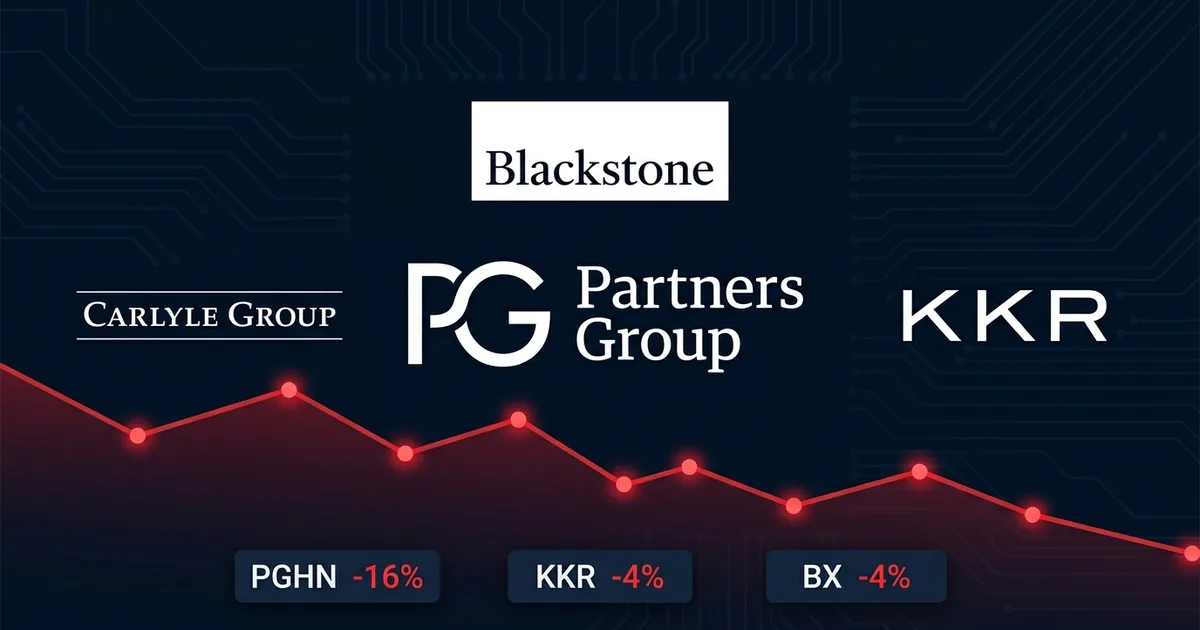
Partners Group, the Swiss alternative-asset manager overseeing $170 billion, moved this week to cap investor redemptions in its $8.6 billion Global Value SICAV fund at 5% of net asset value after withdrawal requests surged to 9.8%. The decision sent shockwaves through public markets: Partners Group shares plunged more than 16% to a 52-week low, and the contagion spread fast across the sector.
The Fallout Hit Every Major Name
Carlyle Group dropped more than 5%. KKR shed 4%. Blackstone and Ares Management each slipped around 4%, while Blue Owl Capital fell more than 3%. In a single session, the listed private equity complex lost roughly $50 billion in market capitalization, according to CNBC’s tracking of the selloff.
The trigger was specific, but the anxiety is structural. Partners Group CEO David Layton tried to frame the 5% cap as a feature, not a bug: “This feature of capping redemption requests at 5% of the fund is a key attribute of this fund.” That is technically true. Evergreen fund structures have always included gating provisions. But when the gate actually slams shut, the theoretical becomes visceral. Investors who thought they had liquidity just discovered they do not.
Why This Matters Beyond One Fund
The deeper issue is what Partners Group acknowledged next: volatility that initially emerged in private credit vehicles has now begun affecting private equity investments. That is the crossover event the industry has been quietly dreading.
For years, alternative-asset managers have been selling “democratized” access to private markets through semi-liquid vehicles aimed at individual investors. The pitch was compelling: institutional-grade returns without the traditional 7-to-10-year lockup. But those structures depend on a steady flow of new capital and low redemption pressure. When both conditions break, the math unravels.
Individual investors accounted for most of the withdrawal pressure in Partners Group’s fund, despite institutional clients representing roughly 80% of the firm’s overall investor base. That pattern reveals the structural fragility: retail money is the first to flee, and in semi-liquid vehicles, retail flight forces asset sales or gating that punishes everyone.
The Liquidity Illusion Under Stress
The broader private equity industry has roughly $4 trillion in assets under management globally, and a growing share sits in these semi-liquid retail-accessible structures. Blackstone’s BREIT, the most famous example, went through its own redemption crisis in late 2022, and the sector thought it had learned its lesson. Apparently not.
What makes this moment different is the macro backdrop. Interest rates remain elevated. The IPO window, while reopening for marquee names, has not cleared the backlog of portfolio companies waiting to exit. And the denominator effect that plagued endowments in 2022 is creeping back as public equity valuations hit new highs, making illiquid private holdings look disproportionately large on balance sheets.
Alphabet’s $84.75 billion equity raise this week underscores the dynamic: the biggest capital formation events are happening in public markets right now, and private equity’s fundraising moat looks thinner by the quarter.
The Valuation Premium Problem
Before the selloff, the listed alternative-asset managers were trading at some of the richest multiples in the sector’s public history. KKR’s market cap had roughly quadrupled from its 2020 lows. Blackstone was valued at more than 20 times forward earnings. Those premiums were priced on two assumptions: that fundraising would keep accelerating, and that management fees would remain sticky through any cycle.
Partners Group’s gating calls both assumptions into question. If retail redemptions force managers to slow or cap inflows, the compounding flywheel that drove the stocks stalls. And if gating events become more common, the retail distribution channel that was supposed to be the industry’s next growth frontier becomes a liability instead.
The timing is especially painful because the sector was leaning hard into retail expansion. In 2025 alone, Blackstone, KKR, and Apollo collectively launched more than a dozen new semi-liquid products targeting high-net-worth and mass-affluent investors, according to industry filings. That distribution push is now facing its first demand-side shock.
What Comes Next
The question is whether Partners Group’s gating is an isolated event or the first of several. If other semi-liquid vehicles face similar redemption pressure, the listed PE complex could see sustained selling. Partners Group itself warned that the volatility which started in private credit has spread to private equity, suggesting the risk is not confined to one fund or one firm.
Credit markets are watching closely. Private credit funds, which grew to roughly $1.7 trillion globally by the end of 2025, face similar liquidity mismatches. Several large private credit vehicles have already seen elevated redemption requests this year, though none have publicly gated yet.
For anyone watching the private capital stack, the signal is clear: the golden era of private equity’s retail expansion just hit its first real stress test. The fund structures worked beautifully when markets only went up. Now we get to see what happens when they do not.