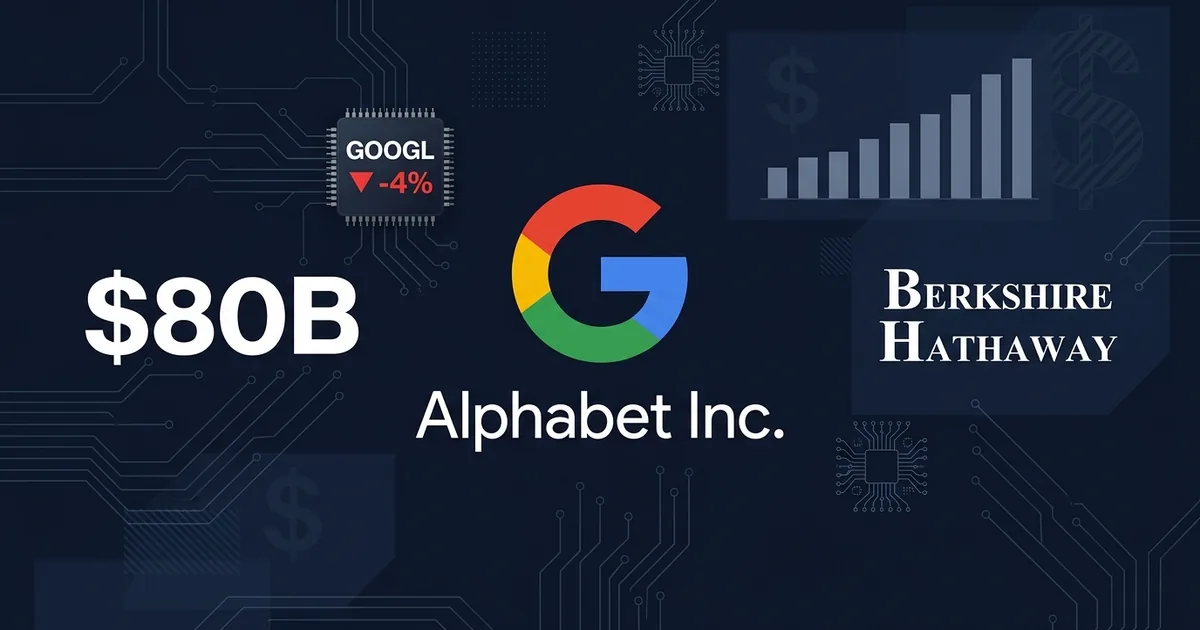
Alphabet just announced the largest equity capital markets transaction in history: an $80 billion fundraise designed to bankroll an AI infrastructure buildout that will cost the company up to $190 billion in capital expenditures this year alone. Investors responded by wiping more than $100 billion off the company’s market cap in a single session, a sharp reminder that even Google’s parent is not immune to dilution anxiety when the check gets big enough.
The Structure of an $80 Billion Deal
The offering breaks down into three components. A $30 billion underwritten block combines new shares with mandatory convertible preferred stock. A $40 billion at-the-market program will feed shares directly into the secondary market starting in Q3 2026, creating a slow but steady stream of supply that could weigh on the stock for quarters. And a $10 billion private placement goes to Berkshire Hathaway, giving Warren Buffett’s conglomerate its first significant position in Alphabet and lending the deal a credibility anchor that no underwriter alone can provide.
CNBC reported that Alphabet plans to use the proceeds exclusively for AI compute infrastructure, including data centers, custom TPU chips, and networking hardware needed to support Gemini and its cloud AI services.
Why the Market Sold Off
Alphabet shares fell roughly 4% on June 2, erasing more than $100 billion in market capitalization. The selloff was not about doubt in AI’s long-term value. It was about the math of dilution.
The $40 billion at-the-market program is the piece that spooked investors most. Unlike a one-time block trade, an ATM program drips shares into the market over months, creating persistent selling pressure with no defined end date. For a company that has been buying back stock aggressively, the pivot to net issuance is a philosophical reversal that investors are pricing in real time.
The $80 billion total would surpass Petrobras’s roughly $70 billion offering in 2010 as the largest equity capital markets deal ever, a record nobody expected a technology company to break.
The Capital Expenditure Arms Race
Alphabet projected 2026 capital expenditures of $180 billion to $190 billion, nearly double 2025 levels, with further increases expected in 2027. Those numbers place Alphabet in the same capex tier as national infrastructure programs. It is building an AI compute layer at a scale that rivals the buildout of entire power grids.
The question investors are asking is straightforward: does the return on this investment justify the cost? Google Cloud is growing, Gemini is gaining traction, and the company’s AI search integration is driving engagement. But $190 billion in a single year requires conviction that AI monetization will scale at a pace the market has never seen in enterprise software, cloud computing, or advertising.
For context, Alphabet expanded its AI ambitions at Google I/O 2026 just weeks ago, where CEO Sundar Pichai outlined the Gemini 3.1 family and a vision for AI-native computing. The $80 billion raise is the financing layer beneath that product roadmap.
The Berkshire Signal
The $10 billion Berkshire Hathaway placement is the most strategically interesting piece of the deal. Buffett has historically avoided large technology positions, and his willingness to take a direct equity stake in Alphabet at this scale sends a signal that transcends the AI narrative: it says the valuation, post-dilution, still represents value at current prices.
For Alphabet, having Berkshire on the cap table also provides a stabilizing influence during the ATM program. Institutional investors are less likely to panic-sell alongside Warren Buffett.
What This Means for the AI Capex Cycle
Alphabet’s $80 billion raise is the clearest signal yet that the AI infrastructure buildout is entering a new phase. The companies building AI are no longer funding expansion from operating cash flow alone. They are tapping public markets for capital at scales that would have been unthinkable two years ago.
SoftBank committed up to 75 billion euros for French data centers last week. Anthropic filed confidential IPO paperwork. The capital requirements of the AI industry are now so large that they are reshaping the structure of capital markets themselves.
The risk is that this becomes a capex bubble where the buildout outruns demand. The opportunity is that whoever builds the most compute capacity first wins the platform war. Alphabet is betting $80 billion that it would rather be wrong about timing than wrong about being in the race.