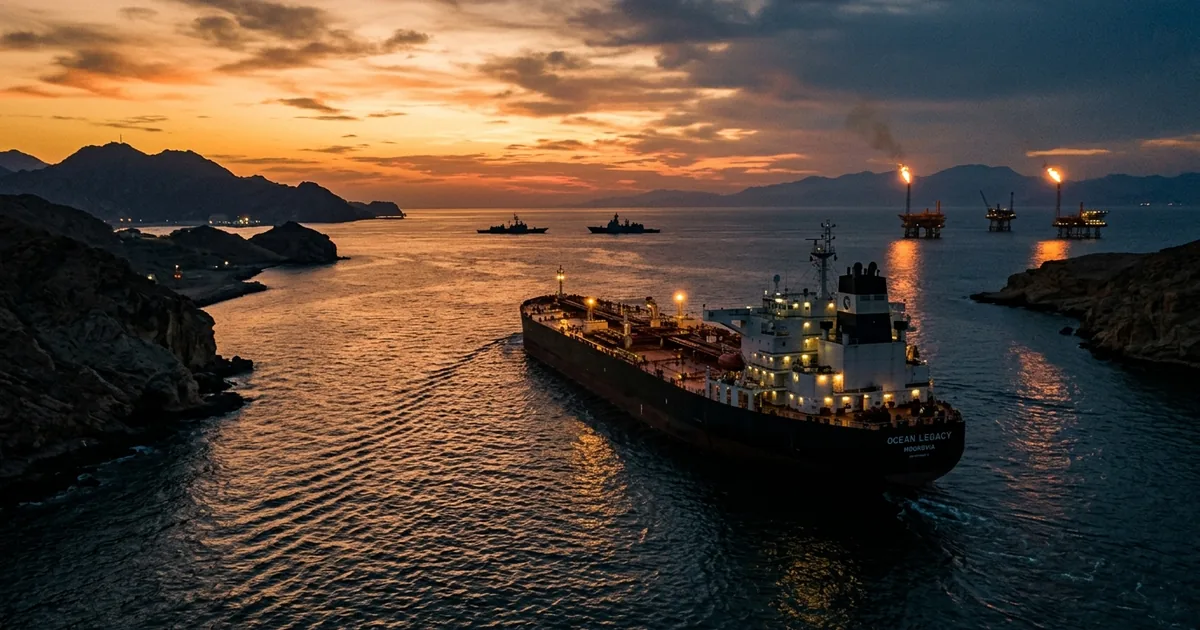
The fragile calm in the Strait of Hormuz lasted about two weeks. Brent crude rose roughly 0.9% to $72.51 per barrel on Monday after US Central Command confirmed strikes on Iranian targets over the weekend, and Iran responded with missiles and drones aimed at American bases in Bahrain and Kuwait.
For a market that had been cautiously trading the thesis that diplomacy would hold, the weekend was a sharp reminder that nothing about this crisis has a floor.
What Happened Over the Weekend
US forces struck Iranian positions on Friday and Saturday after Iran attacked two commercial vessels transiting the Strait of Hormuz, according to Al Jazeera’s reporting. The exchange of fire revived a pattern that has defined the 2026 Hormuz crisis since it erupted in May: temporary pauses followed by escalation, each one testing the threshold for disrupting roughly 20% of global oil supply.
The structural problem is straightforward. Neither side controls the escalation cycle. Washington insists on freedom of navigation through the strait, while Tehran treats the waterway as a pressure lever tied to its broader nuclear and sanctions posture. Every “ceasefire” since the crisis began has been a tactical pause, not a strategic agreement, and the weekend’s tit-for-tat underscores why the market prices these pauses with deep skepticism.
Iranian doctrine treats commercial shipping interdiction as an asymmetric tool: cheap to deploy, expensive for the US to prevent, and capable of generating global economic pressure that exceeds Iran’s conventional military weight. That calculus has not changed in any of the negotiating rounds so far.
Markets React With Cautious Relief
The immediate market response was counterintuitive. US stock futures climbed Monday morning, with Dow futures up 205 points (0.39%), S&P 500 futures gaining 0.74%, and the technology-heavy Nasdaq-100 advancing 1.08%. The reason: Washington and Tehran agreed to halt attacks and resume peace negotiations in Doha on Tuesday.
WTI crude settled at $69.94 per barrel, and both benchmarks remain well below the March 2026 spike above $120 that followed the initial closure of the strait. Traders have learned to price the conflict as a series of disruptions rather than a permanent blockade, building in a geopolitical risk premium that rises with each breakdown but has not returned to the panic levels of three months ago.
That calculus holds only as long as each breakdown stays contained. If a commercial tanker is sunk, not just damaged, the insurance market alone could force a rerouting of traffic around the Cape of Good Hope that adds two weeks and roughly $1 million per voyage to every shipment.
The Doha Talks Are the Real Variable
The Tuesday resumption of talks in Qatar carries more weight for oil markets than the weekend strikes themselves. Previous rounds of negotiation have produced frameworks that collapsed within days, often over Iran’s insistence that sanctions relief precede any maritime de-escalation.
If Doha delivers even a provisional commitment to reopen the strait to commercial traffic with international monitoring, Brent could ease toward the low $60s. If talks break down again, the March playbook, rapid escalation, tanker rerouting, and a supply squeeze, comes back immediately.
The broader supply context matters. OPEC+ has held production steady through the crisis, reluctant to add barrels while demand forecasts stay uncertain and the group’s own unity is under strain from members pushing for quota relief. Saudi Arabia and the UAE hold roughly 3 to 4 million barrels per day in spare capacity, but releasing it sends a signal that the kingdom is subsidizing a geopolitical crisis it did not create. Riyadh has shown no appetite for that role.
That means any supply disruption from the strait has no built-in offset. The $69 to $73 range is the market’s bet that diplomacy holds. The March $120 spike is what happens when it does not.
A Compressed Week With Heavy Data
This is not just an oil story. Markets face a shortened trading week with the Fourth of July holiday closing exchanges on Friday. The June nonfarm payrolls report lands Thursday, moved up a day from its usual Friday release slot. Consensus expectations point to a more modest gain after May’s 172,000 print, and a miss in either direction will interact with oil volatility in ways that complicate the Fed’s already difficult rate calculus.
The Fed has held rates steady while inflation, driven partly by energy costs linked to this very crisis, remains above target at 4.2% as of May. A strong jobs number could push rate-hike expectations higher just as oil markets are absorbing fresh geopolitical risk. A weak number could ease pressure on the long end of the curve but raise recession fears that weigh on crude demand.
For energy traders and the broader equity market, the next 72 hours compress an unusual amount of risk into a short window: Doha on Tuesday, payrolls on Thursday, and a market closed for the holiday on Friday. The Hormuz crisis has been priced as manageable. The weekend was a reminder that “manageable” can change over a single Saturday.