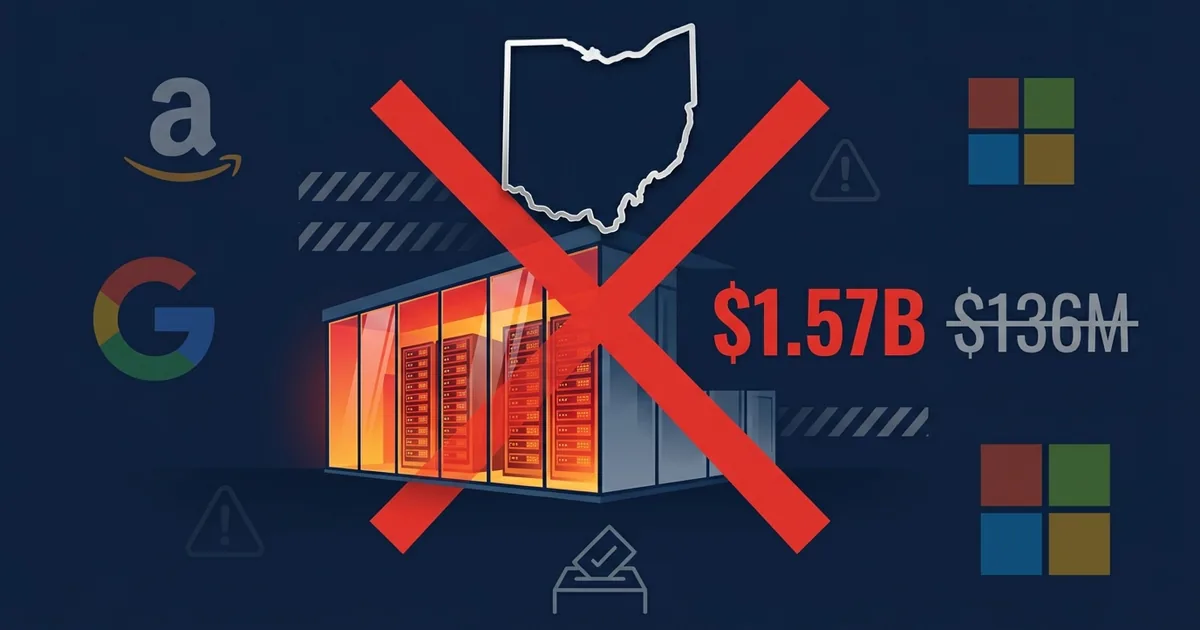
Ohio Governor Mike DeWine ordered the state’s Tax Credit Authority to stop accepting new data center tax exemption applications on June 1, after the cost of the program exploded from a projected $136 million to $1.57 billion in a single fiscal year. The suspension is the first significant state-level pushback against the AI infrastructure boom, and a citizen-led ballot initiative could go further: a permanent ban on hyperscale data center construction, which would make Ohio the first state to let voters kill the buildout directly.
How a $136 Million Program Became a $1.57 Billion Problem
The data center sales tax exemption was designed to attract investment by waiving up to 100% of Ohio’s 5.75% sales tax on construction materials for facilities costing $100 million or more, for up to 15 years. The original fiscal projections estimated the exemption would cost the state $136 million in fiscal 2025.
The actual cost came in at $1.57 billion, more than 11 times the estimate. The explosion was driven by the sheer scale of AI data center construction pouring into the state. Amazon, Google, Microsoft, and Meta have all announced or expanded Ohio facilities, drawn by cheap land, available power, and the very incentive that is now being paused.
Governor DeWine’s order does not cancel existing exemptions. Projects already approved retain their tax breaks. But no new applications will be processed while the state legislature’s Joint Data Center Committee studies the program’s growth and fiscal impact.
The Ballot Initiative That Could Go Further
The suspension may be the moderate outcome. A citizen-led initiative is gathering signatures to place a permanent ban on hyperscale data center construction on the November ballot. Organizers face a July 1 deadline and need more than 400,000 signatures to qualify. If the measure makes the ballot and passes, Ohio would become the first state to impose a voter-mandated moratorium on large-scale data center development.
The initiative reflects growing frustration in communities where data centers consume enormous amounts of electricity and water while creating relatively few permanent jobs. A single hyperscale facility can draw as much power as a small city but employ fewer than 50 full-time workers once construction is complete.
Why This Matters for the AI Infrastructure Buildout
The Ohio situation is not unique in substance, but it is unique in severity. Virginia, Texas, and Georgia have all seen local resistance to data center expansion, but none have reached the point of a statewide tax incentive suspension, let alone a voter initiative to ban construction outright.
For the hyperscalers, the implications are immediate. Ohio’s cheap power and central location made it one of the most attractive sites for new AI data center capacity. If the tax exemption stays paused or the ballot initiative succeeds, hundreds of millions in planned investment will shift to other states, exactly the outcome Ohio’s incentive was designed to prevent.
The broader pattern is a familiar one in infrastructure politics: communities welcome the investment until they see the cost. Data centers promised economic development and tax revenue. What many Ohio communities got instead was higher electricity prices, strained water resources, and a tax exemption so generous it cost the state more than 11 times what anyone projected.
For context, the push for clean energy to power AI infrastructure is intensifying precisely because of conflicts like Ohio’s, where the gap between the energy demands of hyperscale computing and the capacity of local grids creates political backlash that threatens the entire buildout timeline.
What Comes Next
The Joint Data Center Committee is expected to deliver recommendations by fall. The most likely outcomes are a reformed incentive with caps, clawback provisions, and local impact requirements, or a more restrictive framework that limits exemptions to facilities meeting specific job-creation or community-benefit thresholds.
The ballot initiative is the wild card. If 400,000 Ohioans sign by July 1 and the measure reaches the November ballot, every hyperscaler with Ohio expansion plans will be watching the results. A ban would not just affect Ohio. It would signal that the political tolerance for AI infrastructure has a ceiling, and that ceiling is lower than the industry assumed.
The AI buildout needs power, land, water, and political consent. Ohio just proved that the last one is not guaranteed.