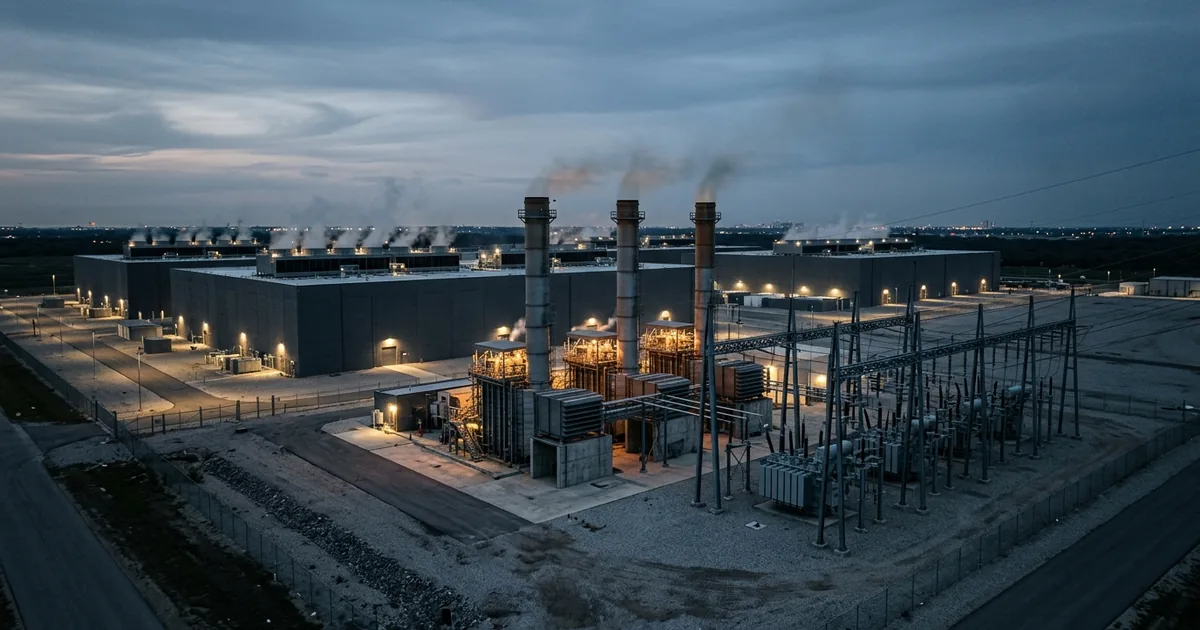
Microsoft is quietly walking the most ambitious corporate climate pledge in technology back from the cliff. Per a Bloomberg report this week, the company is weighing whether to delay or abandon its 2030 “100/100/0” goal of matching every hour of its electricity use with zero-carbon energy on the same grid. The math behind the rethink is brutal and increasingly unhideable. Microsoft is adding roughly one gigawatt of data center capacity every three months, enough power to run 750,000 homes, and the AI-driven demand curve is steepening, not flattening. The pledge that defined Big Tech climate leadership in 2020 may not survive 2026.
The Pledge That Was Always Going To Get Tested
When Brad Smith stood up in 2020 and committed Microsoft to 100/100/0, the framing was deliberate. One hundred percent of electricity used, matched one hundred percent of the time, by zero-carbon sources connected to the same grid. It was tighter than Google’s 24/7 carbon-free energy goal, and it was meant to set a new floor for what corporate climate accountability looked like. Inside Microsoft, the pledge was treated as a forcing function: hit the metric and the company would have built a new template for hyperscaler operations.
The premise depended on a forecast that no longer exists. The 2020 plan assumed AI workloads would scale, but inside a power consumption envelope similar to the cloud cycle that came before it. Generative AI training and inference broke that envelope inside two years. Hyperscaler power demand is now compounding faster than zero-carbon supply can be permitted, built, and interconnected. The math that worked on a 2020 trajectory does not work on a 2026 one, and Microsoft is the first of the four hyperscalers willing to acknowledge that publicly.
Three Mile Island Was Already The Tell
The early signal that Microsoft was hedging arrived two years ago. The September 2024 Constellation Energy deal to restart the Three Mile Island Unit 1 reactor, rebranded as the Crane Clean Energy Center, was an obvious tell. Buying the entire 835 megawatt output of a recommissioned nuclear plant is not the move of a company comfortable with its zero-carbon pipeline. It is the move of a company quietly acknowledging that wind, solar, and grid storage cannot scale fast enough for what its AI roadmap now requires.
The Three Mile Island deal was followed by other signals that did not get the same coverage. Long-term natural gas contracts in Texas and Wyoming, on-site generation projects rated for combustion turbines as primary load rather than backup, and direct lobbying support for grid interconnection reform that explicitly contemplates faster-permit gas-fired capacity. Each of those moves was defensible on its own. Stack them together and the trajectory is clear: Microsoft has been quietly building a power portfolio that can carry the AI buildout, and that portfolio is no longer purely zero-carbon.
The Buildout Is Bigger Than The Grid Can Carry
The scale of what Microsoft is doing physically is the part most consumers and many investors still underestimate. One gigawatt of new capacity every quarter is roughly the output of a large nuclear reactor, and Microsoft is now stringing them together at hyperscale data center campuses across the United States, Ireland, the Nordics, and Asia. The interconnection queues at every major US grid operator are clogged with multi-year backlogs precisely because hyperscalers are submitting load applications at a pace transmission planners did not model. PJM, ERCOT, and MISO have each acknowledged that data center demand is the single largest driver of their forward capacity needs through 2030.
The constraint is not money. Microsoft has the capex envelope to commit hundreds of billions. The constraint is that you cannot pour electricity at the rate AI training requires from a grid built for a different demand curve. We covered the industrial side of this when Caterpillar’s record Q1 print showed how on-site gas turbines have moved from backup to primary load source for hyperscaler campuses. That shift is not climate friendly. It is what is happening at the worksite.
What Folding On 2030 Actually Means
A delay or abandonment of 100/100/0 is not the same as walking away from climate goals. Microsoft will almost certainly retain a longer-dated net zero commitment and continue funding the largest corporate renewable purchase agreement portfolio on the planet. What the rethink concedes is the time-of-day, same-grid matching standard. The looser version most likely to replace it will count annual zero-carbon procurement against annual consumption, with offsets filling the rest.
That is a meaningful step backward. Hourly matching was what made 100/100/0 harder than its peers. Without it, Microsoft’s climate accounting collapses back into the same averages the rest of corporate America already uses, removing one of the few corporate disclosures that could not be smoothed over with renewable energy credits.
Will Amazon, Meta, And Google Hold The Line
The harder question is whether the rest of the hyperscaler bench can hold their own pledges if Microsoft moves first. Amazon’s commitment to 100 percent renewable electricity by 2025 was already loosely interpreted, with annual matching rather than hourly. Google’s 24/7 carbon-free energy goal is structurally similar to Microsoft’s, and Google is roughly the same magnitude of AI capex committer. Meta is funding multi-billion-dollar geothermal and small modular reactor projects precisely because it has the same arithmetic problem.
If Microsoft formally publicly relaxes its 2030 pledge, the public pressure on the others to follow will be substantial in two directions at once. Climate advocates will demand they hold the line. Boards and CFOs will quietly note that the pledge has just become competitively expensive to keep. The middle path most likely to emerge is a synchronized softening, with each hyperscaler issuing its own revised standard inside a six to nine month window. The optics will be ugly. The economics will be unanimous.
The Investor Read
For Microsoft shareholders, the climate rethink is rationally a positive on the spending side. A relaxation of hourly matching constraints lets Microsoft buy the cheapest available reliable power for its AI campuses without paying the premium that strict 24/7 matching imposes. That is incremental margin protection at a moment when AI capex is already pressuring free cash flow. According to Bloomberg’s coverage of the recent megacap earnings stretch, hyperscalers committed more than $130 billion in AI capital expenditures in Q1 alone, and the market is rewarding companies that can convert that spend into revenue rather than into deeper unfunded commitments.
For climate-aligned investors and pension funds with stewardship obligations, the calculus is harder. A formal walkback would force a wave of engagement letters, ESG rating reviews, and possibly index reweightings. The risk is reputational, but reputational risk does not move stock prices when the underlying business is compounding into the largest infrastructure cycle in technology history.
The Question That Matters Most
The interesting framing is not whether Microsoft folds on 2030. That now looks like a question of timing, not direction. The interesting framing is what replaces the pledge. If the new standard is honest, time-bounded, and includes credible firm-power decarbonization milestones, the climate community can keep working with the company. If the new standard is vague annual matching with offsets, then the 2020 era of corporate climate leadership is officially over, and the technology industry’s defining environmental commitment has been written off as a casualty of the AI boom. We will know which version Microsoft picks within the next few quarters. Per Microsoft’s own sustainability disclosures, the next reporting cycle is the place to watch.