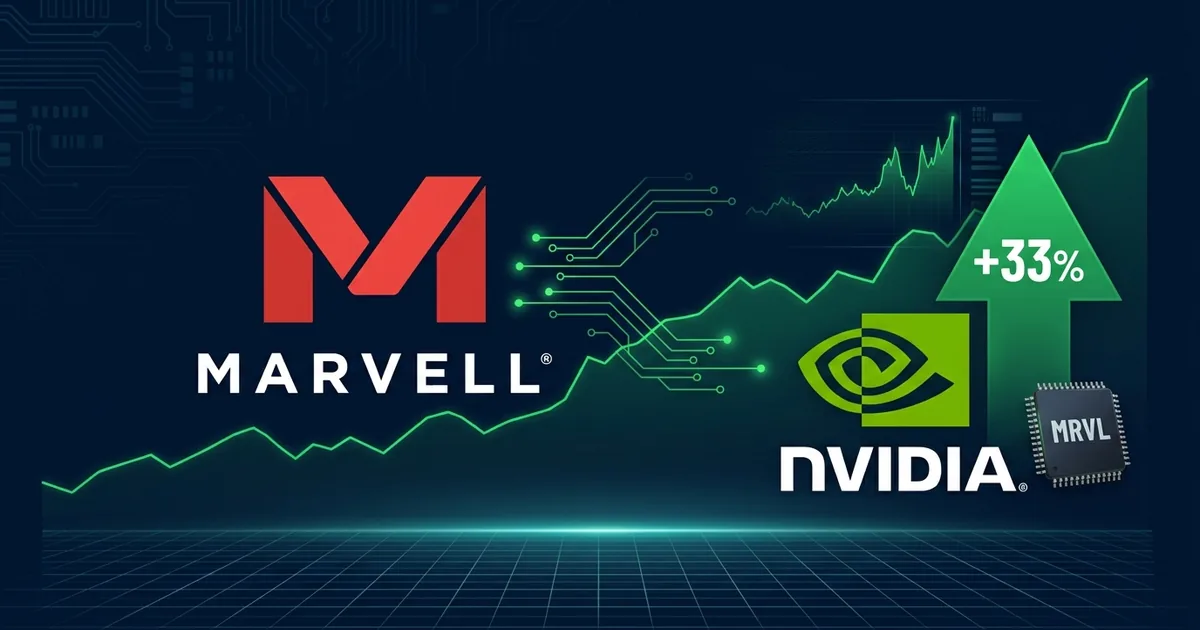
Marvell Technology added $60 billion in market value in a single trading session on Monday after Nvidia CEO Jensen Huang pointed at the company onstage at Computex in Taipei and declared it “the next trillion-dollar company.” It was the biggest one-day percentage gain in Marvell’s history, and it signals just how much a single endorsement from the most powerful figure in AI infrastructure can reshape the semiconductor landscape overnight.
What Jensen Huang Actually Said
The moment came during a joint appearance with Marvell CEO Matthew Murphy at Computex Week. Huang was not hedging or speaking in hypotheticals. He told the audience directly that Marvell’s networking and connectivity chips are essential to the data centers where AI workloads are distributed across thousands of interconnected processors, and that the company’s trajectory puts it on a path to a trillion-dollar valuation.
Nvidia recently backed those words with capital: the company invested $2 billion in Marvell and other firms developing photonic interconnect technology, which is critical for moving data at the speeds AI training clusters demand. That is not a casual endorsement. That is a strategic bet from the company that designs the GPUs those clusters run on.
The Numbers Behind the Move
Marvell shares closed up 32.52% on June 2, adding roughly $60 billion in market capitalization in one session. The stock narrowly topped its previous record single-day gain set in May 2023. Trading volume surged to multiples of its 30-day average as institutional money piled in.
The market’s enthusiasm reflects a broader shift in how investors value the AI supply chain. Nvidia designs the processors, but those processors need to communicate, and that is where Marvell’s custom silicon for networking, switching, and optical interconnects becomes the connective tissue of every major hyperscaler’s AI infrastructure. Without the plumbing, the processors are just expensive heat sinks.
Why This Matters Beyond One Day’s Trade
Huang’s endorsement does more than move a stock price. It positions Marvell alongside Broadcom as one of two companies Nvidia sees as critical partners in the next phase of AI infrastructure buildout, where the bottleneck is no longer compute but connectivity.
The S&P 500 closed above 7,600 for the first time on Monday, with chipmakers driving the latest leg higher. Marvell’s surge was the single largest contributor to the Nasdaq’s gains on the day, illustrating how concentrated the AI trade remains in a handful of semiconductor names.
The timing also matters. Nvidia unveiled the RTX Spark superchip at the same Computex event, signaling its push into personal computing with Arm-based processors. Huang is building Nvidia’s presence at every layer of the AI stack, from data center GPUs to PC chips, and he is publicly naming the companies he wants standing next to him at each layer. Being named by Jensen Huang is, at this point, the single most valuable endorsement in the semiconductor industry.
The Risk the Market Is Pricing In
At a trillion-dollar valuation, Marvell would be trading at roughly 40 times its projected revenue, a multiple that only makes sense if the AI infrastructure buildout accelerates from its current pace. The company’s custom silicon business is growing rapidly, but revenue still trails Broadcom’s by a wide margin, and the custom chip market is inherently lumpy: large design wins take quarters to ramp, and customer concentration is a structural risk.
Investors should also consider that Huang’s endorsement is strategic, not disinterested. Nvidia benefits directly from a strong Marvell because better networking means better utilization of Nvidia GPUs. The trillion-dollar call is as much about Nvidia’s own ecosystem as it is about Marvell’s standalone trajectory.
What Comes Next
The real test is whether Marvell’s next earnings cycle validates the market’s repricing. Custom silicon wins from hyperscalers like Amazon, Google, and Microsoft are the revenue line to watch. If those ramp on schedule, the trillion-dollar target starts to look less aspirational and more inevitable. If they slip, Monday’s 33% surge becomes a case study in how quickly momentum can reverse when narrative gets ahead of fundamentals.
For now, the market has made its bet. Jensen Huang said “trillion dollars” and $60 billion appeared. In the AI chip economy, that is how power works.