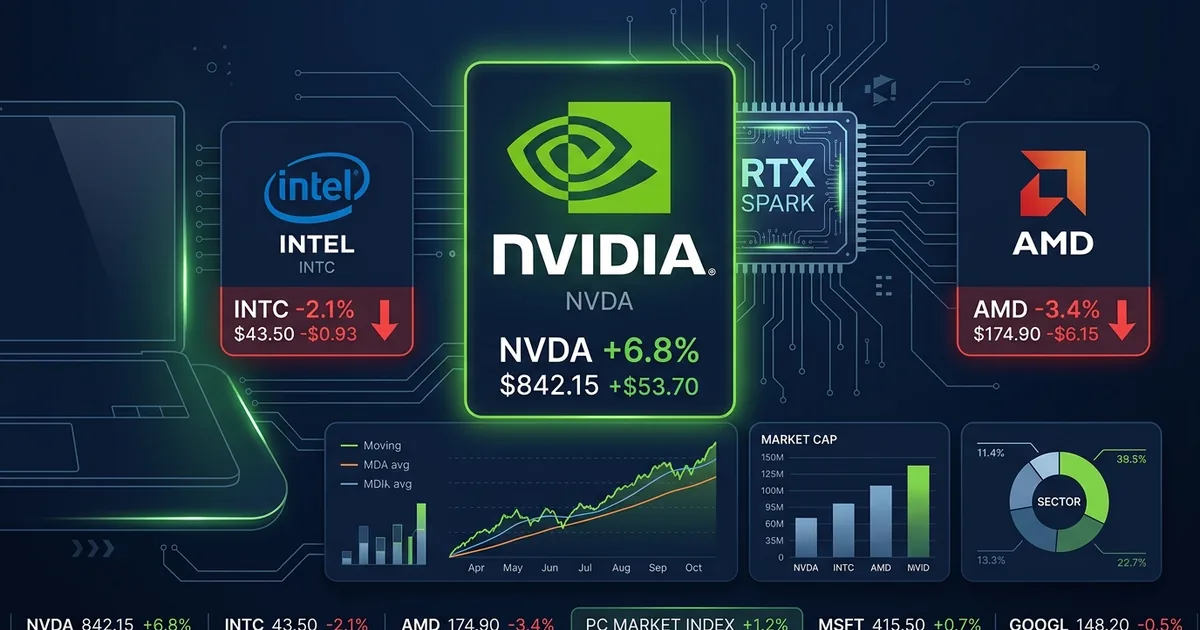
Jensen Huang just declared war on the PC chip establishment. At Computex 2026 in Taipei, the Nvidia CEO unveiled the RTX Spark Superchip, a combination of Blackwell GPU and Grace CPU on a single die that promises to turn every Windows laptop into an agentic AI workstation. Intel shares dropped more than 5% on the news. AMD and Qualcomm followed it down. The message from Nvidia is unmistakable: the company that owns the data center now wants to own your desk, your lap, and the entire Windows on Arm ecosystem.
What RTX Spark Actually Is
At full strength, the RTX Spark Superchip packs 20 Arm-based CPU cores, a Blackwell GPU with 6,144 CUDA cores, 128 GB of unified LPDDR5X memory, up to 300 GB/s of memory bandwidth, and one petaflop of AI compute. The CPU and GPU communicate over NVLink C2C, the same chip-to-chip interconnect Nvidia uses in its data center accelerators. Total transistor count is 70 billion, fabricated on TSMC’s 3nm process.
Tom’s Hardware reported from the Computex keynote that the Spark can run 120-billion-parameter AI models locally with million-token context windows. That is not a demo specification: it is a capability that directly competes with cloud-hosted inference for many enterprise workloads.
Who Loses
Intel is the most exposed. The company has dominated x86-based PC processors for decades, and its recent stock rally, which had pushed shares up roughly 200% from 2024 lows, was built on the thesis that its foundry turnaround and Core Ultra chips would defend the franchise. Monday’s 5% drop to $114.68 suggests traders see RTX Spark as a structural threat, not a niche product. Intel cannot match Nvidia’s GPU architecture, and its x86 instruction set is becoming a liability in an Arm-first Windows world.
AMD and Qualcomm also sold off. AMD fell on the recognition that its Ryzen AI line faces competition from a company with far deeper AI software integration. Qualcomm, which had been the only Arm-based chip option for Windows laptops with its Snapdragon X series, saw its shares slide as Yahoo Finance reported after Nvidia entered its territory with a product that combines a better GPU, more memory, and deeper OEM partnerships.
Who Wins
Nvidia, obviously, but also every OEM that wants to sell premium AI-capable hardware. Dell, HP, Lenovo, Asus, MSI, and notably Microsoft with a new Surface Ultra laptop are all launch partners. The Surface partnership is particularly significant: Microsoft building its flagship hardware around Nvidia silicon, rather than Intel or Qualcomm, signals where Redmond sees the PC platform heading.
Apple should be watching closely. The M5 MacBook is the current benchmark for Arm-based laptop performance, and Nvidia has positioned RTX Spark as a direct competitor to Apple’s own chip architecture. The difference is that Spark runs Windows and its full AI agent stack, while Apple’s ecosystem remains more closed. For enterprise buyers who need Windows compatibility and local AI inference, Spark could be the first real alternative to shipping workloads to the cloud.
The Platform Play
The hardware is impressive, but the real story is the software platform. Nvidia announced that RTX Spark will turn Windows into what it calls an “agentic AI operating system,” where AI agents can run persistently on local hardware with the full memory and context depth they need. This is Nvidia’s answer to the inference bottleneck: instead of renting GPU time in the cloud, enterprises can deploy agents on employee laptops with Spark hardware, at a fixed hardware cost and zero per-token cloud fees.
What This Means for Investors
The PC chip market generates roughly $80 billion in annual revenue. Nvidia just signaled it wants a meaningful share of that pie, starting with the premium tier and working down. The RTX Spark roadmap Huang outlined includes three generations: the current Grace Blackwell chip, a Vera Rubin successor with LPDDR6, and a future Rosa Feynman design. This is not a one-off product. It is a multi-year platform commitment that will pressure Intel and AMD earnings for years.
The Compute Economics
There is a financial argument hiding inside the spec sheet. A single RTX Spark laptop with 128 GB of unified memory can run inference workloads that currently cost $0.50 to $2.00 per thousand tokens in the cloud. For a company running 50 AI agents across its sales, support, and engineering teams, the annual cloud inference bill can easily reach six figures. A fleet of Spark-powered laptops would amortize that cost into a hardware refresh cycle that IT departments already budget for.
This is the same playbook Nvidia used in data centers: make the hardware so capable that the total cost of ownership beats the alternative, then lock in the ecosystem through CUDA and software tooling. Whether Intel and AMD can mount a competitive response before the fall launch is the open question, and Monday’s stock action suggests the market is not betting on it.
RTX Spark laptops will hit the market this fall. For Intel and AMD shareholders, the countdown has started.