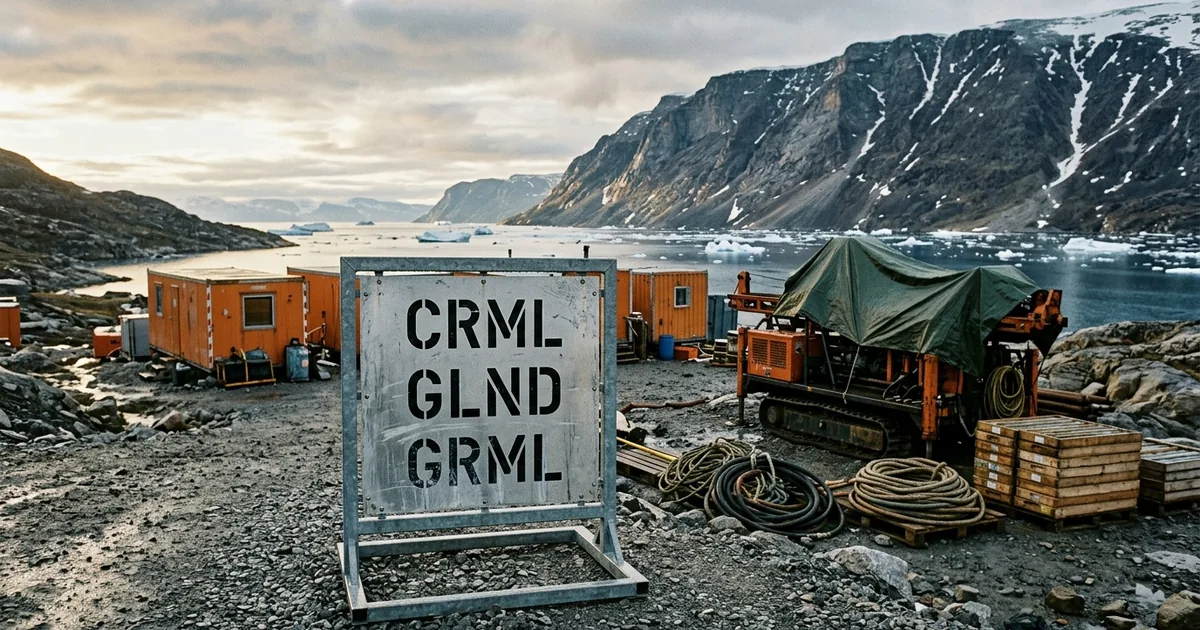
Three Greenland-linked stocks ripped higher overnight after President Trump announced a security agreement with Denmark covering the island, and the size of each move ran almost perfectly inverse to how much Greenland ore the company actually controls. Greenland Energy, an early-stage oil and gas explorer that has not drilled a well, led the tape. Critical Metals Corp, which owns 92.5% of Tanbreez, one of the largest rare earth deposits on the planet, came last. Every outlet published the percentages. None of them published that ranking, and the ranking is the story.
Here is what moved. Greenland Energy, which trades as GLND, rose roughly 150% overnight and was still up more than 141% in premarket trade. Greenland Mines, GRML, added about 72%. Critical Metals, CRML, gained 34%. The broader tape was calm by comparison: S&P 500 futures were up 0.66% and Nasdaq 100 futures 1.04% as of 4:46 a.m. Eastern, with the Dow coming off a third straight losing week.
What the Agreement Actually Says
The pact Trump announced on September 18 gives the United States permanent access, basing and overflight rights on Greenland. It bars non-NATO states from establishing military bases there, lets Washington block what the text calls sensitive investments by adversaries, and survives even if Greenland eventually becomes independent. Secretary of State Marco Rubio called it a historic deal and a huge win at zero cost to the American taxpayer.
Read that list again and notice what is absent. There is no mining licence in it. No permit. No offtake contract, no loan guarantee, no price floor, no Defense Production Act allocation, no equity stake. The investment provision is a veto over Chinese and Russian money, which is a restriction on who may fund Greenland projects rather than a commitment that anyone will. The agreement also still needs sign-off from Danish and Greenlandic lawmakers, and it is due to be signed during this week’s UN General Assembly. Monday’s buyers were paying up for a document that has not been executed.
The Inverse Ranking
Take the three companies in the order the market ranked them.
Greenland Energy is not a miner. It is an oil and gas exploration company working the Jameson Land Basin in East Greenland, run out of Denver, and it is in the middle of acquiring 80 Mile for about 61.5 million pounds to consolidate its position there. Its drilling programme was pushed back in August to winter 2027 pending further regulatory review. A rare earth security pact does nothing for a hydrocarbon explorer whose rigs are two winters away, and it was the single biggest gainer of the three.
Greenland Mines is a more interesting case. Until March 12 of this year the company was called Klotho Neurosciences and it was in cell and gene therapy. It renamed itself and changed its Nasdaq ticker to GRML after acquiring control of the Skaergaard palladium, gold and platinum project in southeast Greenland. It has since added Sarfartoq, a neodymium-praseodymium asset in the southwest, for $35 million, and it says output there could eventually equal 34% of non-Chinese refined NdPr supply. That is a real claim about a real orebody. It is also a claim made by a company that has been in the mining business for six months.
Critical Metals is the one with the asset. It closed the final 50.5% of Tanbreez in April, taking ownership to 92.5%, with European Lithium holding the rest. It has reported better than 99% dissolution of Tanbreez concentrate into 19 high-purity products and projects annual refinery revenue of $1.8bn to $2.2bn at full run rate. Greenland ranks eighth worldwide for rare earth reserves at roughly 1.5 million tonnes, and Tanbreez is one of the two deposits that put it there. First ore is targeted for late 2028 or early 2029.
The company with a defined orebody, a processing flowsheet and a production date moved a third as much as the company that has not drilled.
That is not a re-rating of Greenland assets. That is a keyword trade. The two largest gainers have the word Greenland in their corporate names; the smallest gainer does not.
What BTN Thinks
This was a bad day’s price discovery and it is worth saying so plainly rather than describing it as volatility. A military basing agreement is not a mining catalyst, and treating it as one requires believing that the binding constraint on Arctic rare earth production has been the absence of American troops. It has not been. The constraints are permitting timelines, processing capacity outside China, Arctic construction costs, a short shipping season and the capital to carry a project for half a decade before first revenue. The pact touches none of them.
CNBC International put the point to CSIS directly, and the answer was that American rare earths from Greenland are not arriving any time soon whatever Washington signs.
Responsibility for the distortion sits with the buyers, not the companies. None of the three issued a release claiming the security deal advanced their projects. The move was made by people screening on a country name during an overnight session with thin liquidity, which is how you end up bidding an undrilled hydrocarbon play twice as hard as a rare earth deposit with a published flowsheet.
There is a defensible version of the Greenland trade. The investment-veto clause does plausibly raise the strategic value of Western-controlled Arctic tonnage over time, because it forecloses Chinese capital from the alternative. If you believe that, the logical expression is the company holding the largest defined deposit. The market bought the other two harder.
What to Watch
Ratification is the first checkpoint: Danish and Greenlandic legislative approval converts this from a presidential announcement into an instrument. After that, the questions that matter are whether any American agency attaches money to the strategic language, whether Critical Metals hits its 2028 ore target, and whether Greenland Mines can finance Sarfartoq on equity that now costs it far less than it did on Friday.
This is not the first time a Greenland headline has repriced assets that have nothing to do with Greenland. In January, a Trump tariff threat aimed at the island whipsawed the broader US market and wiped $875 million out of crypto in a day. The island has become a macro keyword. Monday showed it is now a single-stock one too.