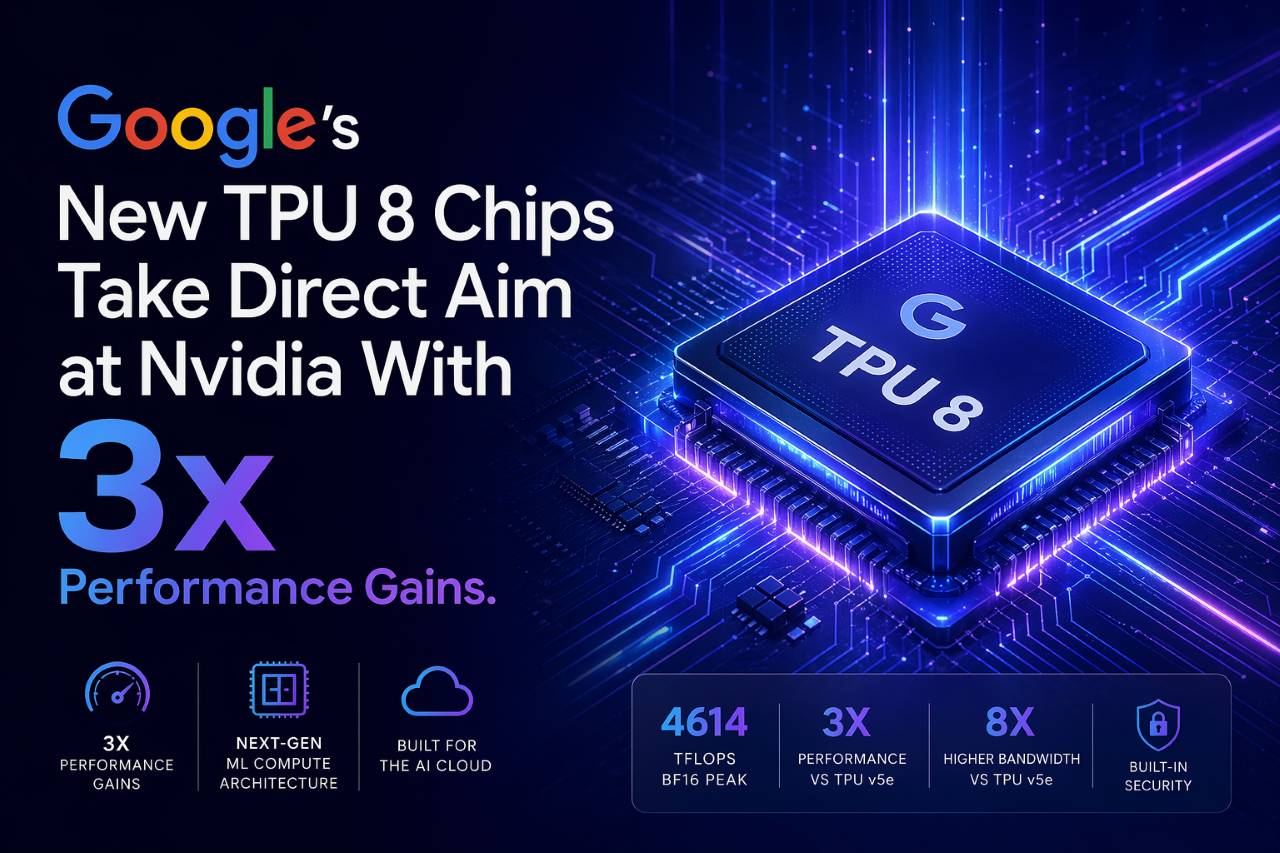
Google just announced something that should keep Nvidia’s board up at night. On April 22, at Google Cloud Next 2026, the company unveiled the TPU 8, its eighth-generation tensor processing unit, and it’s not your typical incremental chip refresh. This is a direct shot across the bow of the GPU monopolist, with Google essentially saying: we’re done renting computational power from your duopoly. We’re building our own.
The numbers are blunt. The new chips deliver 3x the processing power of Google’s previous flagship Ironwood processor. The training variant can scale to 9,600 units in a single superpod with 2 petabytes of shared high-bandwidth memory. The inference chip delivers 3x more on-chip SRAM and 80% better performance per dollar than the previous generation. Alphabet’s stock popped 2% on the news, a telling signal that Wall Street sees this as more than just another hardware announcement.
Why This Matters for the Chip War
We’re watching the biggest industrial infrastructure shift in a decade, and most people don’t realize what’s happening. For years, the AI boom enriched Nvidia almost by default. Jensen Huang’s company became the default choice because GPUs were general-purpose enough to handle training and inference, and Nvidia had the software ecosystem locked down. But that created a problem for hyperscalers: they were paying rent to a landlord with extraordinary pricing power.
Google, Amazon, and Microsoft collectively decided that paying Nvidia’s premiums wasn’t sustainable. So they’re doing what every sophisticated manufacturer does when vendor lock-in becomes intolerable: they’re building their own supply chain. Google’s TPU strategy is the most aggressive version of this play. These chips are purpose-built for Google’s specific workloads. They don’t need to be general. They just need to be better and cheaper than what Nvidia sells.
The company even announced it’s in talks with Marvell Technology to develop a memory processing unit and an inference-optimized TPU variant. This isn’t Google hedging its bets. This is Google building a portfolio. Notice the timing too: this comes as chipmakers have been on a 16-day winning streak amid the AI infrastructure gold rush. The market sees where this is going.
The Architecture Tells the Story
Here’s where Google got clever. Instead of chasing Nvidia’s all-in-one approach, it split the TPU 8 into two specialized chips: the TPU 8t for training and the TPU 8i for inference. This is pragmatic engineering. Training and inference have fundamentally different computational requirements. Inference needs speed and efficiency. Training needs bandwidth and scale.
The TPU 8t targets the “agentic era” that every AI company is suddenly obsessed with. That means running millions of AI agents simultaneously, each making decisions, fetching information, taking actions. At scale, that’s a different problem than training a single model. Google is betting that this architecture can handle workloads that generic GPUs simply aren’t optimized for.
The 2 petabytes of shared high-bandwidth memory in a single superpod is the real flex here. That’s nearly double what competitors have. More memory bandwidth means less time waiting for data. Less time waiting for data means better utilization and faster throughput. In the cloud business, throughput is revenue.
The Economics That Actually Drive This
Let’s talk about what doesn’t get discussed enough: cost structure. When you’re operating at Google’s scale, the difference between 2x and 3x performance per watt matters. It matters to power bills. It matters to cooling. It matters to real estate costs in data centers. Over thousands of chips, those “small” efficiencies compound into nine-figure savings.
The 80% better performance-per-dollar metric on the inference chip is even more important commercially. Inference is the workload that actually generates revenue for cloud providers. That’s where customers run their models in production, processing user queries, powering applications. If Google can deliver inference 80% more efficiently than competitors, it can undercut Nvidia’s pricing while maintaining margins. That’s not just competitive advantage. That’s a competitive nuclear option.
The availability timeline matters too. Google said these will be generally available later this year. That’s not vague. That’s a commitment. It suggests the chips are done, tested, and ready for manufacturing at scale. By the end of 2026, Google will have TPU 8 capacity in production. That’s not hypothetical competition to Nvidia. That’s real supply hitting the market.
The Bigger Picture in Custom Silicon
Google isn’t alone in this game. Amazon has been building Trainium and Inferentia chips for years. Microsoft is developing its own processors. Meta is designing custom silicon. The pattern is obvious: every hyperscaler with the engineering talent and capital is reducing dependency on Nvidia. This is structural, not cyclical. This is the future of cloud infrastructure.
What makes Google’s move different is the vertical integration and the relentless R&D commitment. The company has been iterating on tensor processing units since 2016. That’s a decade of engineering experience, manufacturing partnerships, and ecosystem development. Each generation has gotten sharper at the specific problem Google needs solved.
Nvidia still has momentum and market share. The installed base of CUDA-optimized software is enormous. But the narrative of Nvidia’s inevitable dominance requires you to believe that hyperscalers will keep paying premium prices for general-purpose hardware when they can build custom solutions. History says that bet loses.
What This Means for the Market
Nvidia’s stock price reflects a scenario where the company maintains 80-90% market share in AI infrastructure indefinitely. That scenario just got less likely. Not because TPU 8 is perfect. But because it’s good enough to take meaningful share from Nvidia’s captive customer base.
Google’s announcement is a reminder that in infrastructure, being the default choice is fragile. It requires continuous innovation, alignment with customer economics, and pricing discipline. Nvidia’s data center margins have been extraordinary precisely because there was no alternative. Now there is.
The real story here isn’t about chips. It’s about power shifting from suppliers to consumers. Google, Amazon, and Microsoft are large enough to change the rules of the game. They’re using custom silicon to do it. This is how infrastructure markets mature. Incumbents eventually face substitution from above.
For more on Google’s infrastructure strategy, see this Bloomberg analysis of the TPU 8 announcement and TechCrunch’s coverage of how this shifts the AI chip landscape.