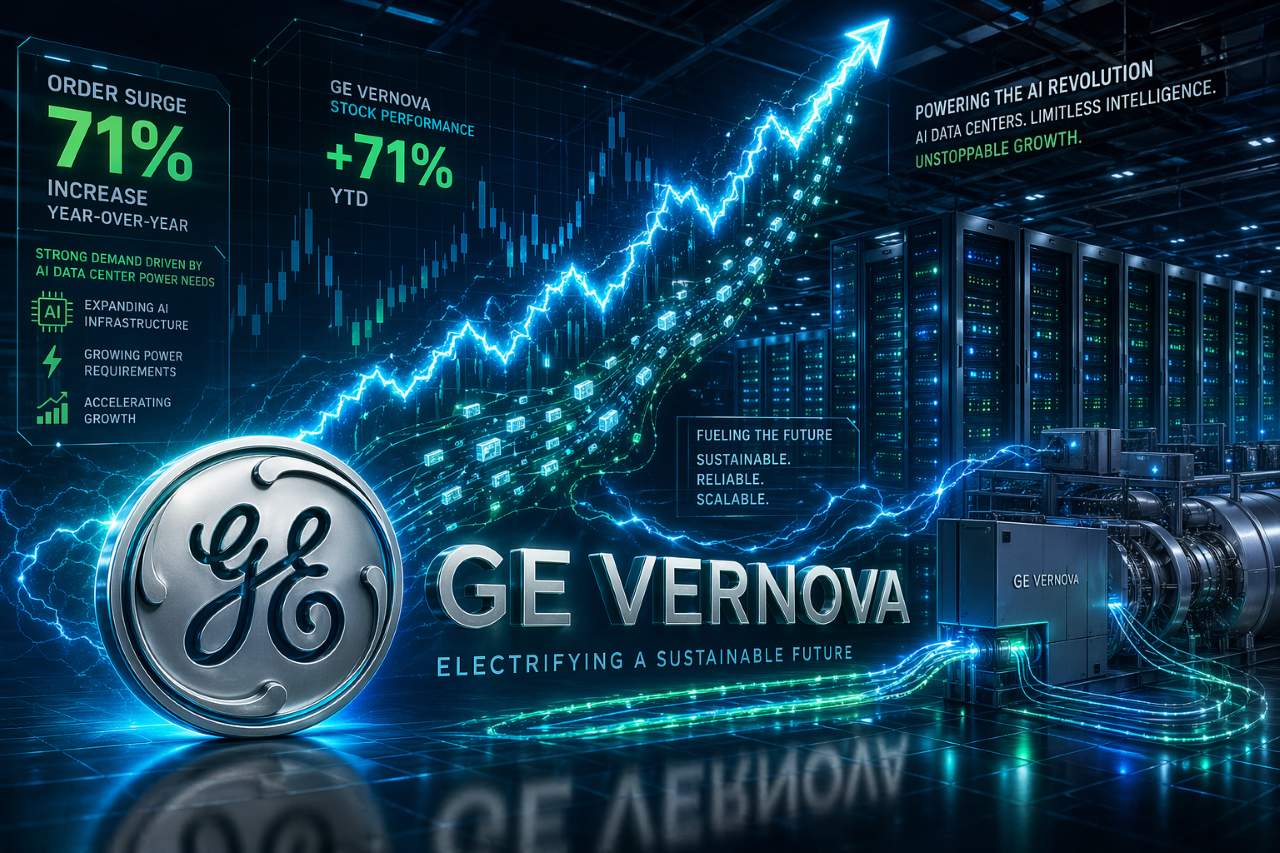
GE Vernova just showed the market something it desperately needed to see: the unglamorous truth about how we actually power an AI revolution. While everyone was fighting over GPU allocations and chip fabs, the company that makes transformers and grid equipment quietly posted a 71 percent surge in orders, driving shares to an all-time high on Tuesday. This isn’t hype. This is what happens when the infrastructure underneath the hype finally gets its moment.
The numbers tell the real story. GE Vernova reported first-quarter revenue of $9.34 billion, beating estimates by $230 million and growing 16 percent year-over-year. But the orders number is the one that matters: $18.3 billion in new bookings, a jump that makes you understand the actual scale of what’s happening in AI data centers. The company raised full-year revenue guidance to $44.5 billion to $45.5 billion from the prior $44 billion to $45 billion range. Free cash flow guidance jumped from $5 billion to $5.5 billion to $6.5 billion to $7.5 billion. These aren’t tweaks. These are major recalibrations.
The Picks and Shovels Play Nobody Wanted to Talk About
Here’s what makes this story different from the usual AI inflation narrative. Nvidia gets the attention. Everybody knows about the chip shortage and the race for GPUs. But to actually run an AI data center, you need something far more mundane and far more essential: reliable power delivery. You need transformers. You need high-voltage systems. You need grid equipment that can handle loads that would have seemed science fiction five years ago.
GE Vernova’s electrification backlog hit $42 billion as of the first quarter. Let that number sink in. At the end of 2022, that backlog was $9 billion. That’s not growth. That’s metamorphosis. The company is now quoting Q2 pricing that runs 10 to 20 percent above late 2025 levels, which tells you something crucial: demand is not cooling. Customers are locking in supply chains because they’re terrified of supply becoming more constrained.
The contrast with the broader market was instructive. On the same day GE Vernova surged 12 percent to record levels, GE Aerospace fell 5 percent. One division is riding the infrastructure wave of the AI era. The other is caught in the traditional aerospace cycle. This is what a structural inflection looks like when you see it clearly.
The Real Cost of the AI Boom
There’s been a lot of hand-wringing about the power consumption of large language models and data center buildouts. The numbers are staggering. A single large AI model training run can consume as much electricity as a small country. And we’re not doing this once. We’re doing it continuously, iteratively, at scale. The hyperscalers building these facilities aren’t treating power as an afterthought. They’re treating it as the central constraint.
This is what GE Vernova’s backlog actually represents: the dollar value assigned to solving that constraint. Forty-two billion dollars worth of transformers, switch gear, and grid infrastructure. That’s not speculative demand. That’s contractually committed work.
The broader context matters here too. Earlier this month, Phononic, a company focused on AI cooling solutions, was exploring a sale process with a potential valuation around $1.5 billion. Cooling and power delivery have become the actual competitive moat in AI infrastructure. You can fab chips everywhere now. But can you power them reliably? Can you keep them cool? That’s where the scarcity lives.
What Wall Street Got Wrong About This Play
For months, investors treated GE Vernova as a modest electrification story. Europe going green. Renewables infrastructure. All true, all relevant, but it missed the second act entirely. The company isn’t just benefiting from the energy transition. It’s becoming critical infrastructure for the technology transition that’s happening on top of that.
The timing is interesting too. GE spun out Vernova less than two years ago, in April 2024. The market was skeptical about whether a standalone power and electrification company could thrive. Instead, the company is showing what happens when you have a pure-play on infrastructure that suddenly becomes indispensable. No legacy drag. No competing business units. Just relentless demand.
Adjusted EBITDA margin guidance expanded to 12 percent to 14 percent from 11 percent to 13 percent. That’s mix improvement and pricing power flowing through. When customers are desperate for your product, they don’t negotiate as hard on price. They negotiate on timeline.
The Unsexy Infrastructure Thesis
Everyone wants to find the next Nvidia. Everyone wants the company that will 10x in three years. But sometimes the real money is in companies that solve unglamorous problems at scale. That boring transformer you’ve never heard of. That grid equipment nobody photographs. That high-voltage system that enables the systems everyone actually cares about.
GE Vernova’s earnings weren’t a surprise to people paying attention. Demand for power infrastructure around AI has been obvious for months. But the magnitude of the raise and the confidence in the guidance suggests management is seeing something more durable than a typical cycle. This isn’t inventory building by customers. This is long-term capacity creation.
What happens next matters. The company can execute on a $42 billion backlog, or it can stumble. But the orders are real. The demand is real. And the structural shift toward treating power infrastructure as a competitive advantage in the AI era is unmistakably real.
The picks and shovels play isn’t about destiny. It’s about mathematics. You can’t build data centers without transformers. You can’t handle the power loads without grid equipment. You can’t deliver on the AI promises without solving the infrastructure problem underneath. GE Vernova is now the company solving that problem at scale.
That’s why Tuesday’s surge wasn’t a pop. It was a repricing. The market was finally recognizing what the order book had already known: there’s money in the foundational infrastructure that makes everything else possible. It’s not as exciting as the AI narrative itself. But it might be more profitable.
For more, see Reuters’ coverage of GE Vernova’s guidance raise and Yahoo Finance’s analysis of the earnings beat.