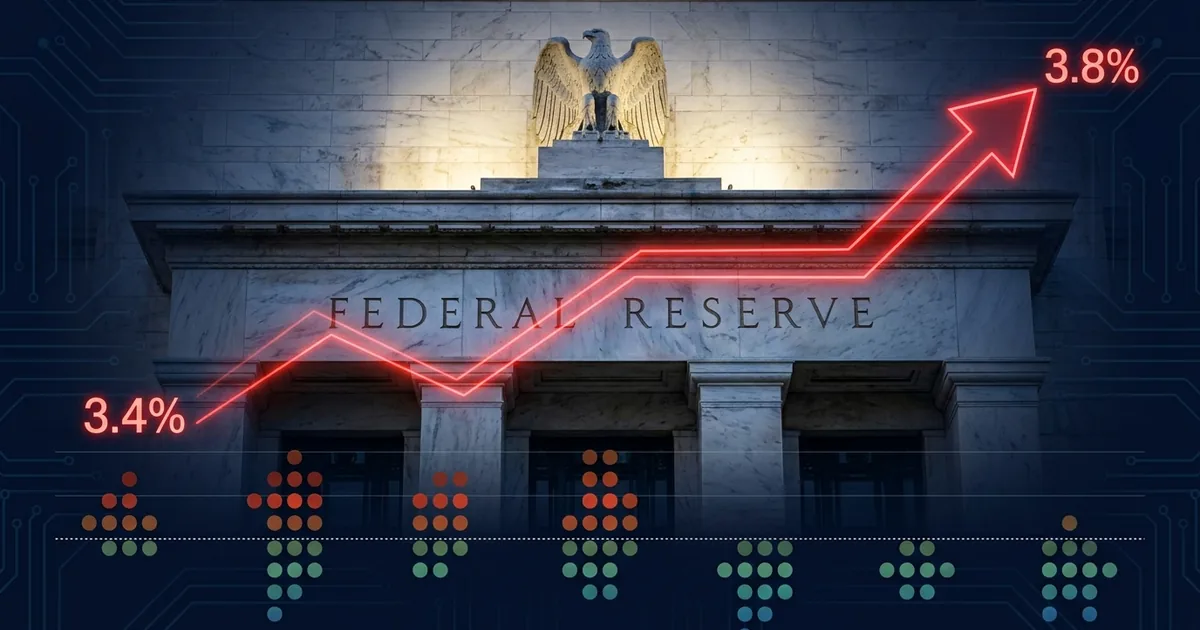
The Federal Reserve held interest rates steady on Wednesday, but the real story was the hawkish jolt buried in the updated dot plot: nine of 18 policymakers now project at least one rate increase before December, a sharp reversal from March when the median forecast still pointed to a cut.
The Dot Plot Shock That Moved Markets
The S&P 500 dropped 1.21% and the Nasdaq shed 1.34% within hours of the release, as traders digested what amounts to a full policy pivot. The median year-end federal funds rate forecast jumped to 3.8%, up from 3.4% in March, and six of those nine hawkish dots project two quarter-point hikes, not just one. Markets are now fully pricing in at least one increase by year-end, a scenario that seemed remote just three months ago.
What changed? Inflation, mostly. The Consumer Price Index hit 4.2% in May, its highest level in three years, driven largely by energy costs that have surged since the Iran conflict erupted in late February. The job market has also firmed, giving policymakers less cover to hold rates low.
Warsh Plays It Close to the Vest
New Chair Kevin Warsh, who took office May 22, opted not to submit his own projection to the dot plot, a move most Wall Street analysts expected. Warsh has long criticized the dot plot as a communication tool, arguing it creates false precision about the rate path. Whether he objects on principle or simply considers it premature to broadcast a forecast five weeks into the job, the result is the same: markets got a hawkish signal from his colleagues without a clear read on where the new chair himself stands.
The policy statement reinforced the ambiguity. The FOMC stripped its prior easing bias, removing references to “additional rate adjustments” and adopting what Warsh called a purely data-dependent posture. No forward guidance, no hints about direction. The message: the Fed will react to what the economy does, not what it expects the economy to do.
What the Iran Premium Means for Rate Policy
The elephant in the room remains energy. Brent crude has traded above $90 for months, propped up by the ongoing disruption in the Strait of Hormuz, where 10 to 11 million barrels per day of crude remain shut in. A tentative U.S.-Iran interim deal is reportedly moving toward a formal signing as early as Friday, which could eventually flood markets with an estimated 100 million barrels of stranded oil. But analysts at Sparta Commodities estimate three to six months to fully normalize flows, meaning the inflation impulse from energy is not going away overnight.
For the Fed, that creates a bind. Hiking into a supply-driven energy shock risks choking growth. Holding steady risks letting inflation expectations drift higher. The dot plot suggests most officials have decided that the inflation risk outweighs the growth risk, at least for now.
The Warsh Task Forces
Beyond rates, Warsh used his first meeting to announce several internal task forces aimed at overhauling major Fed operations, a signal that structural reform is on his agenda alongside monetary policy. Details were thin, but the move aligns with Warsh’s reputation as an institutionalist who wants to modernize how the central bank communicates and operates.
What Comes Next
Markets are closed Thursday for the Juneteenth holiday, giving investors an extra day to digest the shift. When trading resumes Friday, the focus will split between any developments on the Iran deal and whether Warsh offers more color in the coming weeks about his own rate preferences.
The bottom line: the Warsh Fed is not the Powell Fed. Where his predecessor leaned on forward guidance and gradual signaling, Warsh appears content to let the data and his colleagues do the talking while he reshapes the institution from the inside. For markets conditioned to parsing every comma in a Fed statement, the silence itself is the signal.