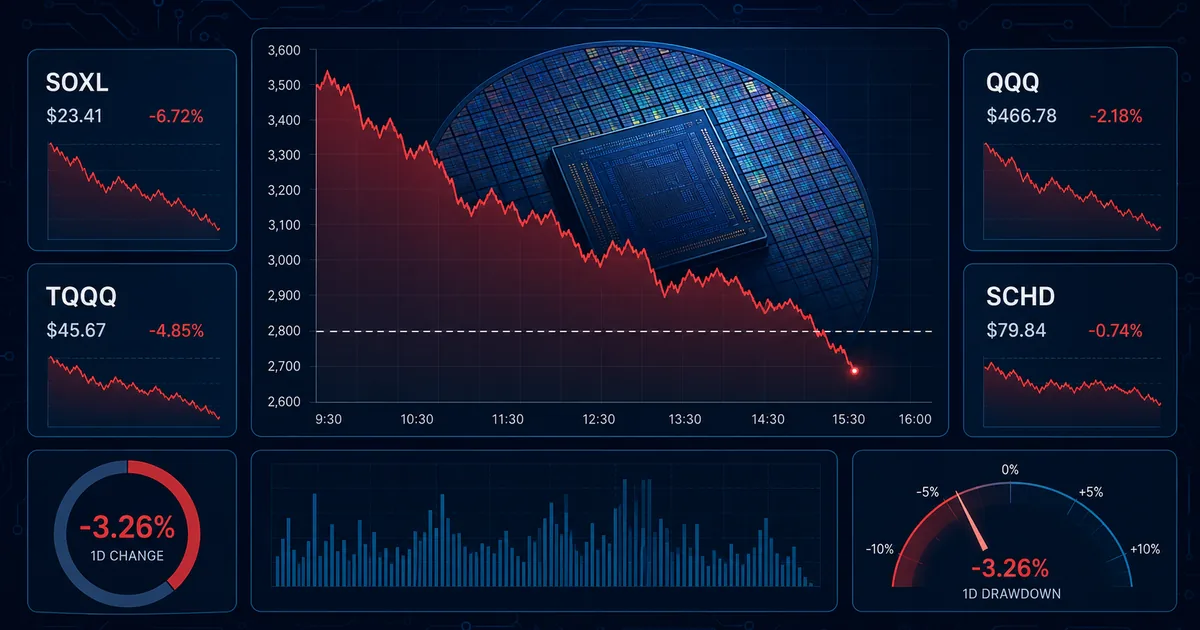
The Philadelphia Semiconductor Index has given back more than 20% from its 52-week high since peaking in late June. Intel is down 21% and Micron 17%, and the Nasdaq 100 has fallen roughly 10% from its record, which puts it on the doorstep of a correction.
Now look at what Americans are actually typing into Google this morning. The live US trending feed is carrying micron stock, soxl stock, tqqq and qqq. Two of those are triple-leveraged.
What the Search Data Does and Does Not Say
Be precise about this, because the distinction matters and most coverage will blur it.
Trending search volume is an attention signal. It is not a flows number, it does not confirm a single share was bought, and elevated interest in a ticker is consistent with panic-selling, dip-buying, or simply reading the news. Anyone telling you the retail bid is confirmed by a Google Trends screenshot is selling something.
What it does tell you is where non-professional attention is concentrated, and the concentration here is unusual. SOXL is the Direxion Daily Semiconductor Bull 3X fund. TQQQ is the ProShares UltraPro QQQ, also 3x. Both are showing up in the trending feed on a day when the underlying indices are in or near correction. That is retail attention flowing toward the most aggressive available expression of a bounce, in the middle of a drawdown that has not established a bottom.
The other name in that same feed is SCHD, a plain dividend-equity fund. So the honest read is not “retail is greedy.” It is that retail is splitting, hard, between maximum leverage and maximum defense at the same moment, which is what you would expect from a crowd that has no shared view of what this selloff is.
The Math Is Hostile to Exactly This Trade
Here is the part that deserves more attention than it gets.
Daily-rebalanced leveraged funds do not deliver three times the return of the index over any period longer than a day. They deliver three times the daily return, compounded, which in a choppy market produces volatility decay. An index that falls 10%, rallies 10%, and repeats can leave a 3x fund materially underwater even when the index has gone nowhere. The instrument is designed for a directional move over a short holding period. It is structurally punishing in precisely the conditions that make people want to buy it: high volatility, no clear trend, and a strong urge to make the drawdown back quickly.
The prospectuses say this. They say it in plain language, near the front. It does not appear to matter much, because the people reaching for these products during a rout are generally not arriving from the prospectus.
There is a real consumer-protection question sitting in here that nobody in Washington is currently asking. A 3x fund is a legitimate professional instrument. It is also sold, frictionlessly, with no suitability gate, to retail accounts at the exact moment those accounts are most likely to misuse it. Regulators have spent years on payment for order flow and gamified trading interfaces while the most mathematically dangerous retail product on the shelf sits one search away.
Why the Selloff Is Not Obviously Over
The bull case for buying this dip is that semiconductors have corrected hard several times through this cycle and every one of those was a buying opportunity. That is true, and it is also exactly what you would say right before the one that was not.
Two things are different in the current leg, and the breakdown of what triggered this selloff names both. The first is that the driver is no longer a demand scare, it is a spending scare. Investors are questioning the durability of Big Tech’s AI capital expenditure, which means the thing under threat is not chip demand next quarter but the multi-year order book that the entire complex has been valued against. The second is China. Signs of genuine progress in advanced domestic chipmaking hit the terminal-value assumption directly, and terminal value is where most of the multiple lives.
Set that against what these companies were reporting a month ago. Micron posted record margins on AI memory in its June quarter, and the stock is down 17% anyway. When a name sells off through excellent results, the market is repricing the story rather than the quarter, and story repricings take longer to finish than earnings misses do.
The Setup Into Tonight
Microsoft and Meta report after the close, and their capital expenditure guidance is the closest thing to a direct verdict on the thesis driving this rout. If the guidance holds, the AI-capex scare loses its strongest argument. If either trims, the chip complex has a considerably worse Thursday.
Which is a reasonable thing to have a view on, and a genuinely bad thing to express with a product that decays while you wait to be right.