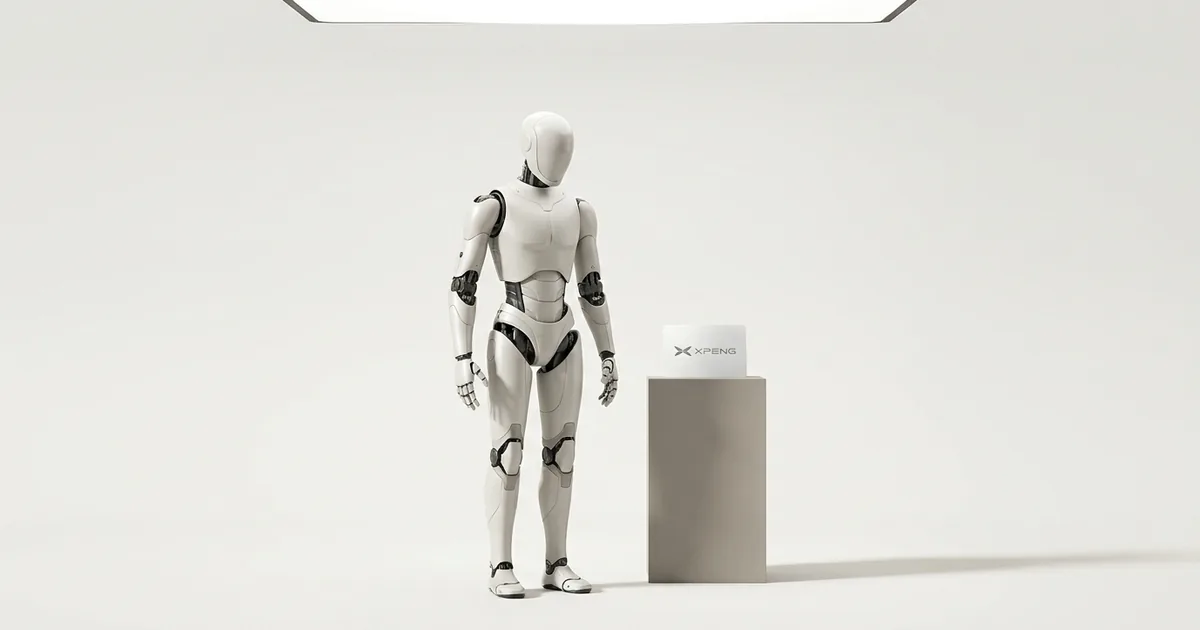
XPeng’s robotics business has never shipped a product to a paying customer, and investors just handed it more than $900 million at a post-money valuation above $6.3 billion. The company called it the largest single-round private raise in China’s embodied AI sector, and on the numbers alone that claim holds up.
A Carve-Out, Not a Side Project
The structural detail is the one worth noticing, and most of the coverage skipped past it. XPeng did not fund this out of the car business. It raised outside capital into the robotics unit specifically, which turns a line item on an automaker’s R&D budget into a separately capitalized company with its own valuation, its own equity to hand to engineers, and an obvious path to its own listing.
That is a deliberate piece of financial engineering, and it solves a problem Chinese EV makers know intimately. Automotive margins in that market are brutal. Funding a decade-long humanoid program from them would mean asking the car business to subsidize a bet that may not pay for years. Carving it out moves the risk to investors who signed up for exactly that risk.
Who Wrote the Checks
IDG Capital led the round with Gaorong Ventures participating, but the names that change the read are Tencent and Alibaba, both in as strategic backers. Neither of those companies invests in hardware for the hardware. They invest for the compute relationship, the model-training pipeline, and eventually the distribution.
The composition of the money is unusual too. Of the total, roughly $600 million came from external investors, about $200 million from an XPeng subsidiary, and roughly $100 million from the company’s own leadership, according to Electrek’s breakdown of the round. Executives putting nine figures of personal capital into their own pre-revenue unit is a signal. It is not proof of anything, but it is not nothing either.
The Machine Itself
The second-generation IRON is a genuinely impressive piece of engineering, which is a sentence that should be read with the emphasis on engineering rather than on impressive. It runs three custom Turing AI chips producing roughly 3,000 TOPS, moves with 82 degrees of freedom, and carries hands with 22 degrees of freedom of their own. It uses a solid-state battery and a bionic spine under flexible skin.
The company’s public reveal became a viral moment for the wrong reason: the walk was smooth enough that a chunk of the internet decided there was a person inside the suit, and XPeng eventually opened the robot on stage to prove otherwise. That episode tells you something real about where the field is, and something misleading. The gait problem is close to solved. The gait problem was never the hard part.
The Number That Does Not Work Yet
XPeng says IRON enters mass production by the end of 2026, with commercial deliveries in China and abroad starting in 2027, and the capital is earmarked for model training, data generation, production facilities and overseas expansion. CEO He Xiaopeng has talked about running more than 1,000 units a month by the end of this year and has floated a target of a million units by 2030, at a price under $30,000.
Run that arithmetic and the valuation stops looking aggressive and starts looking like a bet on a specific industrial outcome. A million units at $30,000 is a $30 billion revenue line. At 1,000 units a month, it is $360 million a year. The gap between those two numbers is the entire investment case, and nothing about the current round tells you which one is real.
There is also the question nobody in the sector answers cleanly: what does the robot do once it arrives. Factory work, logistics and retail service all get named, none get specified with a customer and a contract. We wrote about this pattern last year when UBTech’s humanoid ambitions ran ahead of its hardware, and the lesson has not aged out. Demos scale beautifully. Deployments do not.
Tesla’s Problem Is Structural
The obvious comparison is Optimus, and the comparison flatters XPeng in a way that has little to do with robotics. Tesla funds Optimus from inside Tesla, which means the program competes for capital with the vehicle line, with energy storage, with the robotaxi buildout that regulators in Nevada just cleared to expand. Every quarter Optimus has to justify itself against alternatives that generate revenue today.
XPeng’s unit does not. It has $900 million, a dedicated cap table, and investors whose only exposure is to this. That is a real advantage in a race where the binding constraint is patience, and it is why XPeng is currently on track to reach volume production ahead of Tesla despite starting later and spending less.
What 2027 Actually Has to Prove
Chinese hardware companies have a habit of hitting production dates and missing utility ones. IRON will almost certainly come off a line in 2027, because XPeng knows how to build things and has the supply chain to do it. That was never really in doubt.
The thing to watch is not the first delivery. It is the second order from the same customer. Humanoids have been six months from usefulness for about four years now, and the first company to publish a repeat purchase from a buyer who is not also an investor will have proved more than any valuation in this round.