The Chinese AI lab that rattled Silicon Valley without spending a dime of outside capital just priced its first fundraise, and the number tells you everything about where the global AI arms race stands right now.
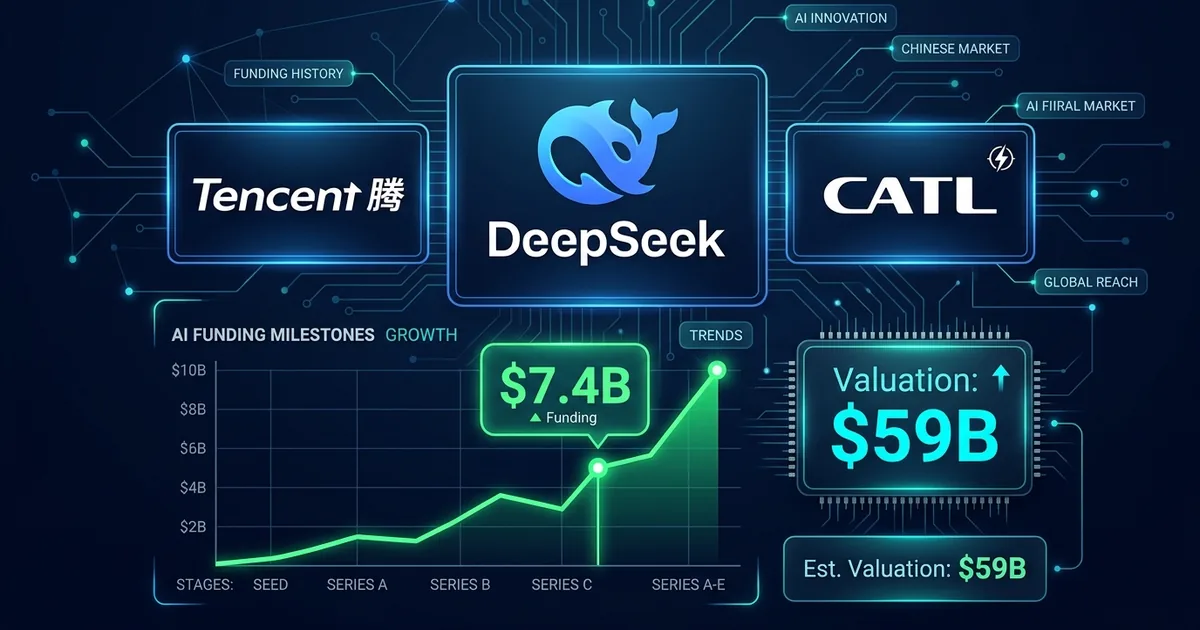
DeepSeek is raising approximately $7.4 billion in its inaugural external funding round at a valuation between $52 billion and $59 billion, according to reporting from TechNode and multiple outlets that confirmed the deal’s structure this week. The investor roster reads like a who’s who of China’s strategic industrial base: Tencent is committing roughly 10 billion yuan ($1.5 billion), battery giant CATL is in for 5 billion yuan ($740 million), and gaming developer NetEase and e-commerce group JD.com round out the cap table.
The Money Follows the Model
What makes this round extraordinary is not the dollar amount, which is modest by the standards of OpenAI’s $40 billion round or Anthropic’s recent $65 billion Series H. It is the context. DeepSeek built V3 and R1 into globally competitive frontier models without outside venture capital, relying instead on the deep pockets of its parent company, quantitative trading firm High-Flyer. Founder Liang Wenfeng is personally committing $2.9 billion of his own money to the round, reinforcing his conviction bet on the company he built.
The investor base is deliberately compact. Fewer than ten participants are expected in the round, and every one of them is domestic. There are no Western VCs, no sovereign wealth funds, no Silicon Valley crossover investors. That is not accidental. It is strategic coherence in a market where AI has become a matter of national industrial policy.
What Tencent and CATL Get
Tencent’s $1.5 billion commitment makes it the largest external investor and signals something bigger than a financial play. Tencent operates WeChat, China’s dominant platform ecosystem with more than 1.3 billion monthly users. Integrating DeepSeek’s reasoning capabilities into WeChat’s search, enterprise tools, and mini-programs would give Tencent a proprietary AI layer that does not depend on Baidu’s Ernie or any Western model.
CATL’s involvement is more unusual and more telling. The world’s largest EV battery maker has no obvious AI product surface, but CATL has been expanding into autonomous driving partnerships and smart manufacturing. Access to DeepSeek’s models could accelerate its push into AI-driven battery design, production optimization, and the vehicle intelligence stack that China’s automakers are racing to build.
The Valuation Gap That Should Worry Silicon Valley
At $52 billion to $59 billion, DeepSeek is valued at roughly one-fifteenth of OpenAI’s reported valuation and one-sixteenth of Anthropic’s latest mark. That disparity is not just a reflection of different markets. It exposes the gulf between China’s AI pragmatism and Silicon Valley’s valuation machine.
DeepSeek achieved frontier-model performance at a fraction of the compute cost that American labs required. Its V3 model was trained on roughly 2,000 Nvidia H800 GPUs, compared to the tens of thousands of H100s that OpenAI and Anthropic deployed. If DeepSeek can sustain that cost efficiency while scaling with $7.4 billion in fresh capital, the competitive implications are significant.
The timing also matters. This round lands just as the U.S. tightens export controls on advanced AI chips to China, and as Anthropic filed its S-1 for a potential trillion-dollar public offering. The AI capital stack is bifurcating along geopolitical lines, and both sides are accelerating their bets.
What the Money Is For
DeepSeek’s decision to raise external capital now, after proving it could compete without it, suggests the next phase of AI competition requires resources that even a wealthy quant fund cannot provide alone. The company needs to build out inference infrastructure at scale, expand its research team beyond the roughly 200 engineers who built V3 and R1, and compete for the applied-AI contracts that will determine which models actually get deployed in production.
The inference buildout is particularly capital-intensive. As more Chinese enterprises adopt large language models for customer service, code generation, and internal automation, the demand for GPU clusters to serve those models grows exponentially. DeepSeek’s training efficiency advantage does not automatically translate into inference cost savings at the volumes Tencent and JD.com would require.
There is also the talent dimension. DeepSeek has recruited aggressively from Tsinghua, Peking University, and China’s top AI research labs, but the global competition for frontier AI researchers is fierce. Fresh capital gives DeepSeek the compensation budget to retain its core team and attract the next tier of researchers who might otherwise head to ByteDance, Baidu, or overseas.
The Strategic Alignment Advantage
For Western investors watching from the sidelines, the message is uncomfortable: China’s most capable AI company just raised a war chest from investors who are also its future distribution partners, its industrial customers, and its national champions. Tencent brings 1.3 billion WeChat users. CATL brings the manufacturing floor. JD.com brings logistics and commerce data. That kind of strategic alignment between capital, distribution, and industrial policy is something Silicon Valley’s VC model does not naturally produce.
The AI race is not just about who builds the best model. It is about who builds the best ecosystem around it. DeepSeek just showed its hand.