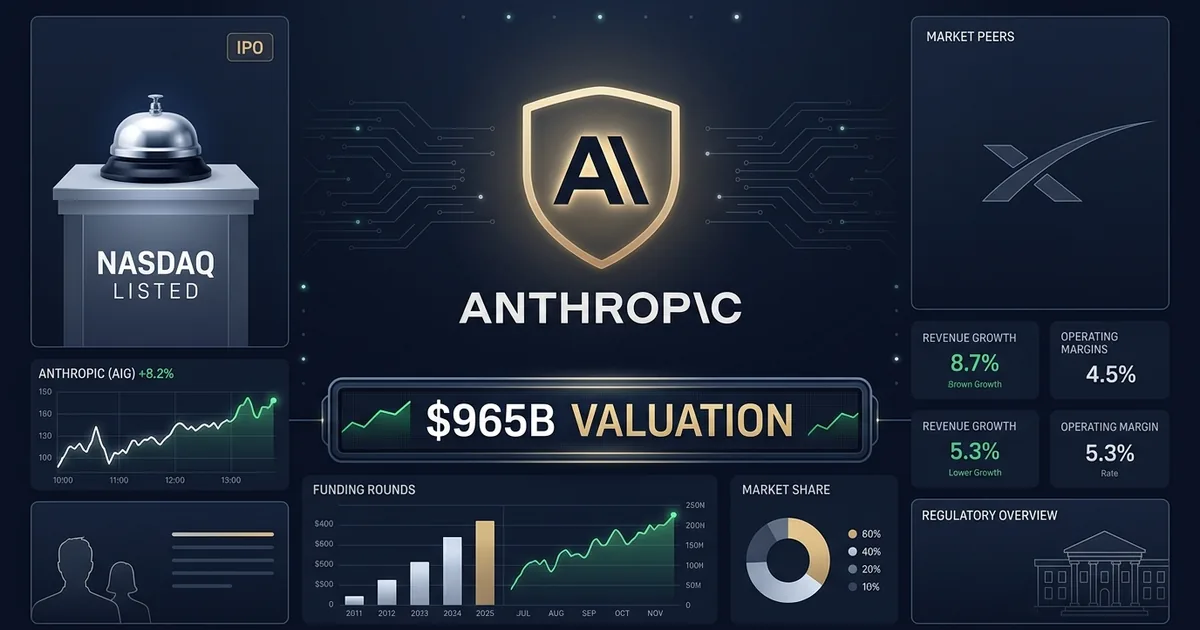
Anthropic quietly dropped its S-1 registration with the SEC on Monday, setting the stage for what analysts are already calling the most consequential AI public offering in history. The Claude maker, now valued at $965 billion after its recent $65 billion Series H, is entering a public markets race alongside SpaceX, and the outcome will reshape how Wall Street prices artificial intelligence for a generation.
The Numbers Behind the Filing
The company submitted a confidential draft registration statement on Form S-1 to the Securities and Exchange Commission, a procedural step that gives Anthropic the option to go public once regulators complete their review. Share count and pricing have not been set, but the trajectory is staggering.
Anthropic’s revenue run-rate hit approximately $47 billion in May 2026, as NPR reported in its coverage of the filing, up from roughly $10 billion the prior year. That is a nearly 5x increase in annual revenue in twelve months, a growth rate that makes even the most aggressive SaaS ramps look pedestrian. The company’s recent funding round at $965 billion surpassed rival OpenAI, flipping a competitive dynamic that seemed settled just a year ago.
Why the Timing Matters
Three forces are converging to make this the right window. First, enterprise adoption of Claude, particularly Claude Code, has accelerated faster than internal projections. The developer tooling market is producing revenue at margins that public market investors understand: software subscriptions with measurable seat expansion. Second, SpaceX filed its own IPO paperwork in late May, and Anthropic cannot afford to be the second mega-listing of the summer. First-mover advantage in the IPO queue means better pricing, more analyst attention, and a cleaner narrative.
Third, the broader market is cooperating. The Nasdaq closed above 27,000 for the first time on Monday, and the S&P 500 briefly eclipsed 7,600. Growth stocks are in demand. AI sentiment is elevated but not euphoric enough to trigger the bubble comparisons that would scare institutional allocators. This is the Goldilocks window, and Anthropic knows it.
What Makes This IPO Different
Most AI companies going public right now are selling infrastructure picks and shovels: chips, cloud capacity, data center cooling. Anthropic is selling the mine itself. The company builds foundation models, and its competitive position rests on a combination of research depth, safety credibility, and enterprise distribution that no other pure-play model lab has matched at this scale.
The safety angle is not just marketing. Anthropic’s constitutional AI approach and its positioning as the “responsible” counterweight to OpenAI’s move-fast culture has earned it preferential treatment from regulators and risk-averse enterprise buyers. Whether that moat holds under the quarterly earnings pressure of public markets is the central question every prospective investor needs to answer.
As CNN reported in its analysis of the filing, the IPO sets the stage for what could be a trillion-dollar debut, a valuation that would make Anthropic one of the ten most valuable public companies on Earth from day one.
The Competitive Landscape
OpenAI, still private, has signaled a potential 2027 IPO timeline but faces structural headaches: its capped-profit model requires complex restructuring before a traditional listing, and its revenue growth, while strong, has not kept pace with Anthropic’s enterprise acceleration. Google’s DeepMind remains a division, not a standalone entity. Meta’s Llama is open-weight and deliberately not a revenue center. That leaves Anthropic as the only pure-play foundation-model company heading to public markets with the scale to justify a mega-cap valuation.
What to Watch Next
The confidential filing means the prospectus will not become public until at least 15 days before any roadshow begins. Market observers expect the actual listing in late Q3 or early Q4 2026. The key variables are: final valuation range (will underwriters push for $1 trillion or anchor below it?), lock-up structure for early investors like Google, Salesforce, and Spark Capital, and whether the company chooses the NYSE or Nasdaq.
For investors, the Anthropic IPO is less about whether AI is real and more about whether a single company can sustain 5x annual revenue growth while spending billions on compute infrastructure. The S-1, when it becomes public, will be the first time anyone outside Anthropic’s board gets to see the unit economics of building frontier AI models at scale. That document will be the most closely read prospectus since Google’s own IPO in 2004.
The Broader Signal
Anthropic’s filing is not happening in isolation. SpaceX, Stripe, and several defense-tech unicorns are all eyeing the IPO window. What distinguishes the Anthropic listing is its potential to set the valuation framework for every AI company that follows. If Anthropic prices above $1 trillion and the stock holds, it validates a revenue multiple that will pull every private AI lab’s valuation higher. If it stumbles, the repricing will be swift and brutal across the entire sector.
The stakes extend beyond shareholders. Anthropic’s public filings will reveal, for the first time, the true cost structure of operating frontier AI infrastructure at scale: how much compute costs, how fast those costs are declining, and whether the company can generate free cash flow before its current cash reserves run dry. Those numbers will become the benchmark every fund manager uses to evaluate AI investments for years to come.