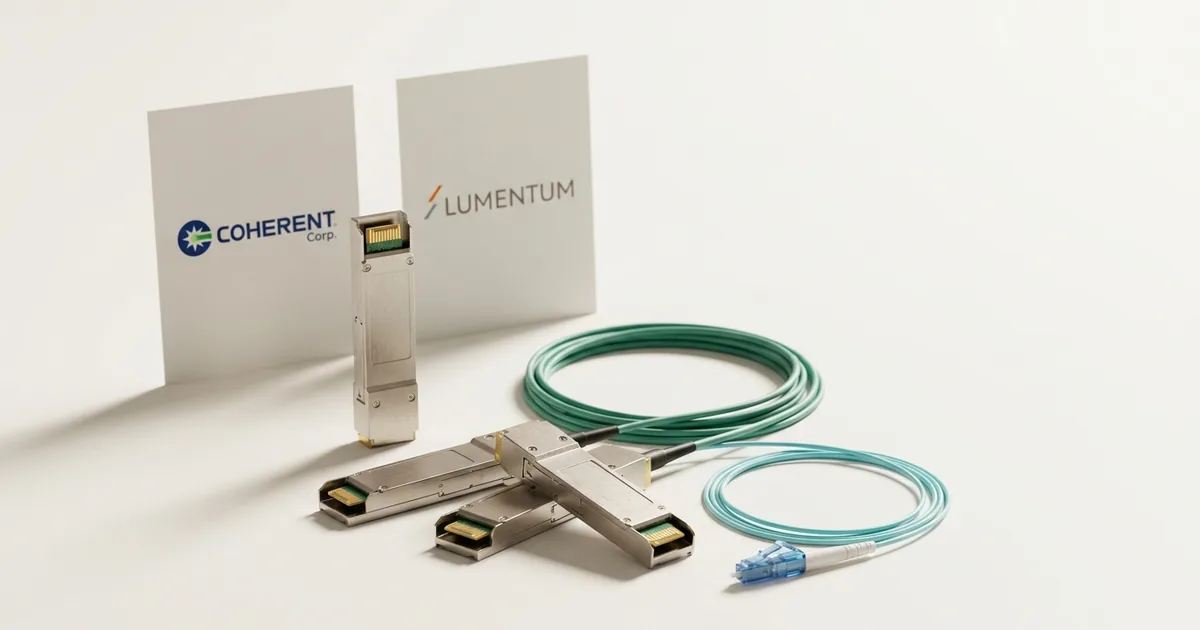
On August 4, a report that the Federal Communications Commission was drafting an import ban on Chinese optical transceivers lifted Applied Optoelectronics 17%, Coherent 11% and Lumentum 6% in a single session. Six sessions later the trade was gone: Coherent gave back 12% on Monday and Lumentum dropped 7%, and none of the three companies had released a financial number in between.
That is the tell. The August rally was not a demand signal. It was a positioning response to a rule that has not been published, does not take effect until the end of 2026, and carries a consequence its buyers priced exactly backwards.
A Rally Built on a Draft Nobody Has Read
The measure at the center of this is narrow and specific. The FCC is preparing a restriction that would block imports of new Chinese optical transceiver models, the components that convert electrical signals into light so data can move through fiber inside a data center. Officials want it published before the end of 2026, at which point it would take effect. Newsweek’s breakdown of the proposal notes that the primary target is Zhongji Innolight, which controls roughly 27% of the global data center transceiver market and books about 90% of its revenue outside China.
Read that quickly and the trade writes itself. Wall off a supplier with a quarter of the market, and the American alternatives, Coherent and Lumentum, inherit the volume. Amazon Web Services and its peers have to buy from somebody.
Read it slowly and the arithmetic gets worse. The reason Zhongji Innolight holds 27% of the market is that it can actually build at that scale. US suppliers cannot absorb that capacity on a compressed timeline, which means the near-term effect of the ban is not a windfall for domestic optics vendors. It is a cost increase and a scheduling problem for the hyperscalers building the data centers, the same companies whose spending underwrites the entire sector. Bloomberg reported that the restriction would inflict real collateral damage on those buyers, with hundreds of billions of dollars of AI infrastructure exposed to the disruption.
A policy that raises the price and lengthens the lead time of a critical component is not straightforwardly bullish for the people selling it, because their customers still have to sign the purchase orders. That nuance does not survive contact with a stock trading at 160 times trailing earnings.
Priced for Perfection, Then Priced Again
Valuation is what turned a headline reversal into a double-digit day. Coherent went into Monday at a trailing price-to-earnings ratio near 160, Lumentum near 146, and both had more than doubled year to date. At those multiples the base case is already extraordinary. There is no room left to price a policy windfall on top of it, so when the enthusiasm faded there was nothing underneath to catch the move.
The dispersion inside the session makes the point cleanly. Applied Optoelectronics, which had already delivered its results on August 6, slipped just 1% to $133.63. The two names that had not yet reported took the damage. That is not a sector rerating on changed fundamentals. That is positioning coming out ahead of a binary event, which is a different thing entirely, and it looks a lot like the leveraged unwind that hit chip ETFs in late July.
The Fundamentals Were Never the Argument Against These Stocks
Here is the awkward part for anyone reading Monday as a verdict on AI optics demand. The underlying businesses are performing about as well as businesses can.
Lumentum reported fiscal third-quarter revenue of $808 million, up 90% year over year and a company record, and guided fiscal Q4 to between $960 million and $1.01 billion with non-GAAP operating margin of 35% to 36%. Its optical circuit switch backlog has pushed past $400 million. Coherent posted fiscal Q3 revenue of $1.81 billion, up 20.5%, and told investors to expect $1.91 billion to $2.05 billion in the June quarter at gross margins of 39% to 41%.
The demand behind those numbers is not softening either. TSMC said Monday that July revenue rose 44.7% year over year to a record NT$467.58 billion, roughly $14.5 billion, and lifted its 2026 growth outlook above 40% in dollar terms. Chips are still moving. The AI buildout we tracked through the $886 billion hyperscaler capex cycle has not paused.
So the selloff was not the market deciding the optics story is over. It was the market deciding it had paid for the optics story twice, once for the fundamentals and once for a regulatory gift that may never arrive in the form it imagined.
What This Week Actually Settles
Lumentum reports fiscal fourth-quarter results after the close on Tuesday. Coherent confirmed it will follow after the close on Wednesday. Both will beat on demand, most likely. Neither can beat the expectations embedded in a 150-times multiple by beating on demand alone.
What matters in those calls is narrower than the revenue line. Watch whether either management team is willing to quantify the transceiver ban as an opportunity, and watch how carefully they hedge it. A company that genuinely expects to absorb Zhongji Innolight’s volume will say so, with capacity commitments attached. A company that knows its customers are about to face a cost shock will talk about supply agreements, qualification timelines and pricing discipline instead, and will avoid the subject the market wants to hear about.
The gap between those two answers is the whole trade. For six sessions, investors assumed the first one. They will find out this week whether the companies agree, and the fact that both stocks fell hard before anyone had to say it out loud suggests a growing number of them stopped waiting to be told.