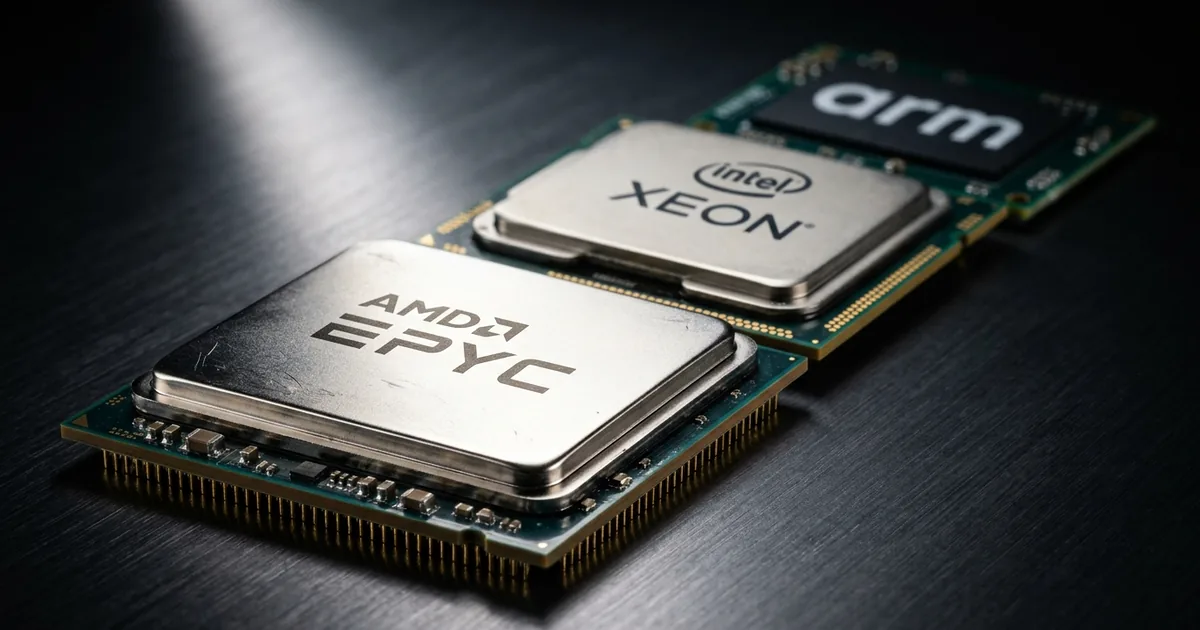
Every headline out of Monday’s session said the same thing: AMD joined the trillion-dollar club. It did not, quite. AMD needed to finish above $612.56 to hold a $1 trillion market capitalization, and it finished below it, ending the day worth about $998 billion on Koyfin data cited by Yahoo Finance. The milestone lasted a few hours of intraday trading and then expired, which is a detail worth more than the headline it undercuts, because the number that actually described Monday was somewhere else entirely. Nvidia, the company that has been synonymous with the AI trade for three years, rose 0.4%.
That is the story the milestone buried. On a day framed everywhere as an AI chip melt-up, the AI chip company barely moved, and the biggest gainers were the companies that sell central processors.
The Rally Went to the Companies Without Accelerators
Arm Holdings closed up more than 12%, and Intel closed up more than 11%, on the same tape where AMD, the name in every headline, was the weakest of the three. Semafor noted that the Philadelphia Semiconductor Index rose 4.3% for its fifth consecutive advance, and the Nasdaq posted its first record close since June.
Arm does not sell an AI accelerator. It licenses CPU architecture. Intel’s competitive position in AI accelerators is, generously, aspirational. These are the two names that led a rally every wire framed as enthusiasm for AI chips. Nvidia, which carries roughly $5.4 trillion of market value and something close to a monopoly on training silicon, was a rounding error on the day.
The trigger was not an order, a contract, or a guidance revision. As 24/7 Wall St. pointed out, no company announcement from Arm, Intel or AMD accompanied the session. What happened is that Meta’s Muse agent, which launched on September 8 with a free tier and paid tiers at $20 and $100 a month, reached number one on the free chart of the US Apple App Store. CNBC tracked the download surge at 1.8 million iOS installs against ChatGPT’s 1.3 million. Meta shares rose 11%. Several hundred billion dollars of semiconductor market value then repriced off a consumer app’s download ranking.
Why an App Store Chart Moved Intel
The mechanism is more interesting than the usual sentiment story, and it is the part the coverage mostly skipped.
Muse does not run the way a chatbot runs. Meta gives every user a dedicated Linux virtual machine, which its own announcement calls Muse Secure VM, provisioned with 2 vCPUs, 8GB of RAM and 100GB of SSD. That machine holds the user’s files, runs a browser, executes tool calls, compiles code, runs sub-agents and keeps cron jobs alive. It persists after the user closes the app.
A chatbot session is a burst of GPU inference that ends when the answer does. An agent is a computer that stays switched on. Those are different purchases. TrendForce put CPU-to-GPU ratios for some agent workloads between 4:1 and as high as 40:1, naming Intel, AMD and Arm as the beneficiaries. Bernstein’s Stacy Rasgon told CNBC’s Squawk on the Street that agentic use cases had not been aimed at ordinary consumers until now, and that broader adoption would press on a CPU supply constraint that already exists.
That constraint is not hypothetical. Intel chief executive Lip-Bu Tan has said the company can meet only half of current customer demand.
The market did not decide on Monday that AI is bigger than it thought. It decided that AI has a different bill of materials than it thought.
The Number Nobody Wants to Multiply
Run the arithmetic Meta’s own specification implies and the picture gets uncomfortable. At 100 million users, a per-user allocation of 2 vCPUs, 8GB of RAM and 100GB of SSD implies roughly 1.58 million server CPUs, about 800 petabytes of memory and around 10,000 petabytes of solid-state storage, on Wccftech’s estimate.
The CPU number is achievable. The memory number is the problem, and this site has been documenting why for a month. Memory suppliers have moved to long-term agreements with collateral attached, which is what a market does when it stops behaving like a cycle. Dell guided its AI server line lower this quarter for the specific reason that it cannot buy enough memory. Nvidia is raising AI server prices by more than 15%, and memory costs are the reason.
So the bullish case for CPUs that traders bought on Monday runs directly into a memory shortage that is already rationing servers. Those two facts were priced by the same market on the same day, in opposite directions, and almost nobody put them in the same sentence.
What We Think
The repricing is directionally right and the way it happened is not defensible.
Agent architectures genuinely do change the mix. A persistent virtual machine per user is real and durable demand for general-purpose compute, memory and storage, and a market that spent three years treating “AI compute” and “Nvidia GPUs” as synonyms was carrying an assumption that needed correcting. Arm and Intel deserve to be repriced on that. Meta, which signed a $100 billion AI chip deal with AMD in February, is a credible customer to read a signal from.
What is not defensible is the basis. App Store rankings two weeks into a launch measure curiosity, not retention, and certainly not committed server capacity. No order was placed on Monday. No company guided higher. Free-tier downloads are the cheapest signal available, and here the cost structure runs the other way: a free user who gets an always-on VM is a user Meta is paying to host. If conversion to the $20 and $100 tiers disappoints, the demand curve traders extrapolated never arrives, and the same desks will discover that a download chart was never an order book.
The honest read is that Monday was a sentiment re-rate wearing a demand signal’s clothes, pointed at roughly the right companies for roughly the wrong reason. The thing worth watching is not whether AMD reclaims $1 trillion this week. It is whether Meta discloses paid conversion and sustained VM counts, and whether memory supply can serve the CPU buildout the market just priced. Until then the most accurate number from Monday remains Nvidia’s 0.4%, the market quietly conceding that the AI trade and the Nvidia trade have stopped being the same thing.