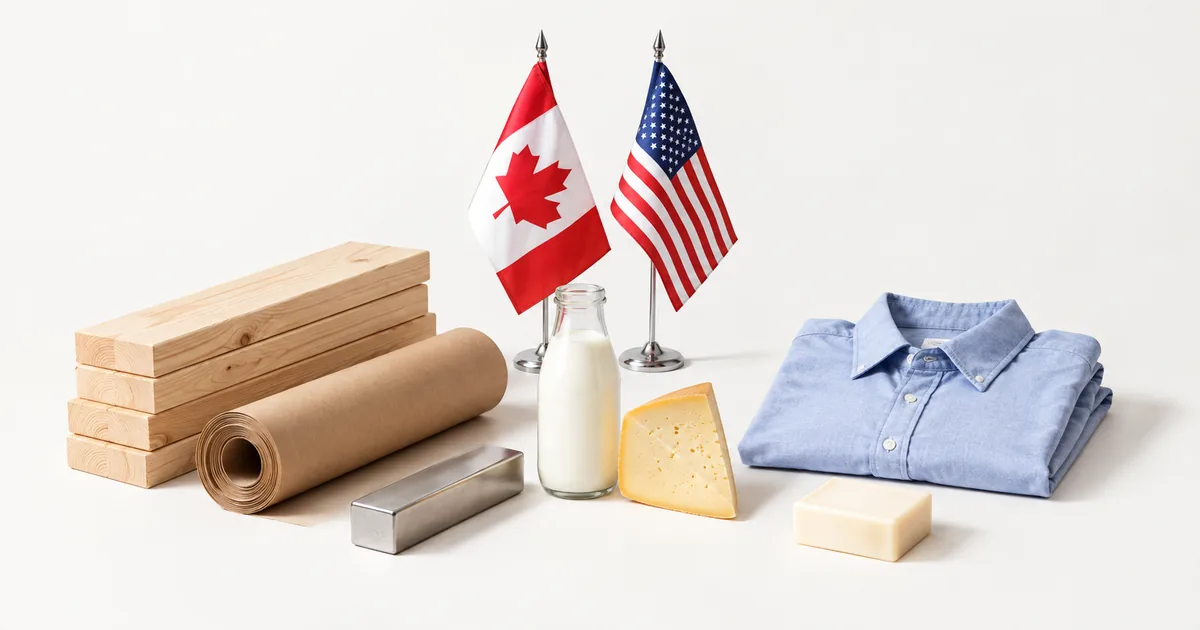
Canada’s counter-tariffs on more than 700 American products took effect Tuesday, and almost every account of them has quoted two different numbers without reconciling them. Ottawa’s own finance department puts the coverage at C$27.6 billion of US imports. Washington’s Section 338 duties, which triggered the response, hit roughly US$20 billion of Canadian goods. Those are the same pile of money. At Tuesday’s exchange rate of 1.3812 Canadian dollars to the US dollar, C$27.6 billion converts to US$19.98 billion, which is what Prime Minister Mark Carney meant by matching Washington “dollar for dollar.” The arithmetic is exact, and the precision is the point.
What almost nobody has followed through on is the other half of that symmetry. Canada has calibrated a multibillion-dollar countermeasure against a US legal authority that has never been used in its 96-year history and has never once been reviewed by a court.
The Statute Washington Reached For
The US duties rest on Section 338 of the Tariff Act of 1930, the law better known for the Smoot-Hawley tariffs that deepened the Depression. Section 338 lets the president impose duties of up to 50% on countries found to be discriminating against US commerce. President Trump invoked it against Canada on 20 July 2026, covering 554 Canadian tariff lines, and the 50% rate took effect on Saturday.
Until this summer, Section 338 was a historical curiosity. Trade researchers at Global Trade Alert note that Washington considered the provision against Spain in 1932 and against the newly Communist China in 1949, and in both cases declined to use it. No president had ever actually imposed a tariff under it. Fortune found trade lawyers who did not know the section was still on the books, one of whom described it as “literally a blank canvas.”
That is not a compliment. A blank canvas is what you get when a statute has no case law, no agency practice, and no judicial gloss telling anyone what its terms mean. The Associated Press reported that the tariffs are untested in court and raise substantial legal questions, with some lawyers arguing the Depression-era provision has been superseded by the modern trade statutes Congress passed precisely to govern this conduct.
The choice of instrument tells you why. Section 232 requires a Commerce Department investigation. Section 301 requires a USTR proceeding, public comment, and findings. Section 338 requires the president to determine that discrimination exists. That is the whole procedure. Washington did not reach for a 1930 statute because it was the best fit. It reached for it because the tested authorities come with process attached, and this one appears not to.
What Canada Actually Taxed
Read the product list Ottawa’s finance department published, reproduced in full by Global News, and the framing in most coverage starts to look off. The headlines lead with steel and aluminum, where Canada doubled its duty to 50% to mirror the American rate. Steel is on the list. So is a great deal that has nothing to do with heavy industry.
The 50% band covers milk powder, whey and cheese, natural honey and molasses, cosmetics and personal care products, plywood and charcoal, toilet paper and tissue, cardboard boxes and stationery, carpets, dresses, trousers and outerwear. The 25% band picks up sawn softwood, kraft paper, non-electric stoves and ranges, tableware and kitchen goods. Goods already in transit on Tuesday are exempt.
This is a consumer-goods list wearing an industrial-policy headline. Ottawa built it that way on purpose: these are categories where Canadian buyers have non-American alternatives and where American exporters have concentrated, politically legible constituencies. Dairy and paper producers notice a 50% wall faster than a steel mill running on long-term contracts does.
The Asymmetry Nobody Is Pricing
Here is where the two legal foundations stop being symmetrical, and it is the part of this story that markets have not worked through.
Canada’s counter-tariffs rest on ordinary Canadian statutory authority to impose surtaxes in response to foreign trade measures. That power is well established and routinely exercised. It was used in the 2018 steel dispute and again this year. If someone challenges it, the challenge is about application, not about whether the power exists.
The American tariffs rest on a provision that has never survived contact with a judge, because it has never met one. If a court voids or narrows Section 338, the US duties on roughly US$20 billion of Canadian goods come off. Canada’s counter-tariffs do not automatically come off with them. They were enacted under a separate legal regime and would require a political decision to lift, taken by a government that has just been told by its counterpart that late-stage terms could be rewritten at will. Carney suspended negotiations after saying US negotiators introduced conditions that were “unfair, uneconomic, and called into question the reliability of any deal.”
That is a genuinely bad trade for American exporters. They are carrying the retaliation now, and the thing generating the retaliation may not be durable enough to trade away later.
Our Read
Canada’s response is the more defensible half of this fight, and it is worth being direct about why. Ottawa matched a number, published the tariff lines, exempted goods in transit, and grounded the whole thing in a power it has used before and can defend in court. That is what a proportionate countermeasure looks like.
Washington’s half is the reckless one. Choosing a dormant 1930 statute over Section 232 or Section 301 was not a legal judgment about which authority fits. It was a decision to skip the investigation and the comment period, and it puts roughly US$20 billion of trade policy on a foundation that no court has ever blessed. Companies now reorganizing supply chains, signing contracts and rerouting shipments are being asked to treat as permanent a measure that a single adverse ruling could vacate. The cost of that uncertainty does not land on the people who chose the instrument. It lands on the American dairy, paper and cosmetics exporters staring at a 50% Canadian wall, and on Canadian buyers paying more for goods they used to source across the border.
If the administration believes the discrimination case is real, it should be able to make it under a statute with a record. Reaching for the one provision with no record at all is a tell.
What to Watch
Tuesday’s tape already reflects some of this. Dow futures fell 491 points, or roughly 0.9%, before the open, with S&P 500 futures off 0.4%, as traders weighed the trade escalation alongside oil pushing to six-week highs on renewed US-Iran strikes. Brent traded at $99.22, up 2.3%. The losses were led by big technology, with Apple down 2.55% and Alphabet down 2.10%, while Caterpillar rose 1.65% and Home Depot gained 0.88%, a split that says more about dollar and rate expectations than about tariff exposure.
The number that matters over the next few months is not the tariff rate. It is the litigation calendar. BusinessTech.News has tracked the Section 338 exposure since Home Depot declined to raise guidance a day before the duties landed, and the collapse of the talks in August removed the diplomatic off-ramp. The legal one is now the only ramp left, and the first court to read Section 338 closely will be doing something no court has done since 1930.