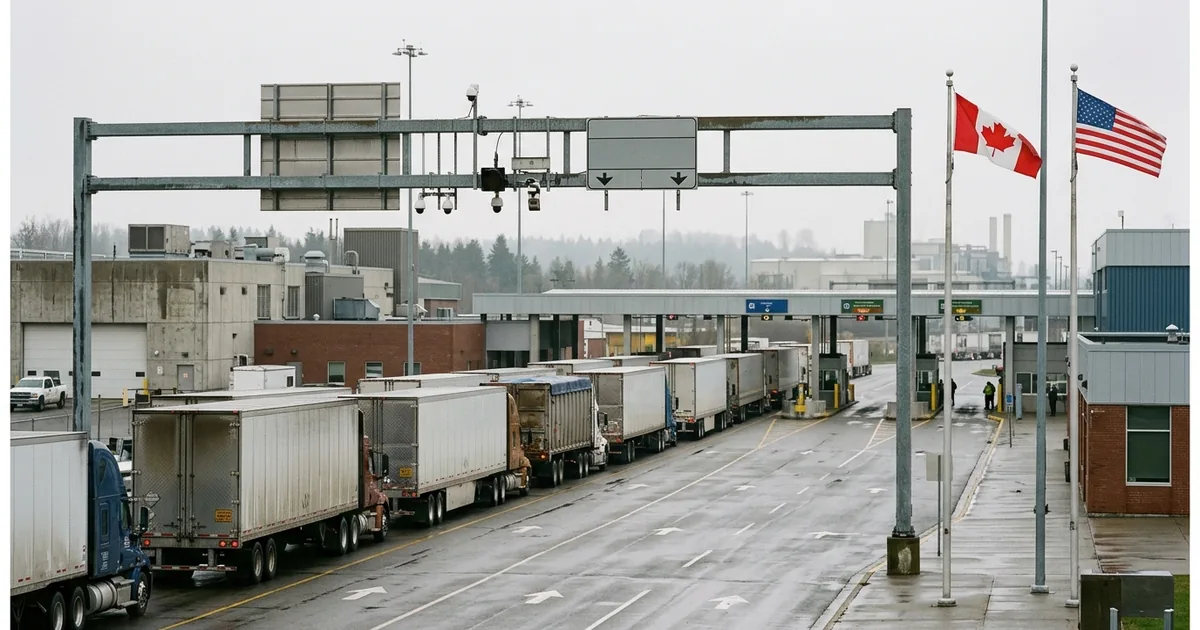
Fifty percent US tariffs on about $20 billion of Canadian goods took effect at midnight Saturday, and the list reads like a customs clerk’s fever dream: hockey sticks, building materials, liquors, certain categories of clothing. That number is small enough to be a rounding error in a $900 billion trading relationship. The reason markets should care is not the $20 billion. It is the sentence Prime Minister Mark Carney used to explain why he suspended the talks.
“In recent days, the U.S. proposed new terms that were uneconomic, unfair, and undermined the net benefits to Canada, calling into question the reliability of any deal,” Carney said in remarks delivered Saturday from Ottawa. Then the line that will get quoted for a year: “In short, they asked too much and offered too little.”
The Reliability Problem Is Worth More Than the Tariff Line
Strip away the hockey sticks and what Canada is actually objecting to is a late-stage change in terms. US Trade Representative Jamieson Greer’s counter-framing, reported by CNBC as the talks collapsed into a wave of new tariffs, was that Canada “declined to finalize the trade deal under the terms agreed earlier this week.” That concedes the same underlying fact from the other direction. Both sides agree there were terms earlier in the week. Both sides agree those terms are not the terms that were on the table Friday night.
That is a pricing problem, not a diplomatic one. A trade agreement is a long-dated instrument. Manufacturers site plants against it, procurement teams sign multi-year supply contracts against it, and lenders underwrite both. If the terms can be reopened between the handshake and the signature, the agreement’s value to a CFO drops toward the value of no agreement at all, because neither one can be planned around. Carney’s phrase, “the reliability of any deal,” is the part a treasurer reads twice.
There is precedent for the counterparty risk here, and it is not distant. The Supreme Court struck down an earlier round of Trump tariffs in February, which means importers have now watched this administration’s trade measures get imposed, litigated, vacated and reimposed inside a single fiscal year. Companies have already been booking the whiplash: Home Depot spent part of its most recent quarter working through Section 338 duties on Canadian goods, and Walmart’s latest print carried a tariff-refund line item, which is what it looks like when a retailer’s finance function has to model policy reversal as a recurring event.
What Canada Took Off the Table
Here is the detail that got buried under the hockey-stick jokes, and it is the one with actual money attached.
Canada had been willing to drop its remaining retaliatory tariffs on steel, aluminum and autos if the United States lowered its own. That offer died with the talks. So the live escalation ladder no longer runs through liquor and building materials. It runs through the integrated North American auto complex, where a single vehicle can cross the border six or seven times as components before it is finished, and where every crossing is a taxable event under a tariff regime.
Carney was specific about the retaliation: Canada will match Washington dollar for dollar, “concentrated in sectors such as steel, dairy, appliances, agricultural equipment, pulp and paper, and electronics,” with the measures coming into force, in his words, “the Tuesday after Labour Day.” That is September 8. Note what the targeting has in common. Dairy and agricultural equipment hit farm-state exporters. Appliances and electronics hit consumer-facing manufacturers with thin margins and no ability to absorb a duty quietly. This is a list assembled by someone who read an electoral map, which is the standard playbook and works about as often as it does not.
The dollar-for-dollar framing also caps the immediate damage in a way worth naming. Matching $20 billion is a deliberately proportionate response, not an escalation. Carney is signalling that he will not be the one to widen this.
The Market Read
US futures were mixed early Monday, with the Nasdaq off 0.7% and the S&P down 0.2%, though attributing that cleanly to Canada would be lazy. This is also the week of Nvidia’s earnings and the Jackson Hole symposium, and the Trump administration’s Iran sanctions package landing Monday has WTI down about 1.6% to $85.65. The tariff news is one input among several loud ones.
The cleaner signal is what Carney said about capital flows, and it cut against the narrative he was otherwise selling. Foreign direct investment in Canada, he noted, is running at its highest level in two decades and at twice the rate of the nearest G7 competitor. A leader announcing a trade war does not usually volunteer that his economy is fine. He does it when he needs domestic room to refuse a deal, which tells you the political constraint here is at least as binding as the economic one. As NPR reported while Canada readied its response, Carney went further and described his country as “at war” with the United States, language a central banker turned prime minister does not reach for casually.
For US importers, the practical exposure is not September 8. It is the discovery that the terms of a negotiated settlement are provisional until the ink is dry, and sometimes after. That is not a cost you can hedge. It is a cost you price into every cross-border commitment you make for the rest of the administration, and it does not show up on any tariff schedule.
Watch the auto sector first. That is where the next move gets made, and neither side has spent its leverage there yet.