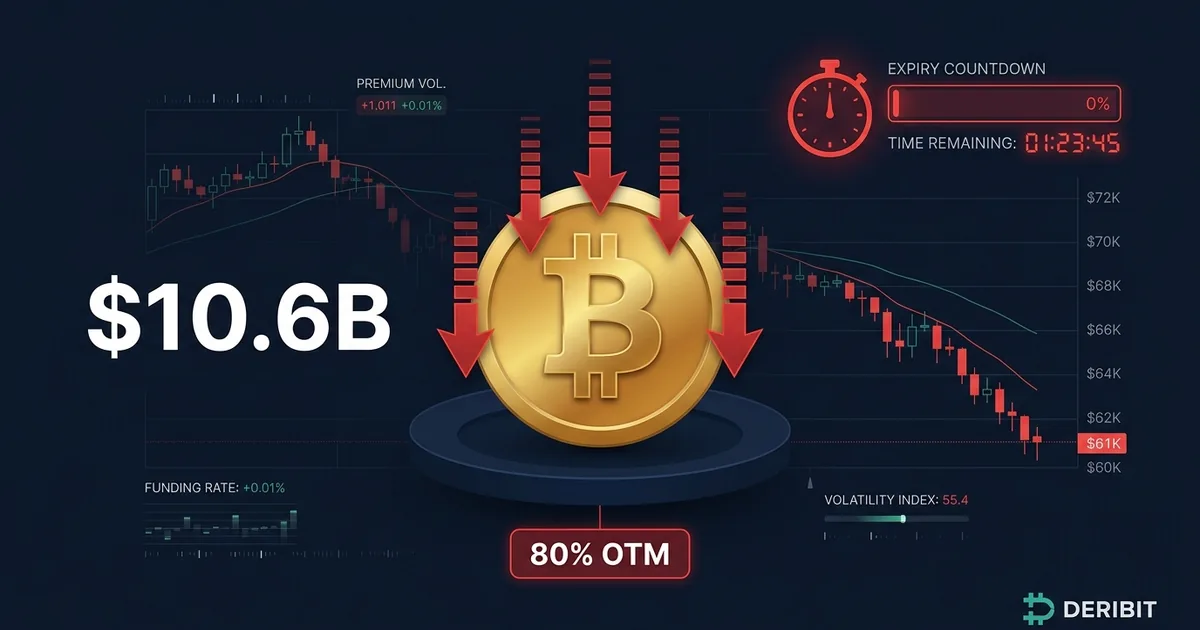
More than $10.6 billion in Bitcoin options expire today on Deribit, making it the largest quarterly settlement of the year and one of the most consequential derivatives events in crypto’s recent history. The problem: roughly 80% of that open interest, about $8.6 billion, is sitting underwater, dominated by bullish call options that were placed when Bitcoin was trading significantly higher.
Bitcoin is currently hovering near $60,000, well below the max pain price of $74,000 where most options would expire worthless. The gap between where traders bet Bitcoin would be and where it actually is creates the conditions for a volatile session.
Why This Expiry Is Different
Quarterly options expiries are routine. This one is not. Crypto Briefing reported that the expiry could compound Bitcoin’s recent selloff because the standard assumption that options settlement is a non-event, that prices drift toward max pain and then normalize, has broken down this cycle.
The max pain theory, which holds that the price gravitates toward the level where the most options expire worthless, has been overwhelmed by a more powerful force: spot ETF outflows. Approximately $6 billion has flowed out of U.S. spot Bitcoin ETFs since mid-June, draining the buy-side support that had been propping up Bitcoin’s price throughout the spring rally.
Negative dealer gamma is amplifying the moves. When dealers are short gamma, as they are heading into this expiry, they are forced to sell when the price drops and buy when it rises. That mechanical dynamic means any move in either direction gets amplified rather than dampened.
The Key Price Levels to Watch
The $60,000 put strike holds $450 million in open interest and has emerged as the critical support level heading into expiry. If Bitcoin breaks below $60,000 during settlement, the cascade of in-the-money puts being exercised could trigger forced selling that pushes the price even lower.
On the upside, the $80,000 call strike carries $406 million in exposure but looks increasingly unlikely to come into play. The max pain price at $74,000 is roughly 14% above current levels, a gap too wide to close in a single session under normal conditions.
What It Means for the Broader Crypto Market
The expiry arrives at a fragile moment for crypto markets. Bitcoin has dropped from above $72,000 in early June to the low $60,000 range, a decline driven by a combination of ETF outflows, profit-taking after the spring rally, and macro headwinds as the Federal Reserve continues to signal patience on rate cuts.
Ether options are also expiring today, with approximately $3.8 billion in additional open interest at stake. The combined $14.4 billion in crypto options expiring in a single session creates the kind of concentrated risk event that institutional traders watch closely, not because the expiry itself moves markets, but because the positioning around it reveals where the market’s actual center of gravity sits.
The Institutional Takeaway
For traditional finance observers watching Bitcoin’s maturation as an asset class, today’s expiry is a useful stress test. The derivatives market has grown large enough to influence spot prices, the ETF flows have become a dominant force in price discovery, and the mechanics of options settlement now interact with margin-backed positions in ways that create genuine systemic risk within crypto markets.
Whether Bitcoin holds $60,000 or breaks lower through settlement will say less about Bitcoin’s long-term value and more about whether the market’s plumbing can handle the strain of a $10.6 billion unwind.