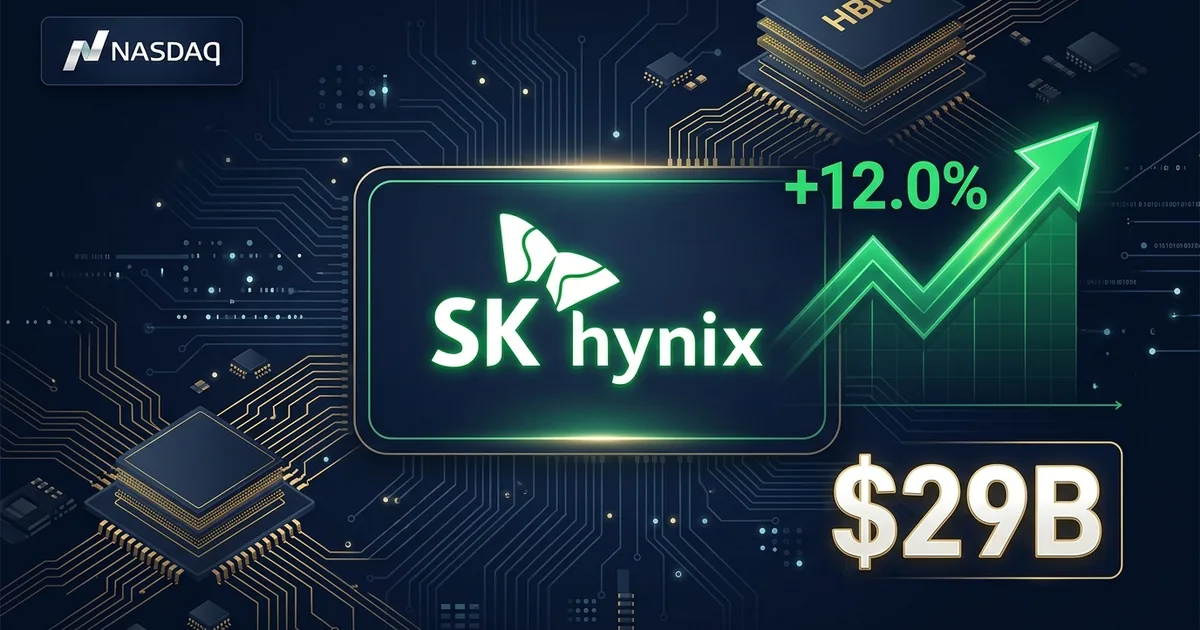
SK Hynix is about to pull off the largest ADR offering in stock market history. The South Korean memory giant confirmed plans to raise up to $29.4 billion through a Nasdaq listing, eclipsing Alibaba’s $21.8 billion New York debut in 2014 and trailing only SpaceX’s $85.7 billion IPO earlier this month as the biggest share sale of the year.
The stock surged 12% on the announcement, a move that underscores just how hungry investors are for pure-play exposure to the AI memory boom.
Inside the Deal
SK Hynix plans to issue 17.79 million new shares as American depositary receipts on the Nasdaq Global Select Market, with an indicative raise of 45.45 trillion won ($29.65 billion). Trading is expected to begin July 10, with subscription and payment on July 14 and the new Korean shares listing on July 29.
The timeline is aggressive but reflects a semiconductor sector that has learned to move fast when the capital window opens. AI memory demand is not cyclical in the traditional sense: hyperscale buyers are locking up capacity with multi-year contracts, and the companies that build fabs fastest win those contracts.
Where the Money Goes
Every dollar of the proceeds is earmarked for manufacturing expansion. The largest allocation goes to building the Y1 fab at SK Hynix’s Yongin semiconductor cluster, a facility designed to produce next-generation HBM (high-bandwidth memory) chips at scale. Additional funds will go toward constructing and equipping the Cheongju P&T7 advanced-packaging fab for AI memory, plus purchasing chipmaking equipment including extreme-ultraviolet (EUV) lithography scanners from ASML.
This is not a diversification play or a balance-sheet exercise. SK Hynix is taking $29 billion from American investors to build the factories that will supply American AI companies with the memory they cannot get enough of. The circular logic of the AI investment cycle has never been more explicit.
The Competitive Context
SK Hynix is currently the dominant supplier of HBM chips, holding an estimated 50% to 53% market share ahead of Samsung and Micron. That position is not guaranteed. Samsung has been shipping HBM4E samples and is investing heavily to close the gap. Micron just posted record Q3 results, with $41.46 billion in revenue and $100 billion in locked-in customer agreements.
The Nasdaq listing gives SK Hynix a direct line to U.S. institutional capital and a U.S.-traded security that pension funds, ETFs, and retail investors can access without navigating the Korean exchange. That matters strategically: TechTimes reported the listing details as the company positions itself as the memory supplier of choice for a U.S.-centric AI infrastructure buildout.
What It Signals for the AI Supply Chain
The size of this raise tells you something about where the AI hardware cycle sits. SK Hynix is not raising $29 billion because the market is uncertain. It is raising $29 billion because demand visibility is so strong that the constraint is not orders but fabrication capacity.
DRAM contract prices have climbed 80% to 90% this quarter. HBM commands even steeper premiums. The downstream effects are already visible: Apple and Microsoft both announced consumer hardware price increases this week, directly attributing them to memory costs. The companies buying AI memory at premium prices are the same companies whose consumer products are getting more expensive because of it.
For investors, the SK Hynix listing offers the most direct bet available on the thesis that AI infrastructure spending is structural, not cyclical. For the rest of us, it confirms that the companies making memory chips have more pricing power right now than the companies putting them into laptops.