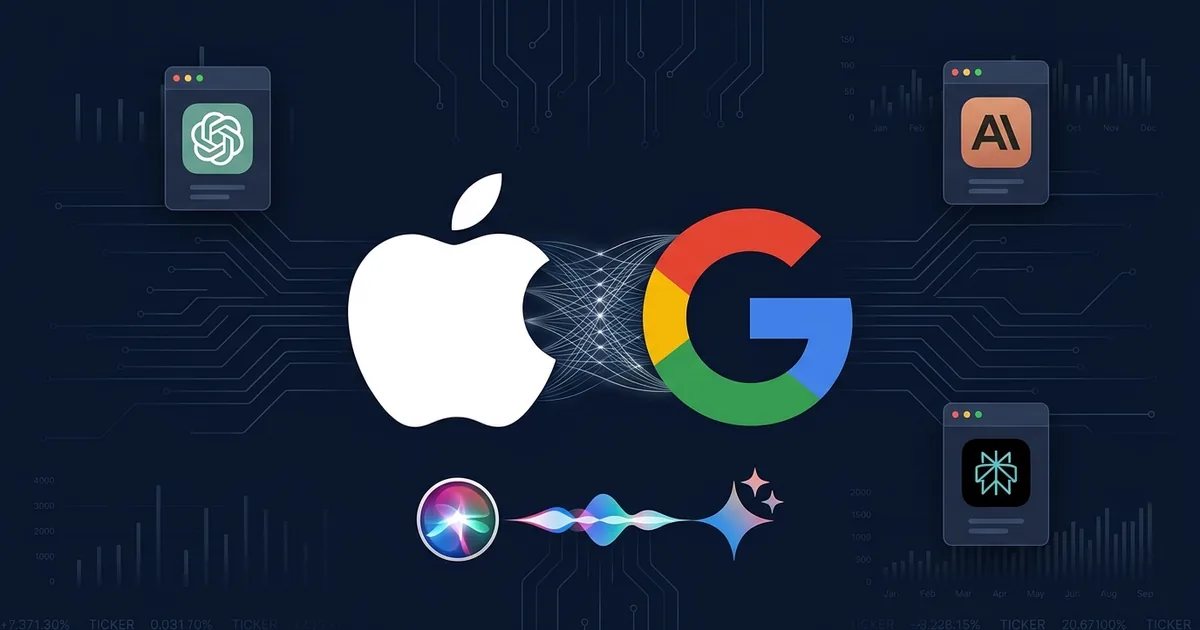
Tim Cook walked onto the Apple Park stage for the last time as CEO on June 8 and announced the most significant pivot in Apple’s AI strategy since the company first shipped Siri in 2011. The rebuilt assistant runs on a custom 1.2-trillion-parameter Google Gemini model under a multi-year deal worth roughly $1 billion per year, and a new iOS 27 framework called AI Extensions lets users swap in ChatGPT, Claude, Grok, Copilot, or Perplexity as their default assistant. Apple is not building the AI. Apple is taxing it.
The Gemini Deal Changes the Economics of AI Distribution
The headline number is the deal itself: approximately $1 billion a year flowing from Apple to Google for access to Gemini’s frontier model. In return, Google gets its inference running on 1.4 billion active iPhones worldwide. That distribution footprint is larger than any AI company can reach on its own, and it instantly makes Gemini the default AI experience for hundreds of millions of users who never downloaded a standalone chatbot.
For Alphabet, the timing is strategic. The company just confirmed an $84.75 billion equity capital raise to expand AI infrastructure, including a $10 billion private placement from Berkshire Hathaway. Locking in Apple as a distribution channel for Gemini justifies a portion of that spend by guaranteeing volume at the inference layer. For Apple, the deal sidesteps the billions in training costs that OpenAI, Anthropic, and Google have poured into foundation models. Cupertino gets a frontier AI product without building one.
AI Extensions Turn the iPhone Into an AI Marketplace
The deeper structural move is iOS 27’s AI Extensions framework. Users can choose their default AI provider from a curated list: ChatGPT, Claude, Gemini, Grok, Copilot, or Perplexity. Each provider plugs into system-level hooks, including Siri’s new dedicated app, multi-step command chains, and Dynamic Island integration. The experience is native, not a web view buried in Settings.
This is the platform play. Apple is positioning itself as the distribution layer for AI, the same way it positioned itself as the distribution layer for apps in 2008. Every AI company that wants iPhone-native access will route through Apple’s terms, Apple’s review process, and eventually Apple’s revenue share. The competitive implications are stark: OpenAI and Anthropic gain access to a billion-plus devices, but they also become tenants on Apple’s platform, subject to the same pressure Apple has exercised over app developers for nearly two decades.
The framework also creates a new competitive dynamic among AI labs. Being selected as a default or featured provider on iOS 27 becomes a distribution advantage worth more than any benchmark score. Expect aggressive deals, subsidized API pricing, and exclusivity negotiations as AI companies fight for placement on the world’s most valuable mobile platform.
Tim Cook’s Exit Sets the Stage for John Ternus
Cook’s final keynote was a deliberate passing of the torch. His successor, hardware chief John Ternus, inherits a company whose AI strategy is now clearly defined: own the interface, outsource the model. The approach mirrors Apple’s historical playbook with components, where Samsung manufactures displays and TSMC fabricates chips, but Apple captures the margin on the finished product.
Investors will be watching whether the revamped Siri can reverse a slowing iPhone upgrade cycle. BTN previously covered Apple’s WWDC preview and the AI accountability questions surrounding Cook’s final act. The answer is now on the table: Apple is betting that AI-powered features, not hardware specs, will drive the next wave of upgrades.
Who Wins, Who Loses, and What Comes Next
The winner’s list starts with Google. Gemini gets default placement on the planet’s most premium consumer device, a distribution moat that no amount of marketing spend could replicate. Apple wins by avoiding the capital-intensive model-training arms race while still shipping a competitive AI experience. Berkshire Hathaway’s $10 billion bet on Alphabet looks better by the hour.
The losers are more nuanced. OpenAI and Anthropic gain iOS distribution through Extensions but cede platform control to Apple. Samsung and Android OEMs face a widened feature gap unless Google extends similar Gemini capabilities to the broader Android ecosystem. And Siri’s old on-device model is simply gone, replaced by cloud inference that raises new questions about latency, privacy, and Apple’s famous “what happens on your iPhone stays on your iPhone” positioning.
The MacRumors WWDC breakdown noted that iOS 27 Beta 1 shipped the same afternoon as the keynote, putting the new Siri in developer hands immediately. The speed signals urgency: Apple knows it is late to the AI race and is compressing the timeline between announcement and availability.
The real test arrives this fall when iOS 27 ships to consumers. If the Gemini-powered Siri delivers the kind of multi-step, context-aware interactions that ChatGPT and Claude have normalized, Apple’s platform tax on AI becomes one of the most consequential business model decisions in tech. If it stumbles, Cook’s successor inherits both the company and the blame.