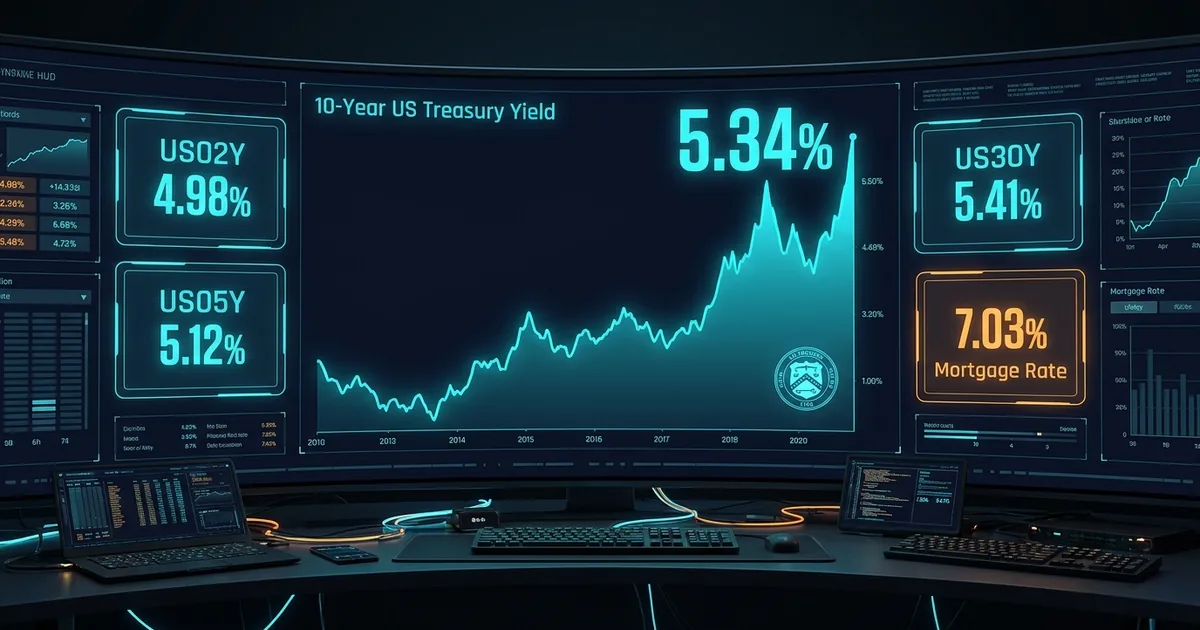
The 10-year Treasury yield touched 5.34% on Thursday, a level last seen in 2002, before buyers pulled it back to about 5.24%.
Here is what is established:
- The 10-year yield eased 5 basis points to 5.243% by the close, and the 30-year, which also hit a 24-year high, fell back to 5.613%.
- The Fed raised its target range to 3.75% to 4.00% on September 16, its first hike in more than three years, with a median forecast for one more this year.
- Freddie Mac put the average 30-year mortgage at 7.03% on September 24, the first reading above 7% in 20 months.
- The selloff was global. The UK 30-year gilt crossed 6% and France’s 10-year yield neared 5%, according to CNN.
The headline reading is “hot economy, so the Fed keeps hiking.” That is only half the story, and the other half is where the money is.
The Gap the Fed Cannot Explain
Do the subtraction. The top of the fed funds range is 4.00%. The 10-year closed Thursday at 5.243%. That is a spread of 1.24 percentage points.
Now assume the Fed delivers the one more hike its own forecast implies. The top of the range goes to 4.25%. The 10-year, at today’s level, still sits about a full point above it.
Normally a long yield above the policy rate pays you for expected hikes. Here the hikes are mostly priced already. Futures put the odds of a move at the October 27-28 meeting at 34%, down from about 51% on September 29.
So the market is demanding a full point on top of a Fed it already believes. That premium has a name: term premium. It is the extra yield investors want for locking money up in a government that keeps issuing more debt.
What the Auction Told Us a Week Ago
We saw a small version of this on September 24. The Treasury sold $70 billion of five-year notes at 5.033% and primary dealers were left holding $11 billion of them.
Dealers are the buyers of last resort. When they end up with that much supply, real money is not stepping in at the offered price.
Thursday’s bounce shows what rescues the market. It was not a change in view about US debt. It was trouble elsewhere: concern over France’s fiscal and political situation sent investors into Treasuries as a haven.
A bid that exists only because someone else looks worse is not a floor.
Why You Feel It in Your Wallet
Mortgages track the 10-year, not the fed funds rate. That is why the Fed hiking by a quarter point has been followed by a mortgage rate above 7%.
A year ago the same loan averaged 6.30%. The September 24 reading was the fifth straight weekly increase.
The same math hits companies. Every bond a corporation refinances this quarter prices off a benchmark that moved more this quarter than in any since the turn of the century, per CNN’s read of the data.
“The 30-year Treasury yield could rise to 6%.” Anshul Pradhan, Barclays, as cited by the Seoul Economic Daily
Six percent on the long bond would be the highest since June 2000.
Where BTN Stands
The October meeting is the wrong thing to watch. A hold or a hike moves the front of the curve by a quarter point. The long end is saying the Fed is not the one setting the price of money anymore.
If you own anything that depends on cheap long-term financing, housing, commercial real estate, leveraged buyouts, a capex-heavy AI build-out, assume 5%-plus is the base case and plan from there. Nobody should be calling this a spike.
Today’s jobs report, due at 8:30 a.m. Eastern, will shift the odds on the next Fed move. It will not close a gap that the Fed did not open.