Micron beat on every line Wednesday night, and the stock still faded after the bell because the company plans to spend about $25 billion on construction and equipment in the next six months.
- Revenue for the fiscal fourth quarter was $54.23 billion, with GAAP net income of $37.70 billion, according to Micron’s own results release.
- Capital spending is guided to roughly $11.5 billion in the first quarter and $25 billion across the first half of fiscal 2027, per the call highlights Yahoo Finance summarized.
- Customers have committed $32 billion under strategic agreements, most of it as cash deposits, according to the same summary.
- Shares dipped in extended trading, which TradingKey tied to the capex outlook rather than to anything in the quarter itself.
Few write-ups put the last two bullets next to each other. The market sold the first number and ignored the second, and the second is the reason the first is not scary.
The Customers Are Paying for the Cleanrooms
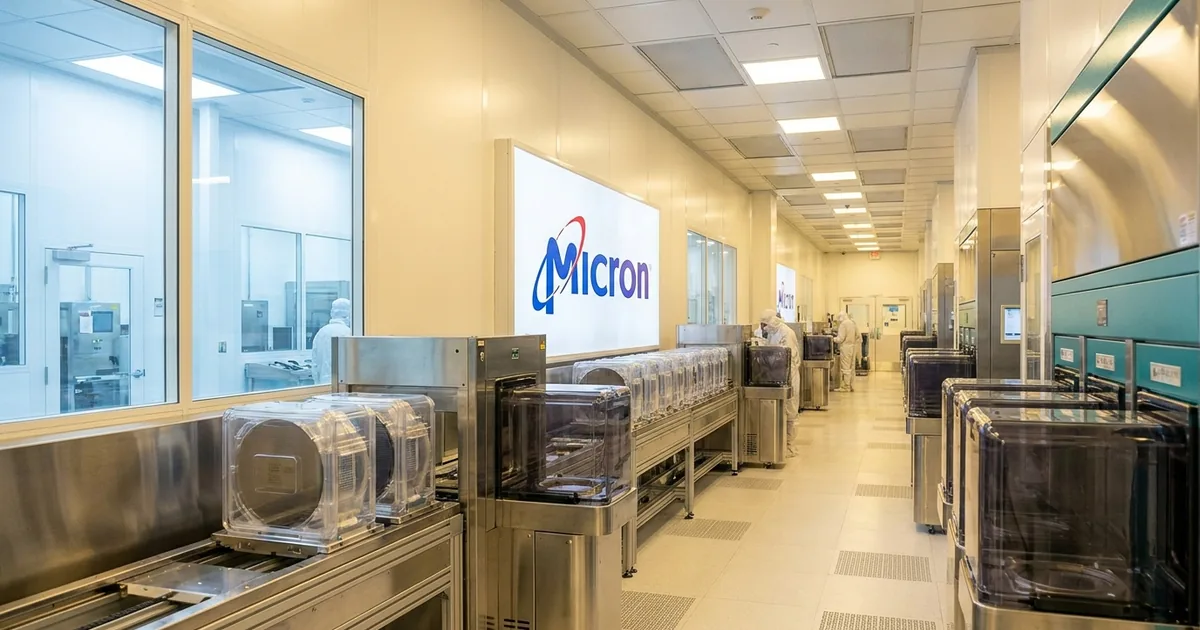
Start with what the spending is for. Management said most of the increase goes to construction, mainly cleanroom space that comes online in late calendar 2028 and beyond.
That is capacity for a market the company can already see. Micron says 26 multi-year strategic customer agreements now cover more than 35% of its revenue through 2030.
Those agreements are not handshakes. The customers have put up $32 billion in financial commitments, mostly cash.
Compare the two figures. The deposits are about 1.3 times the capex Micron plans for the next six months.
Now compare capex with what the business throws off. Fourth-quarter operating cash flow was $43.97 billion. One quarter of cash generation is nearly twice the half-year construction budget.
Net capex for all of fiscal 2026 was $27.37 billion, against $89.68 billion of operating cash flow and $62.31 billion of adjusted free cash flow. The balance sheet holds $73.48 billion in cash and investments against $5.18 billion of debt.
That is not a company stretching to fund a build. It is a company being paid in advance to build.
What the After-Hours Dip Was Really Pricing
So why did the shares slip? The honest answer is that investors were looking at the wrong ratio.
Capex up is a bad sign in a normal memory cycle, because capex up historically meant supply up and prices down. Memory has burned buyers of that story many times.
This time the supply is spoken for. Micron told analysts that memory and storage conditions will stay much tighter through fiscal 2027 and 2028, with DRAM pricing up in the high teens in the quarter. Gross margin was about 87%, and the company called its first-quarter guide of roughly 86% the low point for the year.
The old reflex says a peak margin plus rising capex equals a top. The deposits say the buyers have already signed for the output, at prices set in advance.
Here is where BTN lands. The capex fear is mispriced, and the market is pointing at the wrong side of the trade. The risk in this story has moved off Micron’s balance sheet and onto its customers’.
Think about who is writing the $32 billion in checks. Micron does not name them, but the demand it cites is AI infrastructure, and the AI builders whose books we can read are stretched. We covered one of them two days ago, and its prospectus shows $518 billion in infrastructure commitments against about $20 billion in cash.
Micron is protected if those buyers stay solvent and keep buying. If one of them cannot finish a build, Micron keeps the deposit but also holds a cleanroom sized for a customer that is no longer there.
That is the scenario to watch, and it is a customer-credit question, not a capex question.
Questions Readers Are Asking
Did Micron’s results actually miss anything?
No. Non-GAAP earnings were $33.42 a share against a consensus near $31.61, and revenue rose 31% from the prior quarter and 379% from a year earlier, according to the results release and the earnings coverage that followed.
What does Micron guide for next quarter?
Revenue of $61.5 billion, give or take $1.5 billion, with non-GAAP earnings of about $38.15 a share and a gross margin near 86%, per the call coverage at SSBCrack.
Is this the same Micron that crossed $1 trillion?
Yes. The stock first topped a $1 trillion market cap on June 1, on the same shortage thesis the deposits now back up.
The cleanest test of this reading arrives with the next call. If the $32 billion in commitments grows while capex holds near $25 billion a half, the deposits are doing their job. If the commitments stall and the capex keeps climbing, the market was right to flinch.