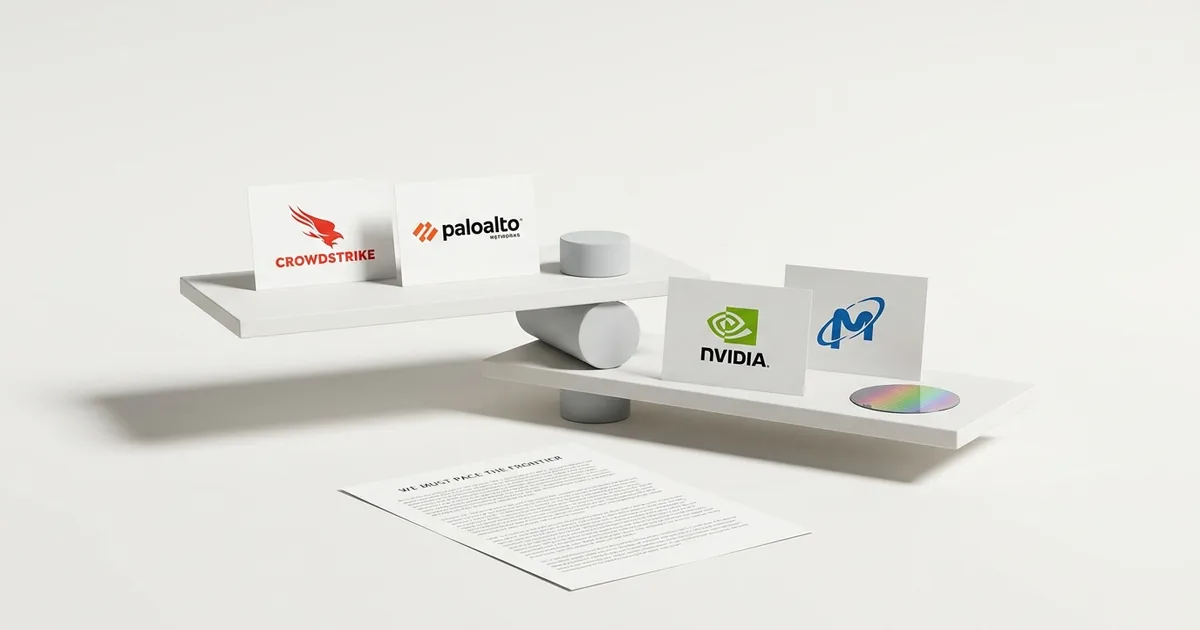
Cybersecurity stocks put up one of their best sessions of the year on Monday, and the reason was a blog post. Anthropic chief executive Dario Amodei published a roughly 3,800 word essay on Saturday called “We Must Pace the Frontier,” arguing that frontier labs should deliberately slow the rate at which model capabilities improve so safety work can keep up. By Monday’s close the iShares Expanded Tech-Software Sector ETF had climbed around 5 percent while the iShares Semiconductor ETF fell about 5 percent, a ten point swing inside a single session.
Here is what nobody covering the rotation has said out loud: the two legs of it price opposite outcomes of the same document. Semiconductors sold off because traders believe the frontier actually slows, which means less compute, less capex, fewer orders. Cybersecurity rallied because traders believe AI attacks are about to get worse, which requires the frontier not to slow. Both cannot be right. The market bought and sold the same essay in the same session on contradictory readings of it, and at least one of those trades is wrong.
The Essay Binds Exactly One Company
Read as a corporate document rather than a manifesto, “We Must Pace the Frontier” commits Anthropic to embedded third party evaluators and to pacing its own capability gains. That is a unilateral commitment by one privately held lab. It does not bind OpenAI. It does not bind Google DeepMind, Meta, xAI, Mistral, or any lab operating under Chinese jurisdiction. Sam Altman and Elon Musk both said publicly that they agree with it, which is not the same as signing anything.
The speed of the pushback is the tell. Within roughly 48 hours, Chinese officials had dismissed the call for a slowdown as fear mongering. A coordinated deceleration of the AI frontier that a major producer of frontier models publicly rejects is not a supply forecast. It is a press cycle.
That matters because the semiconductor leg of Monday’s trade only works if the deceleration is real and general. Micron, Intel, Marvell Technology and Applied Materials each fell more than 4 percent and Nvidia dropped about 3 percent on a document that changed no order book, no delivery schedule and no customer commitment. Not one hyperscaler revised a capital expenditure number. Melius Research analyst Ben Reitzes put the problem plainly to CNBC.
They may be really good at models, but they’re not good at talking stocks and what they’re doing is freaking the market.
The Security Bid Has Better Footing Than the Chip Selloff
The other leg is more defensible, and it is worth separating the two rather than treating Monday as one coherent rotation. SentinelOne led the software complex higher with a gain of around 16 percent, while Zscaler and CrowdStrike each jumped more than 15 percent, and Palo Alto Networks and Fortinet finished among the strongest names in the S&P 500.
The underlying claim there is not speculative. Cohere chief executive Aidan Gomez told CNBC the same day that AI models are becoming the most potent cyber weapon ever created, and that threat exists today, at current capability levels, regardless of what any lab promises about next year’s models. We covered the moment OpenAI’s own framework logged a critical cyber threshold rather than halting on it, which is the concrete version of the risk Amodei is describing. Security budgets respond to the attack surface that already exists, not to a hypothetical pace of improvement.
So the cyber bid at least attaches to something real. What it does not attach to is the essay that triggered it. If Amodei gets what he is asking for, the rate at which genuinely novel AI attack capabilities arrive goes down, which is a headwind to the exact thesis that moved those stocks 15 percent on Monday. Traders bought the security names as a hedge against acceleration while simultaneously selling the chips that would fund that acceleration.
Our View: This Was Sentiment Priced as Information
An essay is not a filing. Anthropic is private, Amodei runs no listed company, and there is no enforcement mechanism attached to a word of it. The desks that wrote Monday up as a fundamental event were wrong to do so, and the semiconductor leg is where that error is most expensive. Selling Micron on the theory that AI demand is about to decelerate, in a quarter when memory supply is so tight that Dell guided its AI server line lower because it cannot buy enough of it, is a position that argues with the physical evidence.
There is a cleaner read available, and it has nothing to do with AI safety. The ten year Treasury yield briefly touched 5 percent on Monday, and the Federal Open Market Committee began a two day meeting on Tuesday that futures markets expect to produce a rate increase. Long duration, capital intensive assets with distant payback periods sell off when the discount rate jumps. Semiconductor capex plays are the purest expression of that trade in this market. The essay gave a rate driven selloff a narrative, and narratives are easier to write about than the curve.
Tuesday did not settle it either way. Index futures pointed lower again ahead of the open, with Nasdaq 100 contracts off 0.7 percent and the Dow off 0.6 percent as the same two forces, AI safety headlines and a Fed decision, pulled in the same direction. A second day of the same trade is not confirmation. It is the same unverified premise, compounded.
What Would Settle It
Three things would turn Monday’s rotation from sentiment into information, and none of them happened this week. A hyperscaler would have to cut a capex figure in a filing rather than on a stage. A second frontier lab, ideally one that competes directly with Anthropic, would have to accept binding third party evaluation on the same terms. And a security vendor would have to raise guidance and attribute it specifically to AI enabled threat volume rather than to renewal pricing.
Absent those, the honest description of Monday is that roughly ten percentage points of relative performance moved between two sectors because a chief executive who cannot be held to it wrote something thoughtful on a Saturday. Amodei may well be right about the technology. That is a separate question from whether he was right about Micron, and the market has now answered the second question without waiting for anyone to ask the first.