Most of the coverage of Apple’s surprise Mac refresh has treated it as a spec bump with an interesting backstory, repeating the line from The Information that the company was caught off guard by business demand. That framing misses what the launch actually reveals, because three facts in it only make sense together. Apple gave its first 2nm processor to a $899 desktop instead of to the iPhone, reversing a hardware hierarchy it has maintained for roughly two decades. It raised the price of that desktop by 50% over two years. And it did both for a customer segment it reportedly has no dedicated engineering team, no developer relations staff and no AI strategy to serve. Apple has stumbled into the most interesting hardware business it has started in years, and it is not organized to keep it.
The Node Went to the Mac First
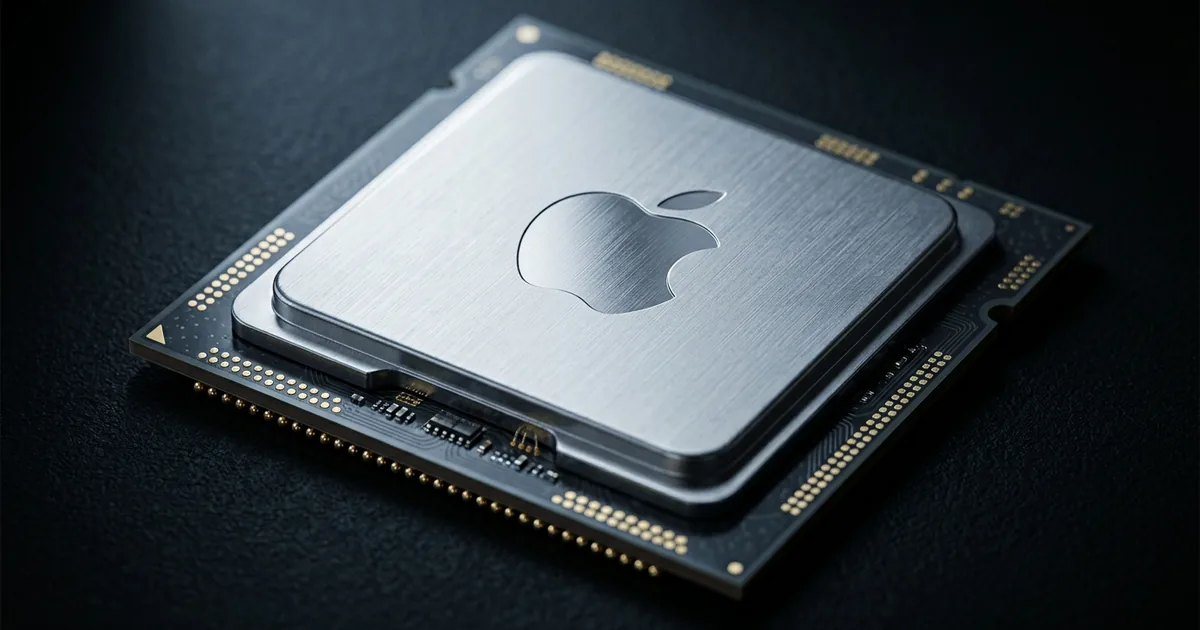
Apple announced the M6 on August 25, and TrendForce identified it as the company’s first chip built on TSMC’s 2nm process, with about a 30% AI GPU compute gain over the M5. The chip carries a 12-core CPU, a 12-core GPU and Apple’s first dual Neural Engine, two 16-core engines where prior chips had one.
The order of that rollout is the part worth stopping on. Apple has traditionally introduced each new process node in the iPhone’s A-series first, then migrated it to Mac silicon a cycle later. This time the sequence is inverted: the iPhone 18’s A20 Pro, targeting the same N2 node, does not arrive until the fall event in September. The cheapest desktop Apple sells got the company’s most advanced silicon before its most profitable product did.
Companies do not casually rearrange a twenty-year product hierarchy. They do it when the demand signal is loud enough to override the plan.
The Prices Went Up, Not Down
Apple also raised prices, which is the detail that quietly contradicts the “caught off guard by demand” framing. Being surprised by demand does not usually produce a price increase within the same announcement, unless you cannot make enough units.
- The Mac mini now starts at $899, up $100 from the prior generation, and $300 above the $599 the M4 model launched at in October 2024, a 50% increase in under two years.
- The Mac Studio with M5 Ultra starts at $5,499, roughly $200 above the M3 Ultra it replaces.
- The M5 Max Mac Studio holds at $2,499.
- Pre-orders opened immediately, with deliveries starting September 22.
Forbes noted how unusual the timing was, landing weeks before Apple’s iPhone event rather than in the October or November window where Mac announcements normally sit. Apple moved a launch out of its own most valuable marketing period. That is a supply-and-demand decision, not a marketing one.
The Buyer Changed
The reason is that the customer for these machines is no longer primarily a developer or a video editor. MacRumors, citing The Information’s reporting, described unexpectedly strong enterprise appetite for local AI hardware, with Apple promoting the machines at a business event featuring executives from Ford, Disney and Anthropic, where the Mac mini was reportedly the standout.
The product decisions line up with that. Apple emphasized clustering multiple Mac Studios into a single system to run large frontier models, a capability with essentially no consumer application and an obvious enterprise one. Companies want inference that runs inside their own network, on their own data, without a per-token bill or a vendor dependency. A rack of Mac Studios is an unusual answer to that, and at current cloud pricing it is not an irrational one.
Which reframes the $899 price. Compared with a Windows mini PC, an $899 Mac mini looks expensive. Compared with a monthly GPU cloud invoice, it is a rounding error. Apple has repriced the Mac against a completely different alternative, and the market accepted it.
What Apple Does Not Have
Here is where the story stops being a success. The same reporting says Apple did not have an engineering team dedicated to business customers, did not have staff focused on developer relations, and had no enterprise AI strategy. Meanwhile a global memory shortage has left high-end configurations out of stock for months, and some enterprise buyers have moved to alternatives including Nvidia’s DGX Spark.
That is a company winning a market by accident and losing customers inside it at the same time. The demand arrived, the supply did not, and there is no organization standing between the two. Enterprise buyers do not tolerate that for long. They need roadmaps, volume commitments, support contracts and someone to call, and every quarter Apple treats this as a pleasant surprise is a quarter a competitor uses to sign the accounts properly.
Our Read
Apple should stop describing this as unexpected and start resourcing it. The evidence that this is structural rather than a spike is already in Apple’s own behavior: you do not invert your silicon rollout, skip your launch window and raise prices twice on a fluke. The company has been handed a genuine position in local enterprise inference, built on the one advantage its competitors cannot copy quickly, which is unified memory at a price and power envelope nobody else reaches.
What it lacks is boring and fixable: enterprise sales coverage, developer relations, supply commitments that survive a memory shortage, and a public roadmap a chief information officer can plan against. Nvidia has all of that and a weaker consumer story. If Apple treats this as a hobby for another two cycles, the DGX Spark defections stop being anecdotes and start being the market.
The M6 in a $899 box before the iPhone was the tell. Apple already knows where the demand is. The question is whether it will admit it on an earnings call and staff accordingly.