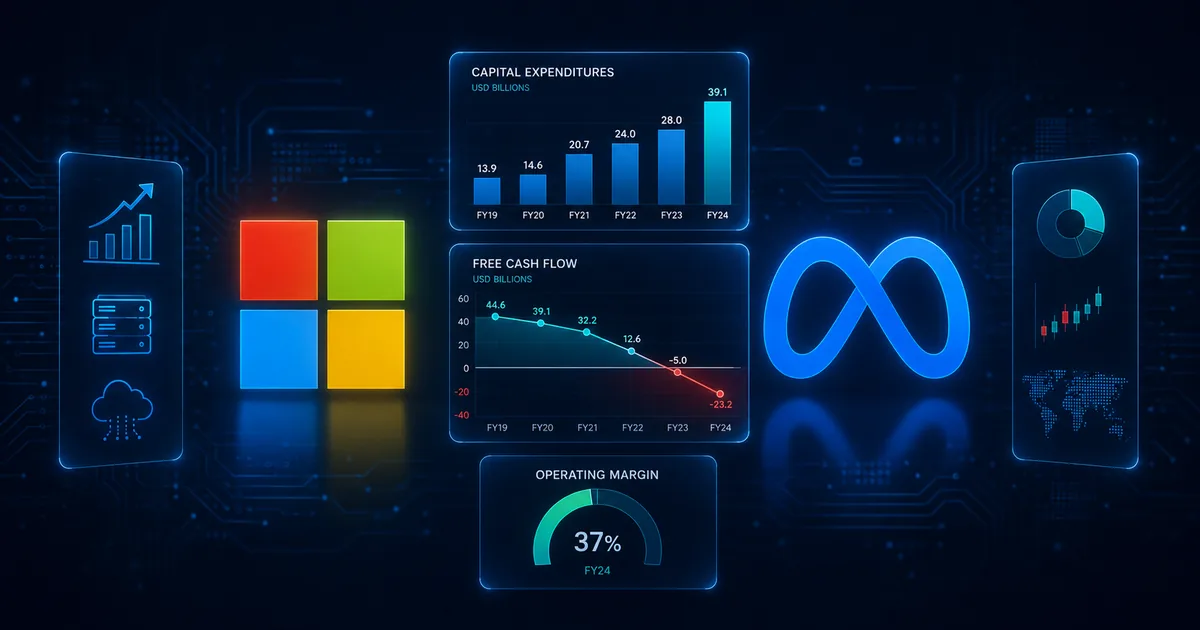
Both companies report after today’s close, and roughly 95% beat odds are already priced into each. Which means the earnings per share number, the thing that will lead every alert on your phone at 4:05 p.m. Eastern, is close to meaningless.
The number that moves these stocks is fiscal 2027 capital expenditure guidance. Alphabet demonstrated why last week, and it should have terrified every investor relations team in Redmond and Menlo Park.
Alphabet Beat and Got Destroyed Anyway
Alphabet posted better-than-expected results and then had its worst day in over a year. The reason was not the quarter. It was that the company showed negative free cash flow for the first time in its life as a public company, because capital expenditure had finally outrun the cash the business generates.
That is a regime change, and it is worth being precise about what changed. For three years the market treated AI capital expenditure as an asset purchase: money converted into future revenue, and the more aggressive the spend, the more serious the company. Under that framing a capex increase was bullish. Alphabet’s print flipped it. The same spending is now being read as cash consumption, and the marginal buyer of megacap tech is pricing free cash flow rather than growth optionality.
We watched this coming when Alphabet raised $80 billion in equity for AI infrastructure and the stock fell on the news. Equity raises to fund capex are supposed to be neutral to mildly positive when the projects have returns. That one was not received that way, and the market has been consistent since.
The Actual Numbers to Watch
Microsoft. The company has guided to roughly $190 billion in capital expenditure for calendar 2026, and analysts are modeling something near $262 billion for fiscal 2027. That is the figure to watch, and the honest question is whether management confirms a number in that neighborhood or quietly walks it down. Azure guidance sits at 39% to 40% constant-currency growth, and Copilot is at more than 20 million paid seats.
Run the arithmetic on that last number, because it is more sobering than the press release suggests. Twenty million seats at the $30 monthly list price is on the order of $7 billion in annual run-rate revenue. Set that beside $190 billion of calendar-year capital expenditure and the ratio is roughly 27 to 1.
That comparison is deliberately unfair and still worth making. The capex underwrites all of Azure, not just Copilot, and infrastructure built this year serves many years of revenue, so no sane analyst expects a single product to cover it. But Copilot is the flagship demonstration that generative AI converts into enterprise dollars, and the flagship is currently returning single-digit billions against a spend measured in hundreds. Every quarter that gap fails to close on a percentage basis, the “it monetizes later” argument gets one quarter more expensive to keep making.
Meta. Full-year 2026 capex guidance is $125 billion to $145 billion, and the pressure point is different. Meta does not have a cloud business selling the compute to third parties, so the spend has to justify itself through advertising efficiency and whatever Reality Labs eventually becomes. Watch whether operating margin holds above the 41.4% posted in the first quarter. If Reality Labs losses plus AI infrastructure costs push it below that, the market gets a clean number to point at.
The asymmetry here is unpleasant for both. Confirming aggressive FY27 capex risks the Alphabet treatment. Trimming it signals that the AI buildout is decelerating, which hits the entire semiconductor complex that has already fallen into a correction on precisely that fear. There is no guidance number that makes everyone comfortable, which is usually the setup for a violent move in one direction.
What It Means Beyond Tonight
If both confirm and the market absorbs it, the AI capex scare loses its sharpest argument and the chip selloff has a floor under it.
If either blinks, the read-through is immediate and it is not confined to two stocks. The semiconductor complex has been valued against a multi-year order book underwritten by exactly this spending. A hyperscaler trimming forward capex is not a company story. It is the first crack in the demand assumption that the entire trade rests on.
Either way, stop watching the EPS line tonight. It has already been priced, twice.