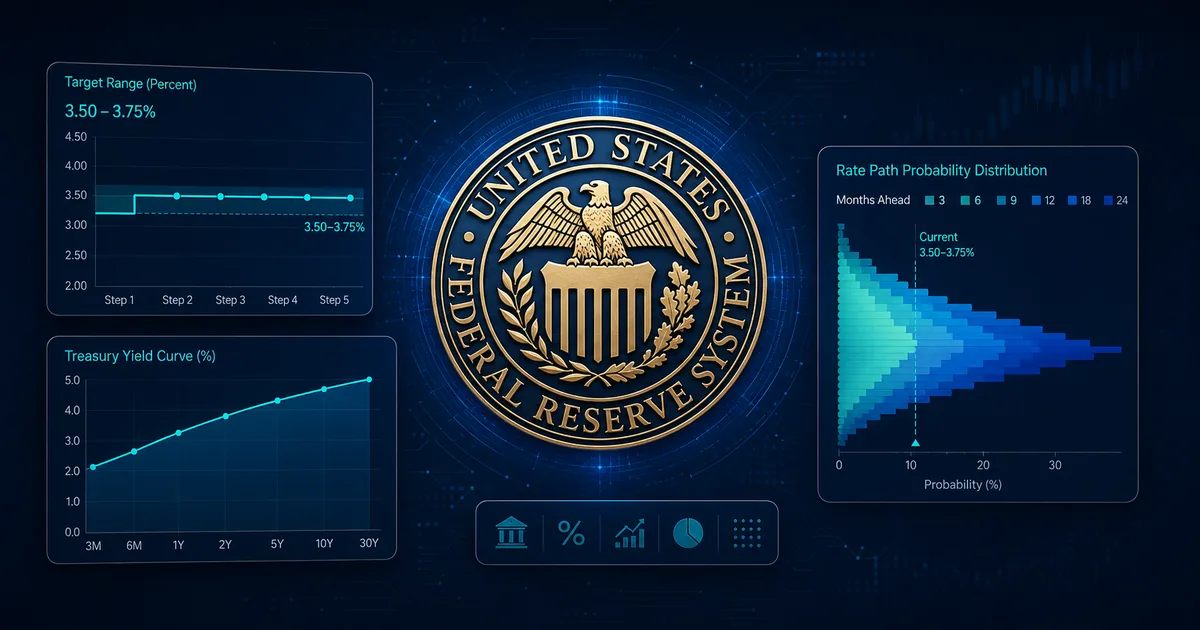
The Federal Open Market Committee announces at 2:00 p.m. Eastern, and economists polled by FactSet expect a fifth straight hold in the 3.5% to 3.75% range. Treat that as settled and stop looking at it, because the hold is not the trade.
What is actually up for decision this afternoon is whether Kevin Warsh keeps refusing to tell the market what comes next. He has been remarkably quiet about the path of rates since taking the chair, and a Fed that will not describe its own reaction function is doing something to asset prices whether or not it touches the target range.
A Hold Is Not a Hold
Rate futures do not price the level. They price the distribution of what comes after it, and two identical holds can be entirely different assets.
A hold delivered by a united committee that signals patience is an anchor. It compresses the range of plausible outcomes six months out, which pulls down implied volatility across the curve and lets everything priced off duration behave itself. A hold delivered over live dissent from members who wanted a hike is the opposite. Same headline, same target range, and a materially wider distribution behind it.
That second version is what today looks like. CNBC’s live coverage has Warsh facing strong dissension from a committee where several members favor a hike outright, which is not a marginal quibble about timing. It is a disagreement about which direction the next move goes. We covered this build-up in June, when nine officials were reported leaning hawkish on hikes, and the composition has not gotten more comfortable since.
Add the Iran escalation and its effect on energy pass-through, and the tail that markets have spent the year ignoring, a hike later in 2026, stops being a tail.
Guidance Is the Policy Now
Here is the part that gets underweighted in the previews. For a central bank sitting still, forward guidance is not commentary on policy. It is the policy.
When the target range has not moved in five meetings, the only live instrument is expectation management. Every basis point of movement in two-year yields between meetings comes from what the committee said, not what it did. A chair who withholds guidance is not being neutral. He is choosing higher term premium, wider dealer spreads, and more violent repricing on every inflation print, because he has removed the thing that was doing the smoothing.
Some of that is defensible. Warsh inherited a committee that does not agree with itself, and a chair who invents consensus at the podium that does not exist in the room gets found out within one meeting cycle. Vague is sometimes the honest answer.
But there is a second reading worth putting on the table, and it has nothing to do with the economy. Warsh took this job amid an unusually direct fight over the Fed’s independence, one that ran through the courts and through open political pressure on the composition of the board itself. A chair in that position has an institutional incentive to say as little as possible that could be quoted back at him by either the White House or the committee. Silence protects the institution. It also, incidentally, protects him.
If that is what is happening, then the guidance vacuum is not a monetary judgment at all. It is a governance one, and it is being paid for in the volatility of everyone else’s book.
What to Actually Watch at 2:00 and 2:30
The statement matters less than two things.
First, the dissent count and its direction. One hawkish dissent is noise from a known hawk. Two or more, especially from members not previously in that camp, tells you the next meeting is genuinely contested and the front end is mispriced.
Second, whether Warsh will answer a direct question about the conditions for a hike at the 2:30 press conference. Not a forecast, a condition. If he names a threshold, even a soft one, the market gets an anchor back and the curve can settle. If he deflects again, the correct read is that the committee could not agree on language, and every subsequent CPI print becomes a binary event.
There is a third thing worth watching that nobody will put in a headline, which is the tone of the questions. When a press corps starts asking about process and independence rather than about inflation, it means the market has stopped believing the reaction function is purely economic. That shift shows up in pricing before it shows up in commentary.
The Cost of Saying Nothing
None of this is an argument that Warsh should pretend to a certainty he does not have. It is an argument that the market is currently paying a premium for the absence of a stated framework, and that premium is real money spread across everyone hedging duration into a divided committee.
Five meetings of holding while declining to explain the conditions for moving is a coherent strategy for exactly as long as inflation cooperates. The moment it does not, a chair with no stated framework has to build one in public, under pressure, in front of a committee that already disagrees with him. That is a much worse afternoon than today’s.