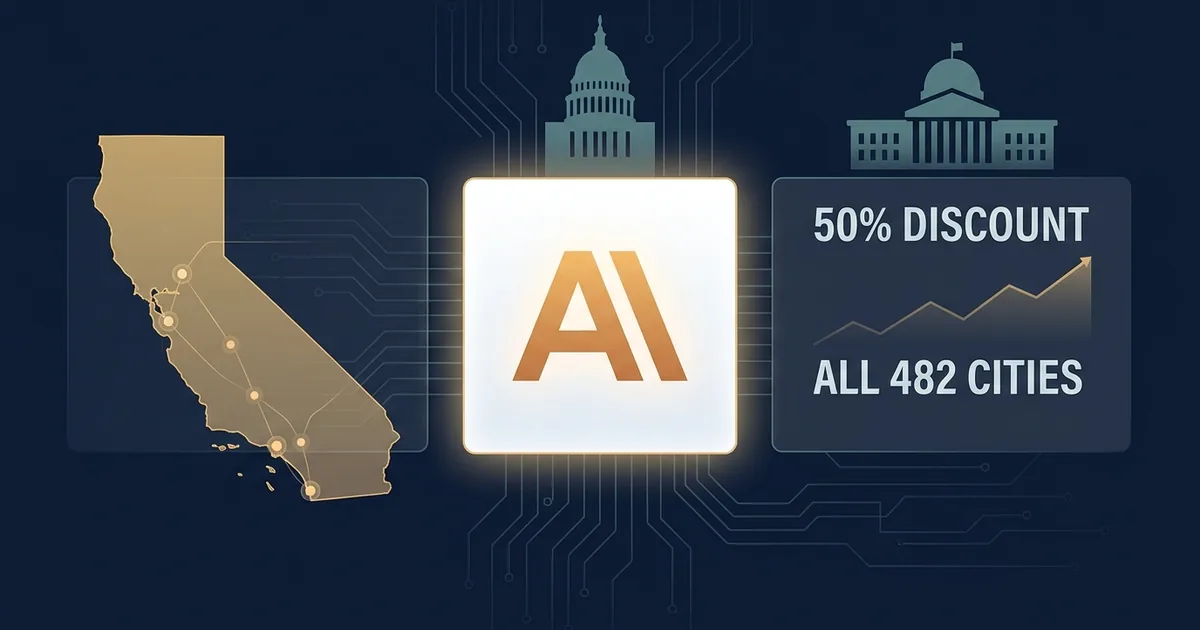
Governor Gavin Newsom just turned California into the biggest public-sector AI customer in America. A first-of-its-kind partnership announced June 29 gives every state agency, plus all 482 cities and 58 counties, access to Anthropic’s Claude at a 50% discount, with free workforce training and dedicated technical support from Anthropic’s own engineers. It is the most aggressive state-level AI deployment in US history, and it comes while the Pentagon still classifies Anthropic as a supply-chain risk.
What the Deal Actually Looks Like
The agreement runs through the California Department of Technology’s new Statewide Information Technology Shared Services portal, making Claude the first AI productivity tool available statewide through a centralized procurement channel. State workers get Claude access at half the commercial rate. Local governments get the same pricing. Anthropic provides free GenAI training, technical assistance, and workflow integration support on top of the discounted license.
TechCrunch reported that several agencies have already started deploying Claude in production environments. The Department of Motor Vehicles is using it for customer service automation. The Department of Health Care Services has integrated it into internal workflows. Perhaps most notably, the California Department of Technology and the Governor’s Office of Emergency Services are partnering to use Claude for cyber defense, running Claude Security and Claude Code to scan, triage, and patch state government code.
The deal also powers Engaged California, the state’s deliberative democracy platform, which now runs on Claude’s infrastructure.
Follow the Money
Anthropic is not giving this away. A 50% discount on a statewide deployment covering the world’s fifth-largest economy is still a massive revenue commitment from Sacramento. California’s state government employs roughly 234,000 workers across dozens of agencies. Even at half price, licensing Claude across that workforce at enterprise scale generates meaningful annual recurring revenue for a company that filed its S-1 in June and is racing toward a trillion-dollar public offering.
The strategic value goes beyond the invoice. Government deployments create institutional lock-in that is nearly impossible to reverse. Once Claude is embedded in DMV workflows, healthcare processing, and cybersecurity scanning, switching costs become prohibitive. Anthropic is buying a reference customer that validates its enterprise credibility at the highest level of government procurement.
For Anthropic’s IPO narrative, this is gold. Institutional investors evaluating the S-1 will see a statewide government contract as proof that Claude can operate at enterprise scale with compliance, security, and audit requirements that consumer products never face. The California deal answers the question every public-market investor asks about AI companies: can you sell to organizations that actually need to trust the output?
The Pentagon Contradiction
The political backdrop makes the deal even more revealing. Fox Business reported that the federal government still categorizes Anthropic as a supply-chain risk after the company refused to let the military use Claude for mass domestic surveillance or fully autonomous weapons without human oversight. The Defense Department’s concern is that Anthropic’s safety commitments create operational constraints that other AI vendors would not impose.
California’s response is essentially to treat those same safety commitments as a selling point. Newsom’s office framed the deal around responsible AI adoption, positioning Claude’s guardrails as features rather than limitations. “AI should not replace the human work of government; it should help our workers move faster, solve problems more effectively, and deliver better results for Californians,” Newsom said in the announcement.
The split between Sacramento and the Pentagon on Anthropic illustrates a fracture in how American government thinks about AI risk. The defense establishment sees safety constraints as operational liabilities. California’s civilian government sees them as procurement advantages. Both are spending public money on AI; they just disagree on what “safe enough” means.
What This Means for the AI Enterprise Market
California’s deal sets a template that other states will either follow or deliberately reject. The centralized procurement model, the bundled training, the local-government extension, these are replicable structures. If California’s deployment shows measurable productivity gains over the next 12 months, the pressure on other large states to match it will be substantial.
For Anthropic’s competitors, the deal creates a competitive moat in public-sector sales. OpenAI, Google, and Microsoft all have government relationships, but none have locked in a statewide all-agencies deal with integrated training and support at this scale. The 50% discount also sets a pricing anchor that will make it harder for rivals to undercut without matching the support package.
The enterprise AI market just got a proof point that none of the competitors can claim. California did not run a pilot, did not hedge with a multi-vendor evaluation, and did not wait for federal guidance. It picked a vendor, signed a deal, and deployed. For a market that has been waiting for large institutional buyers to commit, Sacramento just committed.