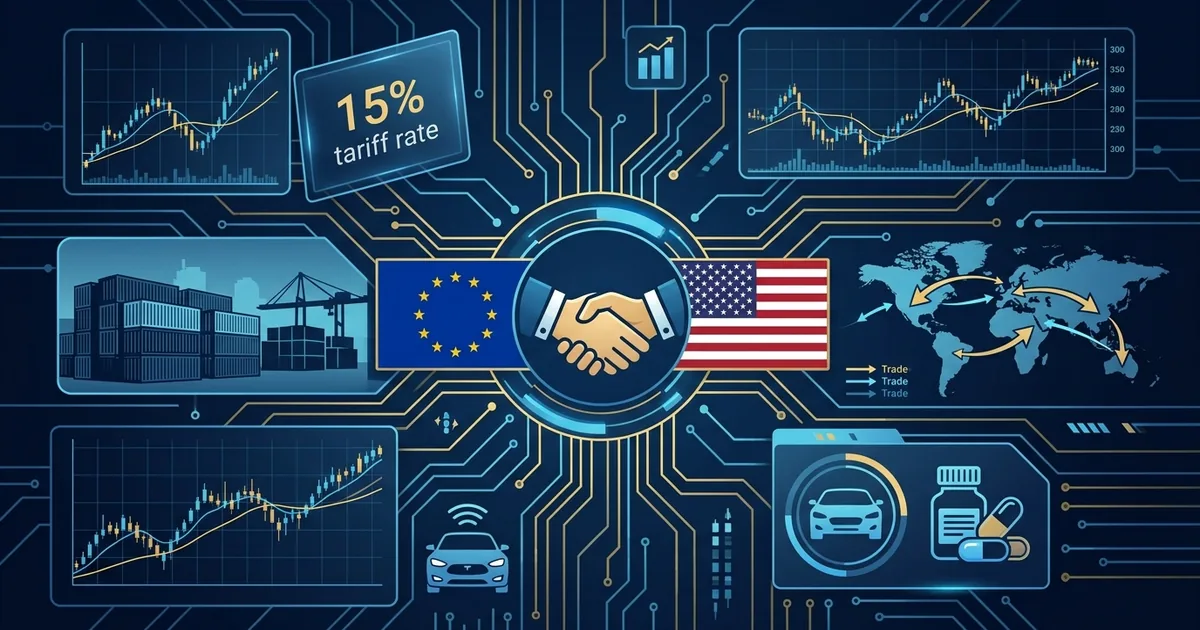
After months of negotiation and legislative ratification across 27 member states, the most consequential transatlantic trade agreement in a generation went live on July 1. Here is what it actually means for companies operating on both sides of the Atlantic.
The European Union formally implemented its trade deal with the United States this week, with the European Commission confirming that the agreement’s tariff provisions took effect on July 1, 2026. Under the deal, the EU eliminated all duties on imports of U.S. industrial goods and improved market access for certain agricultural products, while most EU exports to the U.S. now face a single 15% tariff rate. The agreement passed the European Parliament on June 16 with a 440-151 vote and received final Council sign-off on June 25.
The 15% Ceiling Is the Real Story
The headline number that matters for business planning is 15%. That single rate applies across most sectors: cars, semiconductors, pharmaceuticals, lumber, industrial equipment, and consumer goods. No stacking, no sector-specific surcharges, no ambiguity about which rate applies to which product classification.
For companies that have spent the past 18 months navigating a tariff environment where rates changed by executive order and varied wildly across product categories, a fixed ceiling is a planning revolution. CFOs can now build supply chain models with a known cost input rather than hedging against regulatory volatility that made long-term contracts nearly impossible to price.
The 15% rate is not free trade by any measure. It is a cost floor that will compress margins for European exporters who previously entered the U.S. market at lower rates. But predictability has its own economic value, and after a period where some sectors faced tariffs north of 30%, the ceiling represents a net improvement for the majority of transatlantic trade flows.
What Europe Gave Up
The EU side of the deal is asymmetric by design. Europe eliminated all duties on U.S. industrial goods, a full zero-tariff commitment, while accepting 15% on its own exports into the American market. Euronews reported that EU member states backed the deal despite criticism that the terms favored Washington, with proponents arguing that the alternative was worse: retaliatory tariff escalation that could have pushed rates to 25% or higher.
The agricultural provisions are more nuanced. The EU improved market access for certain “non-sensitive” agri-food products from the U.S. while maintaining protections on the most politically charged categories. For American agricultural exporters, this opens doors that have been closed for years, particularly in processed foods and specialty crops.
The Sectors Watching Closely
Automotive is the most directly affected industry. European carmakers had been facing tariff uncertainty that made U.S. pricing strategy nearly impossible. The 15% rate is lower than the 25% auto tariffs that had been threatened, but higher than the pre-trade-war levels that the industry had built its North American operations around. BMW, Mercedes-Benz, and Volkswagen all export significant volume from European plants to the U.S., and the fixed rate lets them recalculate transfer pricing for the first time in over a year.
Pharmaceuticals face a more complex picture. The U.S. Trade Representative simultaneously initiated a Section 301 investigation against Germany over what it calls “persistent underpayment for innovative pharmaceutical products.” The trade deal provides tariff clarity, but the parallel investigation signals that Washington views pharma pricing as a separate front, one where the 15% ceiling does not settle the dispute.
What It Means for the U.S. Trade Deficit
The deal arrives as the U.S. trade deficit hit $105 billion in the most recent monthly data, driven by an import surge that is already cutting into GDP growth. Zero tariffs on U.S. industrial exports to Europe should help close that gap marginally by making American manufactured goods more competitive in the EU market. But the structural drivers of the deficit, consumer demand for imported goods, energy price differentials, and currency dynamics, are far larger than any single trade agreement can address.
The Digital Services Tax Wildcard
One provision that did not make it into the final agreement is digital services taxation. President Trump has separately threatened 100% tariffs on goods from any country that imposes a digital services tax affecting U.S. companies. France, Spain, Italy, and several other EU members maintain such taxes, and the trade deal does not resolve the conflict. This means the 15% tariff ceiling could be circumvented entirely for specific countries if the digital tax dispute escalates, introducing a new layer of uncertainty into what was supposed to be a stability agreement.
For businesses, the message is clear: the trade deal provides a baseline, not a guarantee. The 15% ceiling is real and enforceable, but it exists alongside ongoing disputes over pharma pricing, digital taxation, and broader geopolitical friction that could produce new tariff actions outside the deal’s scope. The smart play is to plan around the 15% floor while hedging for sector-specific disruptions that the agreement deliberately left unresolved.