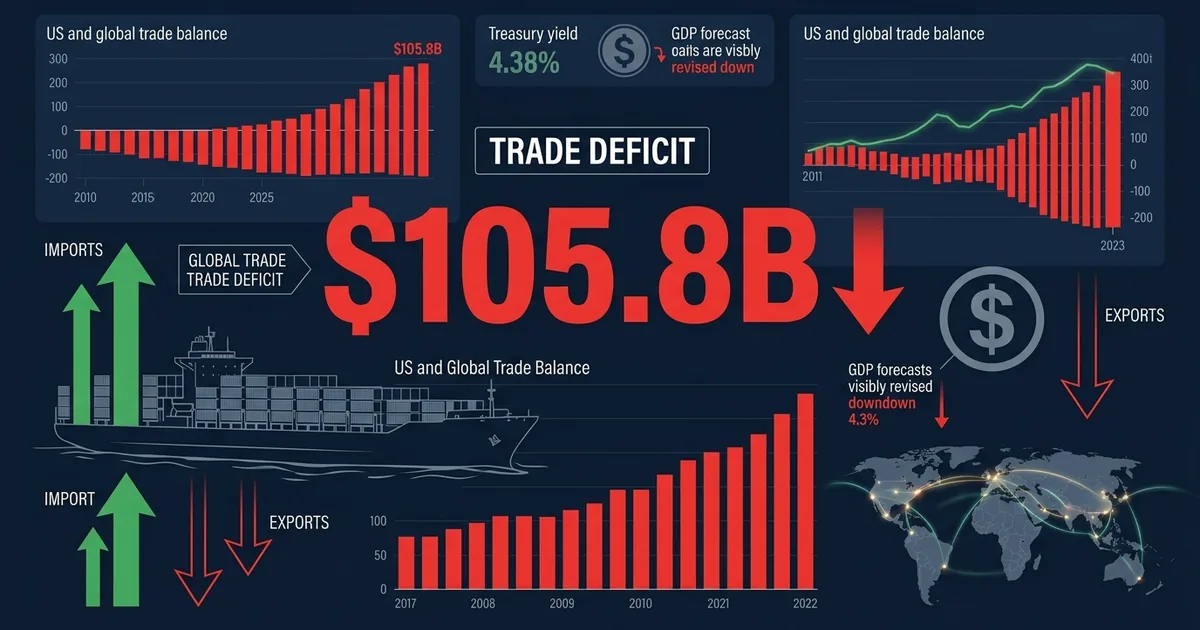
The May goods trade gap came in 27% wider than April and $20 billion above consensus, and the economic ripple effects are already forcing Wall Street to rewrite its growth forecasts.
The Headline Number
The US goods trade deficit surged to $105.8 billion in May, the widest gap in 14 months, according to Commerce Department data released Friday. The number blew past the $85 billion median estimate in Bloomberg’s survey of economists by a margin that would be alarming in any context. In the current one, with a war still technically active in the Persian Gulf and a tariff regime in legal limbo, it is a signal that American businesses are making contingency bets with real money.
Goods imports rose $10.9 billion, or 3.6%, to $313.4 billion, also a 14-month high. The increase was led by a 6.3% surge in automotive vehicle imports and a 5.7% jump in consumer goods. Meanwhile, goods exports dropped $11.8 billion, or 5.4%, to $207.7 billion, the sharpest monthly decline since early 2025.
The Why: War Hedging and Tariff Uncertainty
The structural driver is fear. Businesses have been front-loading imports to build inventory buffers against two overlapping risks: the ongoing Strait of Hormuz disruption from the US-Iran conflict and the unpredictable tariff environment that has kept trade policy in flux for most of 2026.
The Supreme Court struck down Trump’s IEEPA-based tariffs in February, and the Court of International Trade subsequently invalidated the replacement Section 122 tariffs in May. The effective average tariff rate settled at 11.8% in April, but companies cannot plan around a number that changes with every court ruling. The rational response is to import now while the legal window is open and warehouse the goods, exactly what the data shows.
The automotive surge is particularly telling. With tariff threats on imported vehicles cycling between active and enjoined, automakers and dealers have been pulling forward orders to lock in current duty rates. Consumer goods importers are doing the same calculus across electronics, apparel, and household goods.
Wall Street’s GDP Haircut
The deficit’s direct impact on GDP math was immediate. Morgan Stanley slashed its second-quarter growth estimate to a 2.1% annualized rate from 2.5%. Goldman Sachs trimmed by 0.2 percentage points to 2.2%. Net exports, the difference between what the US sells abroad and what it buys, subtract directly from GDP. When imports surge and exports contract simultaneously, the drag compounds.
The 10-year Treasury yield holding near 4.38% adds another pressure point. Higher borrowing costs make it more expensive for businesses to finance the inventory buildup that the import surge represents. Companies are paying more to warehouse goods they may not need for months, betting that the cost of carrying inventory is lower than the cost of being caught without supply when the next disruption hits.
The Broader Trade Picture
The deficit data lands in a trade policy environment that remains deeply uncertain at the federal level. The USTR proposed additional tariffs of up to 12.5% on imports from 60 economies over forced labor practices in June, a move that BTN covered when it was announced. If those tariffs take effect, the import front-loading dynamic intensifies: companies rush to beat the new rates, the deficit widens further, and the GDP drag deepens.
Export weakness tells the other side of the story. American manufacturers and agricultural producers are losing ground in markets where retaliatory tariffs, currency dynamics, and geopolitical friction have made US goods less competitive. The strong dollar, supported by the Fed’s higher-for-longer rate stance, makes every American export more expensive for foreign buyers.
What the Jobs Report Will Tell Us
The June employment report drops Thursday in a holiday-shortened week, and the deficit data raises the stakes. If businesses are building inventory rather than selling through it, the labor market should show strength in warehousing, logistics, and transportation. If the import surge is a precautionary move by companies that expect demand to soften, the hiring data may tell a different story.
The Fed’s dual challenge comes into focus here. Rate cuts would weaken the dollar and help exporters, but they would also risk reigniting the inflation that the tariff-driven import price increases are already feeding. Holding rates steady preserves the inflation anchor but keeps the export headwind in place. Thursday’s jobs number will not resolve that tension, but it will tell us which side of the equation is deteriorating faster.
Either way, the $105.8 billion gap is not a one-month anomaly. It is the market’s real-money verdict on a trade regime that has replaced predictability with litigation, and businesses are spending billions to protect themselves from the outcome.