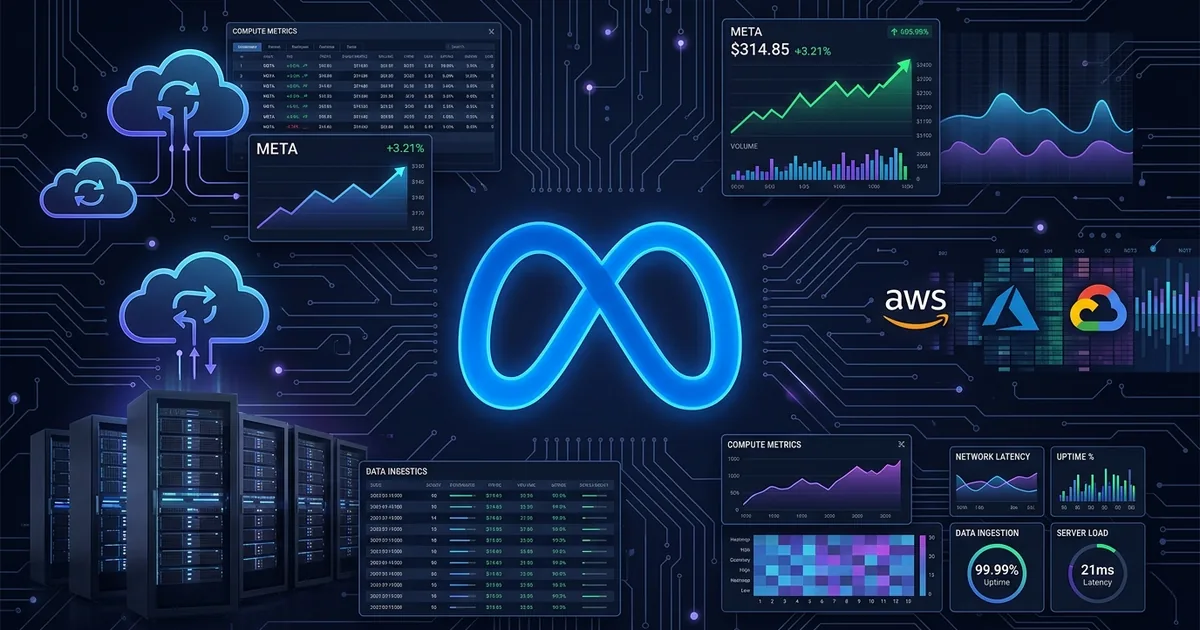
Mark Zuckerberg spent more than $60 billion building AI infrastructure nobody outside Meta could touch. Now he wants to rent it out, and the implications for the cloud market are enormous.
Meta Platforms is developing a cloud infrastructure business that would sell access to AI computing power and models to outside developers, Bloomberg first reported this week. The initiative, internally called Meta Compute, would put the company in direct competition with Amazon Web Services, Microsoft Azure, and Google Cloud in the fastest-growing segment of enterprise tech.
The Leadership Says Everything
The team running Meta Compute tells you exactly how seriously Zuckerberg is taking this. Santosh Janardhan, Meta’s head of infrastructure, is co-leading alongside Daniel Gross from the Meta Superintelligence Labs AI unit and Meta President Dina Powell McCormick. That is not a skunkworks project. That is a company-level strategic bet with executive sponsorship from the infrastructure, AI, and business sides of the house simultaneously.
Meta is weighing two service models. The first would let outside developers pay to run queries against AI models, including Meta’s own Muse Spark, on Meta-owned hardware. The second would sell raw computing capacity, essentially the same neocloud model that CoreWeave and Nebius have built their entire businesses around.
Why This Threatens CoreWeave and Nebius
The timing is brutal for the neoclouds. CoreWeave went public in March at a $23 billion valuation, and Nebius has been riding the AI infrastructure wave since its Nasdaq debut. Both companies built their pitch around one thing: GPU-rich infrastructure purpose-built for AI workloads that the hyperscalers were too slow to deliver.
Meta entering the market undercuts that narrative entirely. The company already operates one of the largest GPU fleets on the planet, and unlike CoreWeave, it does not need to raise debt at double-digit interest rates to build it. TechCrunch noted the parallel to SpaceX, which similarly turned excess capacity into a commercial business. The difference is scale: Meta’s AI infrastructure budget dwarfs what any neocloud has deployed, and every dollar of external revenue it generates from that infrastructure improves the ROI on capital expenditures that Wall Street has been questioning for over a year.
CoreWeave and Nebius shares both dropped on the news. The Nasdaq-100’s recent AI rebalance had just added both companies to the index, giving them institutional visibility at the exact moment a much larger competitor signaled it was coming for their market.
The Real Play: Monetizing the CapEx Narrative
Here is the structural why behind this move. Meta has spent aggressively on AI infrastructure, with plans that include a $200 billion data center complex in Louisiana and a $35 billion compute deal with CoreWeave itself. Wall Street has rewarded the AI story broadly but has grown increasingly skeptical about whether the spending translates to revenue. The June semiconductor selloff, which erased $1.3 trillion from chip stocks globally, was driven precisely by that skepticism.
A cloud business changes the math. Instead of AI infrastructure being a pure cost center that supports Meta’s advertising and social products, it becomes a revenue line. Zuckerberg acknowledged the opportunity publicly in May, telling investors that selling computing access was “definitely on the table.” The stock popped on the Bloomberg report, suggesting investors see the cloud pivot as exactly the kind of monetization signal they have been waiting for.
What the Hyperscalers Are Watching
AWS generated $105 billion in revenue last year. Azure is not far behind. Google Cloud crossed the $40 billion mark. Meta entering this market does not threaten those incumbents overnight, but it does something potentially more disruptive: it validates the idea that any company with enough GPUs can become a cloud provider.
That is the precedent the hyperscalers do not want set. If Meta can sell spare AI compute profitably, so can every other company that has overbuilt its AI infrastructure. The cloud oligopoly was built on the assumption that running infrastructure at scale requires deep, specialized operational expertise. Meta’s bet is that AI workloads are different enough, and its infrastructure modern enough, that the traditional cloud moat does not apply.
What Comes Next
The plans are still in development, and Meta’s strategy could shift. But the signal is clear: the company that spent more on AI infrastructure than most countries spend on defense is looking to turn that spending into a business, not just a feature. For CoreWeave, Nebius, and the neocloud cohort, the question is no longer whether a hyperscaler will come for their market. It is whether they can differentiate fast enough before one of the biggest infrastructure operators in history starts taking calls.
For the broader market, Meta Compute represents a potential inflection point in how Wall Street values AI capital expenditure. The stocks that have been punished for spending too much on AI could see a re-rating if the cloud pivot proves viable. And for developers who have been locked into AWS and Azure ecosystems, another option with competitive pricing and purpose-built AI infrastructure is exactly the kind of competition the market needs.